

Difference Between Judicial Separation and Divorce Under Indian Law Explained
For the last few months, Riya and Aman had been living more like roommates than a married couple. He started staying late at work. She stopped asking when he would come home. Even small conversations somehow turned uncomfortable. One night, after another awkward dinner, Riya quietly asked, “Do people separate before divorce… or is divorce the separation?”
And honestly, that is what confuses most couples. The difference between judicial separation and divorce sounds simple from the outside, but when someone is actually going through a difficult marriage, the confusion feels very real. Families give opinions. Friends say different things. Some people say, “take a break.” Others immediately suggest divorce. But very few explain what these legal options actually mean in practical life.
In this blog, we will talk about what judicial separation and divorce really mean under Indian law, how both are different, when couples usually choose one over the other, and what emotional, financial, and legal impact these decisions can have later.
If this sounds like your situation, speaking with experienced divorce lawyers early can help you understand which option — separation or divorce — actually fits your circumstances.
What is Judicial Separation?
Judicial separation means that the court authorises a married couple to live apart without dissolving the marriage.
If it becomes difficult for spouses to live together, either of the spouse can seek judicial separation under Section 10 of the Hindu Marriage Act. Once the order is granted by the court, the pair will not be required to remain married.
But legally, the marriage continues. That is the main difference people often miss. You may live separately, but you are still legally married.
Many couples choose this option when:
- Constant fights are affecting mental peace.
- Children are involved.
- Families want time before divorce.
- The couple feels emotionally confused about ending the marriage.
In simple words, judicial separation gives couples space to think clearly before taking a permanent step like divorce.
What Happens During Judicial Separation?
Judicial separation does not mean that all legal responsibilities are instantly canceled. Some responsibilities may still be there, like:
- Maintenance and financial assistance.
- Child custody.
- A few requirements of marriage.
And no, you can’t get married again. Neither of the spouses is allowed to marry someone else during judicial separation.
This idea also exists under other Indian personal laws, such as:
- Special Marriage Act
- The Divorce Act (Indian)
- The Parsi Marriage and Divorce Act
Case Study: Last year, we worked with a couple in Bangalore who chose judicial separation first. The time apart gave them space to think, cool down, and speak more clearly. Eight months later, they chose to reconcile. Sometimes, that legal pause is what a family really needs.
What is Divorce Under Indian Law?
Divorce is the legal ending of a marriage. Once a divorce order is given, the husband and wife are no longer legally considered husband and wife. This is the primary difference between judicial separation and Divorce. Divorce means both people are free to live their lives the way they want to.
Divorce under the Hindu Marriage Act is either contested or mutual:
Mutual Consent Divorce
This is the point where both couples decide their marriage is not working anymore, and they wish to separate calmly. This is often less emotional and speedier than contested cases.
Contested Divorce
In this case, one spouse files a court complaint against the other based on such things as abuse, infidelity, or desertion. The use of evidence, discussions, judicial hearings, and other procedures often makes these situations take longer to settle.
Difference Between Judicial Separation and Divorce
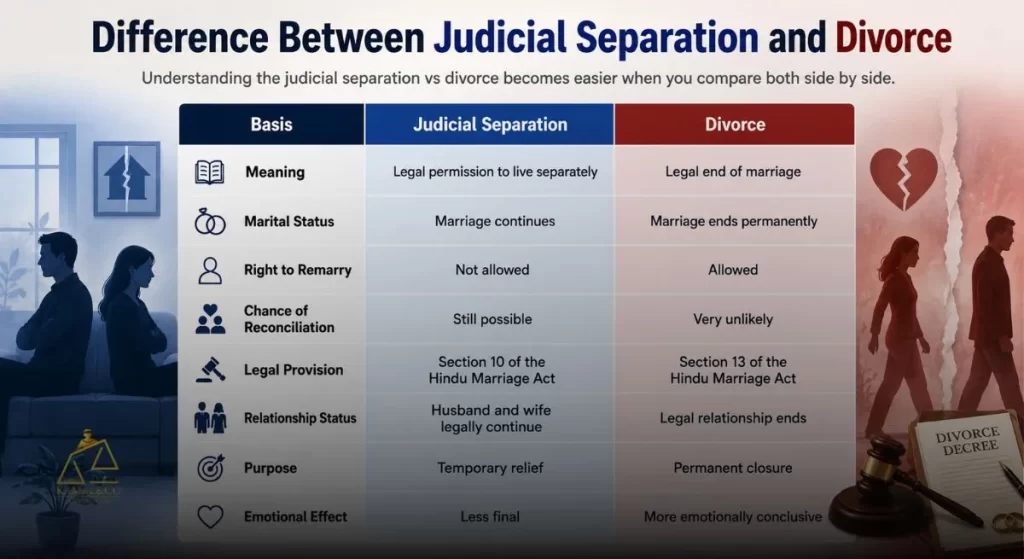
Understanding the judicial separation vs divorce becomes easier when you compare both side by side.
| Basis | Judicial Separation | Divorce |
|---|---|---|
| Meaning | Legal permission to live separately | Legal end of marriage |
| Marital Status | Marriage continues | Marriage ends permanently |
| Right to Remarry | Not allowed | Allowed |
| Chance of Reconciliation | Still possible | Very unlikely |
| Legal Provision | Section 10 of the Hindu Marriage Act | Section 13 of the Hindu Marriage Act |
| Relationship Status | Husband and wife legally continue | Legal relationship ends |
| Purpose | Temporary relief | Permanent closure |
| Emotional Effect | Less final | More emotionally conclusive |
Grounds for Judicial Separation in India
Cruelty
This is one of the most common reasons people approach family courts today. And no, it is not limited to physical violence anymore.
Mental cruelty is now recognised strongly by Indian courts. Constant insults, emotional manipulation, humiliation, public embarrassment, controlling behaviour, and false accusations can all become part of mental cruelty.
Expert Insight: In our work, we have observed that proof is not just about beatings and bruises. Since the Bharatiya Sakshya Adhiniyam (BSA), 2023, came into force, the court’s views on digital recordings have changed. A WhatsApp message or a recorded conversation is as effective as traditional evidence today. This mechanism allows partners to receive legal help from the start of mental abuse, instead of waiting for it to escalate.
Adultery
If one spouse enters into a physical relationship outside marriage, the other spouse can seek judicial separation.
Desertion
When one spouse leaves the other without a reasonable explanation for a long time, desertion may become a legal ground.
Other Grounds
Additional grounds for separation include:
- Mental disorder.
- Conversion to another religion.
- Communicable disease in specific situations.
- Renunciation of worldly life.
- Presumption of death.
Grounds for Divorce Under Indian Law
The grounds for divorce in India are mostly similar to those for judicial separation.
Cruelty continues to be one of the strongest grounds in modern divorce cases. Emotional abuse and psychological suffering are now taken far more seriously than they were years ago.
If you or someone you know is experiencing persistent emotional abuse, the National Commission for Women (NCW) offers services and helplines to assist victims.
Other common grounds include:
- Adultery
- Desertion
- Mental illness
- Religious conversion
- Abandonment
- Long-term separation
What Happens After Judicial Separation?
Many people assume judicial separation ends all legal responsibilities immediately. But it does not.
Maintenance and Financial Support
A financially dependent spouse can still seek maintenance depending on the facts of the case.
Child Custody
Courts separately decide child custody and visitation rights. Courts usually give importance to stability, education, emotional well-being, and the safety of the child.
Reconciliation
This is one of the main reasons judicial separation exists in the first place. Some couples genuinely work through their problems after spending some time apart.
Conversion into Divorce
If reconciliation does not happen and the spouses continue living separately, divorce may later be filed legally. In many marriages, judicial separation eventually becomes the first formal step toward divorce.
Can Judicial Separation Lead to Divorce?
Yes, absolutely. If the spouses live separately after the judicial separation and do not resume their cohabitation for a period permitted by law, any of the spouses may later seek divorce.
But court separation is not required before divorce. If there are already valid legal reasons, then couples can file a petition for a divorce directly without having to obtain a judicial separation first.
Difference Between Judicial Separation and Divorce: Which Option Is Better?
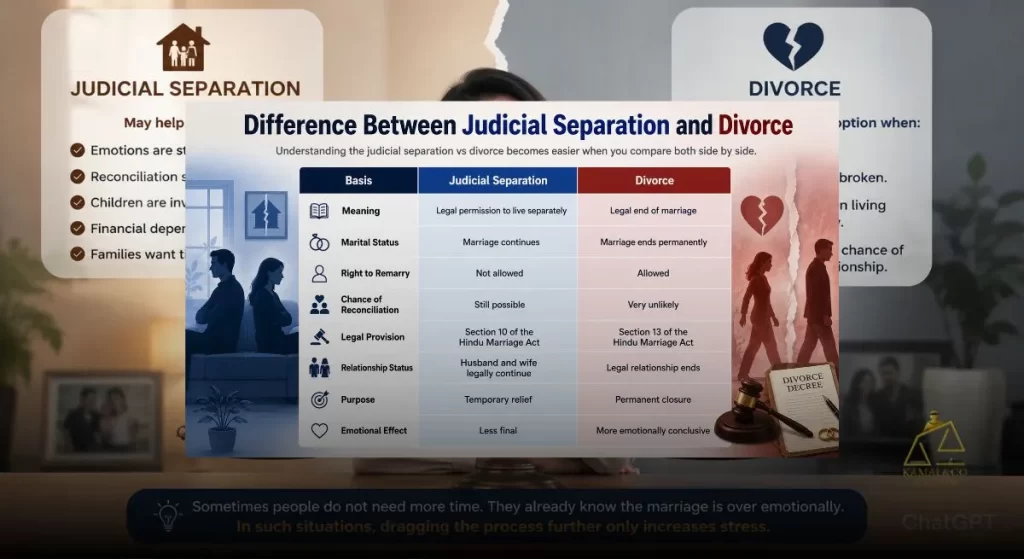
There is no perfect answer because every marriage problem is different.
Judicial separation may help when:
- Emotions are still unclear.
- Reconciliation seems possible.
- Children are involved.
- Financial dependence exists.
- Families want time before divorce.
Divorce may become the healthier option when:
- Abuse is serious.
- Trust is completely broken.
- The couple has been living apart for years now.
- There is no realistic chance of rebuilding the relationship.
Sometimes people do not need more time. They already know the marriage is over emotionally. In such situations, dragging the process further only increases stress.
When Do Family Lawyers Suggest Judicial Separation Instead of Divorce First?
Not every marriage reaches a point where divorce becomes the immediate answer.
Sometimes, couples are simply tired. The fights have been going on for too long, communication has broken down, and both individuals feel psychologically exhausted. Still, a lot of people aren’t sure if they want to end the marriage for good.
This is often when family lawyers first recommend a judicial separation before pursuing a divorce. They usually recommend it when:
- Reconciliation still seems possible.
- Children are involved.
- One spouse is emotionally unsure about divorce.
- Financial dependency exists.
- Both people need time away from conflict before making a final decision.
What is the Difference Between Judicial Separation and Divorce in the Court Process and Time?
We’ve found the first question most people ask isn’t about the laws, but ‘How long is my life going to be on hold?’
The fact is, Indian courts work at their own pace, but the path you take makes a big impact. So here’s a realistic look at what the road ahead looks like:
| What are you looking at? | Judicial Separation | Mutual Divorce | Contested Divorce |
|---|---|---|---|
| How long will it take? | 6 to 12 months | 6 to 18 months (Traditional mutual consent divorce has a cooling-off period of 6 months as per Section 13B of the Hindu Marriage Act.) | 3 to 5+ years |
| Is it final? | No. You are still married on paper. | Yes. You are legally single. | Yes, once the judge signs off. |
| Can I remarry? | No | Yes | Yes, after the appeal period |
| Mediation | Often encouraged to save the bond | Generally skipped if terms are set | Mandatory attempt by most courts |
Things to Consider Before Taking Legal Action in Marriage Disputes
Before taking legal action in a marriage dispute, you need to understand the difference between judicial separation and divorce first, and think beyond emotions before making any decision.
Is the marriage really beyond repair?
A hard time does not always mean the end of the relationship. Some difficulties come from stress, money, or family pressure. Others go deeper, including abuse, lying or repeated betrayal.
Are there children involved?
Children might not understand the situation. But they feel stress. When separation occurs, custody, routine, school, and emotional stability are very important.
Can both sides manage separately?
Living apart changes everything. Rent, legal costs, child support, and daily expenses can rise fast.
Is there still a real chance to fix things?
Some couples just need space. Others already know the relationship has ended in their hearts.
Are you ready for the process?
Court matters can be tiring. Delays, hearings, and personal questions often wear people down more than expected
Final Thoughts on the Difference Between Judicial Separation and Divorce
The difference between judicial separation and divorce may seem legalistic on paper, but for most people, it is a very personal decision. Some couples need space to think without quickly breaking up the marriage. Others just reach a point where staying in the relationship just brings additional stress and emotional isolation.
That is why understanding both options properly matters before thinking of legal separation in India. For people dealing with separation or divorce, Kamal and Co. Advocates offers legal guidance to help people make clearer and more informed decisions during difficult situations.




2 thoughts on “What is Difference Between Judicial Separation and Divorce Under Indian Law?”
Pingback: Can You Remarry According To Second Marriage Law in India?
Pingback: Family Lawyers in Mumbai | Child Custody & Matrimonial Cases