
Reviewed by: Adv. Kamaluddin Ahmad | Written by: Adv. Dheekshanya
Suppose you’re buying a property, selling one, or transferring it to a family member, and while going through the property documents, you realize that you either don’t have an e-Khata certificate, it’s still a draft, or the existing e-Khata records haven’t been updated.
These are the common hurdles in Bangalore property deals, but you can solve them once you know how the system works. The e-Khata is the digital khata record issued through the e-Aasthi portal.
In this blog, we explain how to obtain an e-Khata in Bangalore, what documents you’ll need, and the difference between the draft and final versions. Furthermore, if you need guidance for property papers or transfer, you can speak with our property lawyer in Bangalore.
What is e-Khata in Bangalore?
A khata is the record that a municipal authority maintains of a property for property tax administration. An e-Khata is the digital version of it; you get an electronic document with a unique property ID that can be downloaded and verified online.
Two Things you must know about Khata:
- A khata is classified as an A khata or a B khata. The e-Khata is simply the digital version of your property’s Khata.
- The Khata is not proof of ownership; it is used to maintain municipal and tax account records of the property. Ownership is established through your registered title documents, such as the sale deed.
If you want to complete your property documentation and obtain final e-Khata, you can visit Kamal & Co. Advocates’ office in Bangalore; there, our property lawyers can assist you better.
What is the Difference Between Draft e-Khata and Final e-Khata?
This is where most people are confused: a draft e-Khata is generated automatically with the existing property tax records; it is not a verified document. Whereas a final e-Khata is issued by the authorities after you submit required documents and they verify them.
| Draft e-Khata | Final e-Khata | |
|---|---|---|
| How it is created | Auto-generated from existing records | Issued after you apply and documents are verified |
| Verified by the authority | No | Yes |
| Enough for registering a sale | No | Yes |
| What you need to do | Check it and apply to convert it | Download it and keep copies |
Expert advice by Adv. Dheekshanya: Before you file the application, please match the draft e-Khata details with your sale deed to avoid mismatched data and correct it earlier.
Which Documents Are Required to Apply for e-Khata in Bangalore?
Before you start the application, ensure that all the necessary documents are available at the moment to avoid unnecessary delays. Here’s the list of documents to have:
| Document | Purpose |
|---|---|
| Passport-size photograph of the owner | Owner identification |
| Photograph of the property | Property identification |
| Identity proof of the owner | Verification of ownership-related details |
| Registered title deed | Establishes the source of the ownership claim |
| Aadhaar-based eKYC | Identity verification of the owner |
| SAS property ID and property tax receipts | Identifies your property record and tax status |
| Existing Khata certificate, extract or endorsement | Helps verify previous municipal records |
| Encumbrance certificate (EC) | Shows registered transactions and charges |
| BESCOM details | A utility record linked to the property |
These are the basic documents that you’ll need. Our lawyers can check and verify your documents for you, for a hassle-free procedure. And also, if you don’t have an encumbrance certificate, you can use our guide on how to obtain one.
How to Get e-Khata in Bangalore Online: Step-by-Step Process
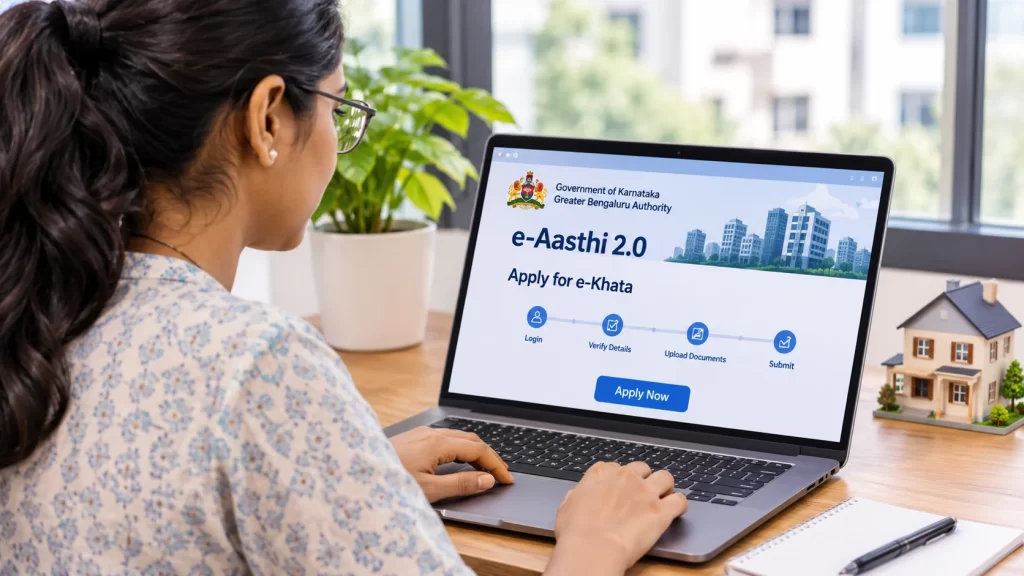
Here’s the step-by-step procedure for how you can apply for e-Khata online on the e-Aasthi portal. The screen may look a bit different due to e-Aasthi upgrades by GBA:
Step 1: Open the official e-Aasthi portal
Open the GBA e-Aasthi portal website, and then log in with your mobile number, OTP, and Aadhaar e-KYC.
Step 2: Find your property
You can identify your property using your SAS ID, ePID, ward details, or the owner’s name. If you find your property, check if you have a draft e-Khata for information verification.
Step 3: Review your draft e-Khata
You must check all the details available in the e-Khata with your registration deeds, like the owner’s name, the extent or area, and the property type (site, house, or flat).
Step 4: Choose the right service
Based on your situation, you can select services like:
- View or download an existing e-Khata.
- Apply for a final e-Khata.
- Apply for a new Khata.
- Request a Khata transfer or mutation.
- Correct existing property details.
- Apply for B-Khata to A-Khata conversion, if eligible.
Step 5: Fill in the details and complete eKYC
Based on the selected services, you’ll be asked for further details that you must fill clearly, understanding all the clauses and avoiding mistakes.
Step 6: Upload your documents
Then you must upload a clear and readable copy of the required documents.
Step 7: Pay any applicable charge and submit
After this, you might be asked for a small fee, which you pay. And submit the application and save the acknowledgement number.
Step 8: Track the status and download
By using your application number, you can check the status of your e-Khata application online. Once the authority verifies and approves it, you can download your final e-Khata.
What Is the Difference Between A-Khata and B-Khata in Bangalore?
This often confuses people, so we have tried to explain the clear difference between the two in easy language:
| Basis | A-Khata | B-Khata |
|---|---|---|
| Meaning | Property listed in the A-Register | Property listed in the B-Register |
| Compliance | Generally indicates better municipal compliance | May indicate pending planning or building compliance |
| Property Tax | Tax can be paid | Tax can also be paid |
| Home Loan | Generally easier, subject to bank checks | May be restricted by lenders |
| Resale | Usually easier | May involve additional checks |
| Conversion | Not generally applicable | May be eligible for conversion, subject to applicable rules |
Why was My e-Khata Application Rejected or Stuck?
There might be some reason that your application has been rejected or stuck. Here are some reasons that can cause it and what you should do after you identify the problem:
| Problem | What to check | Next step |
|---|---|---|
| Name does not match | The spelling and order of the name in the khata, the deed, and Aadhaar | Submit supporting documents or apply for correction through the portal |
| Extent or area mismatch | The area in the draft against the sale deed and earlier records | Follow the section below on mismatched details |
| Blurred or incomplete uploads | The clarity and completeness of every file | Re-upload clear copies |
| eKYC failure | Whether your mobile number is linked with Aadhaar | Update the Aadhaar-linked number and retry |
| Pending property tax | Any pending SAS property ID | Clear the dues and keep the receipts |
| Dispute over the property | Any pending case or competing claim | Speak to a lawyer before proceeding |
What Happens When the e-Khata and the Sale Deed Show Different Details?
It’s normal to make mistakes; you should verify the details of e-Khata and sale deeds first to catch the mistake and correct it on time.
Here is an illustrative example:
| Item | Registered sale deed | Draft e-Khata |
|---|---|---|
| Extent | 1,200 sq. ft. | 1,050 sq. ft. |
| Owner’s name | Ramesh Kumar | R. Kumar |
Here is how to deal with it:
- Compare the underlying records: As mentioned before, match the data line by line in the parent deed, the earlier khata, and the property tax receipts.
- Find where the difference started: It may be in the deed, in the old tax record, or in the digitisation of the draft.
- Fix it at the source: If the errors are in the draft, then submit the correct details with supporting documents through the portal, or approach the corporation’s revenue office. If the registered deed itself is wrong, the remedy may be a rectification deed; for that, you should speak with a lawyer.
- Do not register on the assumption that it can be corrected later: A final e-Khata is linked to registration, so an unresolved mismatch can hold up the sale and the mutation.
It is important that if you find an error yourself or the portal notifies you about one, then you should get it corrected.
Common Mistakes to Avoid While Applying for e-Khata
Here are some mistakes that you should avoid:
| Common mistake | Why you should avoid it |
|---|---|
| Paying an agent or an unofficial website | The official portal does the same job, and look-alike sites can mislead you |
| Skipping mutation after buying | The khata stays in the previous owner’s name, which causes problems when you sell or take a loan |
| Ignoring the encumbrance certificate step | Your final e-Khata may not be ready for a sale without it |
| Applying before checking the draft against the deed | Mismatches are the usual cause of rejection |
| Not saving the acknowledgement or ePID | You need them to track and follow up on your application |
When Should You Speak to a Property Lawyer in Bangalore?
Though nowadays most of the matters can be handled online in a straightforward way, you should consult a lawyer when:
- You are buying a property and want a professional to verify the e-Khata, encumbrance certificate, and registration deeds.
- When the online system rejects the application for e-Khata due to some errors.
- When you need help with drafting registration deeds.
- When you want to convert your B-Khata into A-Khata.
At Kamal & Co. Advocates, we will provide complete assistance from reviewing documents, preparing and drafting applications until the e-Khata is issued.