

Reviewed by: Adv. Dev Rishi (Senior Advocate, Delhi)
Suppose you have one flat in Delhi that you have been renting for a long time. The tenant still pays a very small monthly rent, and now you want the flat for your own use. In this situation, one friend says you can’t just ask the tenants to leave; the Delhi Rent Control Act protects them, while another friend says the law doesn’t apply. Who is right?
To clear this confusion, the Delhi Rent Control Act 1958 is still in force. But now there have been a lot of changes in how this law applies.
In this blog, we have explained the Delhi Rent Control Act 1958, how rent and eviction work under it, how to approach the Rent Controller, and the rights of landlords and tenants. Furthermore, if you need legal guidance, you can speak to our experienced lawyers in Delhi.
What Is the Delhi Rent Control Act, 1958?
The Delhi Rent Control Act, 1958, is a central law passed by Parliament to control rents and evictions in certain areas of Delhi. This Act also governs the rents charged by hotels and lodging houses, and allows vacant premises to be leased to the Government.
This law was established after the partition, when Delhi faced a severe housing shortage, to protect tenants from being evicted at will or charged unfair rents. The Act has been amended several times, and the most important changes came in 1988. That amendment introduced the Rs. 3,500 rent ceiling, a ten-year exemption for new buildings, and the 10% rent revision rule.
All disputes between the landlords and tenants are decided by a Rent Controller, and appeals go to the Rent Control Tribunal.
Is the Delhi Rent Control Act Still in Force in 2026?
Yes. The 1958 Act has not been repealed. Delhi courts still apply it to qualifying tenancies.
Two things often confuse people:
- Parliament has passed the Delhi Rent Act, 1995 to replace the 1958 Act, but it was never brought into force because no commencement notification was issued.
- The Model Tenancy Act, 2021 is only a model law that states must adopt themselves. To our knowledge, Delhi has not adopted it.
Does the Delhi Rent Control Act Apply to My Rented Property?
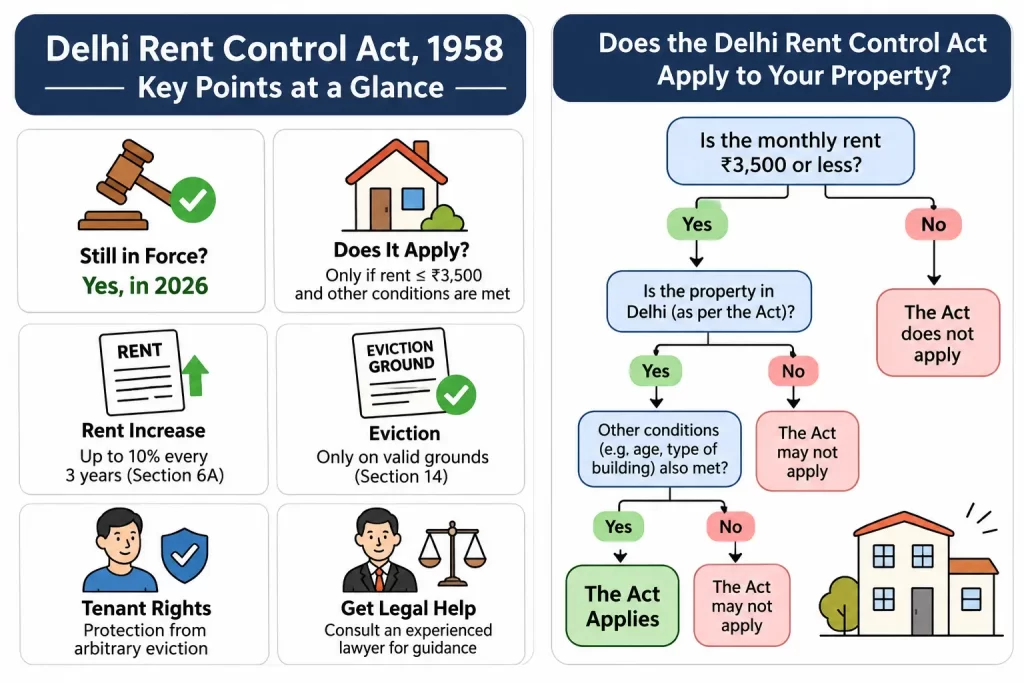
If you want to check whether your premises come under this Act or not, then check these five points:
- Location: The Act covers areas within the New Delhi Municipal Committee, the Delhi Cantonment Board, and certain urban areas of the Municipal Corporation of Delhi listed in its First Schedule.
- Monthly rent: The Act only applies to premises whose monthly rent is under Rs. 3,500.
- New construction: As per Section 3(b), the Act does not apply to premises built on or after the 1988 amendment for ten years from the date of completion.
- Ownership: As per Section 3(a), this Act does not apply to Government-owned premises.
- Type of arrangement: The Act is for the protection of tenants. A person who holds only a licence under the Indian Easements Act is not treated as a tenant.
| Situation | Does the Act apply? |
|---|---|
| Old tenancy at Rs. 1,200 per month, in a covered area | Generally yes |
| Tenancy at Rs. 25,000 per month | No, the Transfer of Property Act and your agreement govern it |
| Building completed after 1988, still within its first ten years | No, exempted for ten years |
| Government-owned premises | Generally no |
| Licence or leave-and-licence arrangement | Depends on the real nature of the arrangement, not just the label |
Can a Landlord Increase the Rent Under the Delhi Rent Control Act?
| Rule | How much can rent go up? | What must be followed |
|---|---|---|
| Periodic revision (Section 6A) | 10% every three years | Applies to the standard rent or, if none is fixed, to the rent agreed between landlord and tenant |
| Improvements (Section 7) | Up to 10% of the cost of the improvement, per year | The improvements should be genuine, and the landlord needs to get the tenant's written approval or the Controller's approval. |
| Written notice (Section 8) | Applies to every increase above | The landlord must give written notice. The increase becomes payable only after 30 days from the date of notice |
Quick example: Suppose your rent is Rs. 2,000, then as per Section 6A the landlord can increase it up to 10%, making it Rs. 2,200. But before that, the landlord must send a written notice, and the new rent is payable only after 30 days from that notice.
Can a Landlord Evict a Tenant Under the Delhi Rent Control Act?
Not freely, here are some legal grounds as per Section 14(1) where a landlord can recover possession with an order from the Rent Controller:
| Ground (Section 14(1)) | What it means in simple terms |
|---|---|
| Arrears of rent | The tenant did not pay or tender the full arrears within two months of a written demand notice |
| Subletting | The tenant sublet or parted with possession without the landlord's written consent |
| Misuse | The premises are used for a purpose other than the one they were let for, without written consent |
| Non-occupation or other accommodation | A tenant has not lived in residential premises for six months, or has acquired or built another residence |
| Bona fide need | The landlord genuinely needs residential premises for himself or a dependent family member |
| Repairs or rebuilding | The premises are unsafe, or must be vacated for repairs or reconstruction |
| Ex-employee | The tenant got the premises as an employee and has left the job |
| Damage or breach of lease terms | The tenant caused substantial damage, or breached conditions imposed by DDA, MCD or the Government |
Some grounds have safeguards, like in case of property misuse, the landlord must first send a notice and wait one month. The Controller can also refuse eviction in some cases if the tenant repairs the damage or pays compensation.
What Happens If the Tenant Does Not Pay Rent?
Unpaid rent is a ground for eviction under Section 14(1)(a), but the process has several steps:
- First, the landlord must send a legal notice demanding payment of the arrears.
- If the tenant doesn’t respond to that within two months, the landlord can apply to the Rent Controller Tribunal.
- Section 15: In this case, the Controller generally orders the tenant to pay the arrears within one month and then pay each month’s rent by the 15th of the following month.
- Section 15(7): If the tenant complies, the court will not order eviction, although it can order the payment of interest.
Also remember:
- Section 26: Rent is due by the 15th of the next month unless the contract says otherwise, and simple interest at 15% per year is payable on defaults.
- Section 27 and 28: If a landlord refuses to accept rent or provide a receipt, the tenant can deposit the rent with the Controller within 21 days of the due date.
- A tenant who has used the protection once and defaults again for three consecutive months loses it.
How Do You File a Case Before the Rent Controller?
Here is the usual process for a landlord seeking eviction under the Act:
Step 1: Confirm that the Act applies
First, we confirm whether the property is governed by this Act, so check the location, rent, building age, and the nature of the arrangement.
Step 2: Choose the ground
Match your facts to a ground under Section 14, or Sections 14A to 14D. Pick only the grounds you can prove.
Step 3: Send the pre-filing notice, where required
Then send a legal notice for the inconvenience you’re facing, like non-payment or misuse of your property.
Step 4: Draft the application
On non-response, you can file an application in the prescribed form with the Rent Controller who has jurisdiction. Rent Controllers sit in the district court complexes, such as Tis Hazari.
Step 5: Service and hearing
The Controller issues summonses. For bona fide need cases, the Section 25B procedure applies. Otherwise, the Controller follows the practice of a Court of Small Causes, including recording evidence.
Step 6: Order and appeal
An appeal against the Controller’s order lies to the Rent Control Tribunal within 30 days. Further, it can be challenged before the High Court is available in limited ways.
Here’s a document list that you’ll need throughout the procedure:
| Document | Purpose |
|---|---|
| Title documents and property tax receipts | To show ownership |
| Rent agreement, receipts or rent deposit records | To prove the tenancy and rent |
| Notices and postal or delivery proof | To show compliance with pre-filing steps |
| Proof of need (family details, current accommodation, other properties) | To support a bona fide requirement claim |
| Rent account or statement | To show arrears |
| Affidavit and vakalatnama | To support the application and authorise the lawyer |
Expert Advice from Adv. Dheekshanya: In bona fide need cases, disclose all other residential properties your family holds. Hiding them is a common reason for losing at the leave-to-defend stage.
What Are the Rights of Tenants and Landlords Under the Act?
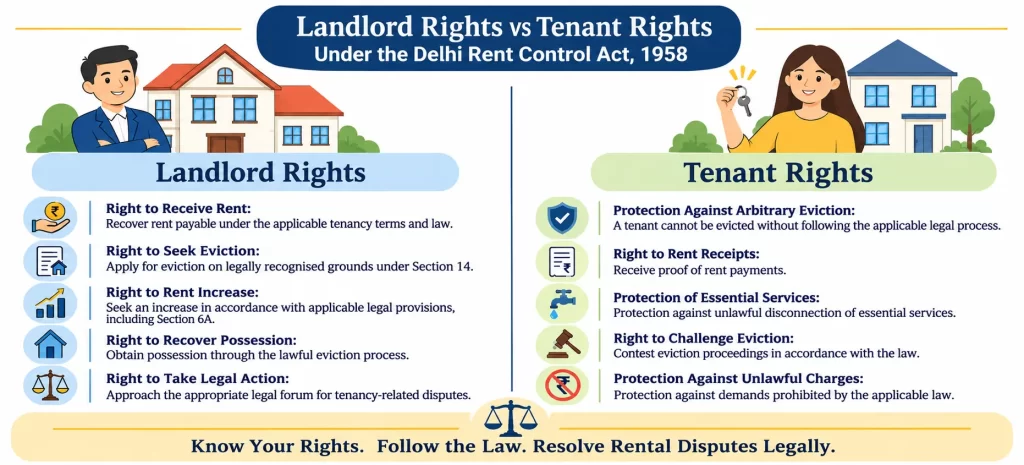
Tenant’s rights
- Rent receipt: Tenant can seek a receipt for rent payment, and if the landlord refuses, the tenant can seek damages of up to double the rent paid.
- No premium or pugree: As per Section 5, demand for premium, similar payments are prohibited, or advance rent above one month’s rent needs the Controller’s permission.
- Refund of unlawful payments: The tenant can apply to the Controller for a refund within one year of payment.
- Repairs: The landlord must keep the premises in good tenantable repair, and the tenant can carry out repairs after notice and deduct limited costs.
- Essential services: The landlord cannot cut off water, electricity or similar supplies without just cause.
- Protection from arbitrary eviction: Eviction is possible only on statutory grounds.
Landlord’s rights
- Eviction on statutory grounds, including bona fide need and the special categories.
- Rent revision: The landlord can increase rent as per Sections 6A and 7.
- Interest on late rent at 15% simple interest.
- Recovery after a limited-period tenancy (Section 21): With the Controller’s prior permission, a landlord can let premises as a residence for a fixed period agreed in writing, and then seek possession when the period ends.
- Protection for their property against sub-letting and misuse.
What Was the Delhi Rent Act, 1995, and Why Was It Never Enforced?
The Delhi Rent Act, 1995, was meant to repeal and replace the 1958 Act. It followed the National Housing Policy and a Model Rent Control Legislation sent to states by the Centre.
The Act received assent in August 1995. However, it was never brought into force because the Central Government did not issue a commencement notification. The 1958 Act has continued to govern covered tenancies ever since.
What If My Tenancy Is Not Covered by the Delhi Rent Control Act?
If your tenancy does not come under this Act, then it is governed by the Transfer of Property Act, 1882 and your agreement. In practice:
- The terms of the agreement matter most, including duration, rent, notice period, lock-in and deposit.
- Leases above one year need to be registered under the Registration Act, which is why 11-month agreements are common.
- In this, the termination is usually according to the agreement and the notice rules of Section 106 of the Transfer of Property Act.
- If the tenant does not leave, the landlord generally files a civil suit for possession and not an application before the Rent Controller.
Common Mistakes Landlords and Tenants Make in Delhi
Here are some mistakes that both parties make that should be avoided:
- Assuming the 1958 Act applies to every property, confirm it with a professional before relying on it.
- Using force or cutting essential supplies to remove the tenants, this is illegal; they can file a criminal complaint against you.
- Ignoring legal notice, it is a mistake that could give a plus point to the defence.
- Not paying rent during the proceedings, it can lead to the defence being struck out under Section 15.
- Relying on the Model Tenancy Act, even though it does not apply in Delhi.
How Can Kamal & Co. Advocates Guide You in a Delhi Rent Dispute?
If you’re having a dispute over rent in Delhi and you’re not sure how to protect your rights. At Kamal & Co. Advocates, we can help you with:
- Reviewing your tenancy papers, rent history and property documents
- Advising on whether the Delhi Rent Control Act or the Transfer of Property Act governs
- Drafting notices, applications and replies
- We can represent you before the Rent Control Tribunal and the High Court