
Suppose you are the bank’s manager; one of the borrowers has stopped paying, and you are confused over which tribunal will hear your recovery case in Chennai and how to file it.
Similarly, many people are stuck at this: At which DRT in Chennai should they file the case, what is the filing process, and how do you keep track of it once it is filed?
In this blog, we have explained the procedure for Debt Recovery Tribunals in Chennai, how to file a case through the e-DRT portal, and how to track your DRT case status. Furthermore, if you need representation in a recovery matter, you can speak with our civil lawyers in Chennai.
What Is the Debt Recovery Tribunal (DRT) in Chennai?
A Debt Recovery Tribunal is a special forum established under the Recovery of Debts and Bankruptcy Act, 1993, to help banks and financial institutions recover large loans more quickly than an ordinary civil court.
Two things you must know about a DRT:
- A DRT is different from a normal civil court. Civil courts do not have a judiciary to hear banks’ recovery claims of Rs. 20 lakhs or more; they all go to the tribunal.
- The DRT also allows borrowers or other eligible persons to challenge the measures taken by the secured creditor under Section 17 of the SARFAESI Act, this application must be filed within 45 days from when the measures were taken.
There are five DRTs in Tamil Nadu, and three of them sit in Chennai. If the appellant is not satisfied with the orders of a DRT, they can challenge it or appeal before the Debts Recovery Appellate Tribunal (DRAT) in Chennai.
How Many DRTs Are There in Chennai, and Which One Will Hear My Case?
Chennai has three tribunals: DRT 1, DRT 2 and DRT 3. But which tribunal has the jurisdiction to hear your case depends on territorial jurisdiction, meaning where the borrower lives or carries on business, where the bank branch is located, or where the cause of action arose.
| Tribunal | What to know | Where to confirm |
|---|---|---|
| DRT 1, Chennai | Covers ten districts as listed on its jurisdiction page | DRT 1 official website, Jurisdiction page |
| DRT 2, Chennai | Covers the Fort-Tondiarpet, Mambalam-Guindy and Triplicane-Mylapore areas of Chennai, among others | DRT 2 official website, Jurisdiction page |
| DRT 3, Chennai | Handles the remaining jurisdiction allotted to it | DRT 3 official website |
| DRAT, Chennai | Hears appeals against DRT orders | DRAT official website |
Which Cases Can Be Filed Before the DRT in Chennai?
The DRT hears:
- Original Applications (OA): At DRT, banks and financial institutions can file a case to recover an amount of Rs 20 lakh or more. The minimum amount for case filing was Rs 10 lakh, which was later raised to Rs 20 lakh by Central Government notification S.O. 4312(E) dated September 6, 2018.
- SARFAESI Section 17 applications filed by borrowers or guarantors against action taken by a secured creditor must be filed within 45 days of the measure taken under Section 13(4) of the SARFAESI Act.
- Interlocutory applications and counterclaims within a pending case.
The DRT does not hear loan disputes between two private individuals or a cheque bounce complaint.
Who Can File a Case in DRT Chennai?
Here are the types of categories that can file a case at DRT in Chennai:
- A bank or financial institution, the applicant in a recovery case.
- A borrower or other eligible aggrieved person, challenging the measures taken by the creditor.
- An advocate on behalf of the party, which remains the applicant.
In a recovery case, the banks are mostly the applicants and the borrower, guarantors, and mortgagors are the defendants.
What Documents Do You Need Before Filing a DRT Case?
Here’s the list of necessary documents, keep them ready so you don’t get stuck midway through the application:
| Document | Purpose |
|---|---|
| Loan agreement and sanction letter | Shows the terms of the debt |
| Statement of account | Proves the amount outstanding |
| Demand or recall notice and NPA notice | Shows the bank asked for repayment before filing |
| Security documents (mortgage deed, hypothecation, guarantee) | Establishes the bank's claim over the asset |
| Identity proof and authority letter or board resolution | Confirms who is filing and on whose behalf |
| Vakalatnama, if a lawyer is appearing | Authorises the advocate |
| Duly completed Original Application with annexures | The actual case you file |
How to File a Case in DRT Chennai: Step-by-Step Process
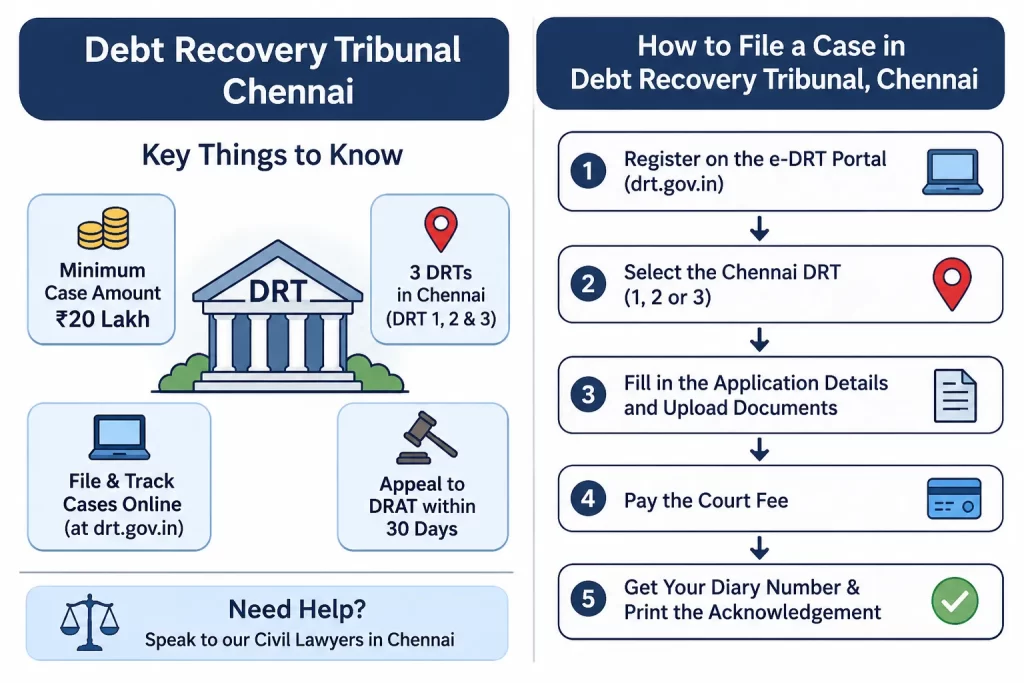
To file a case in the DRTs, you need to go through the e-DRT portal. The process is pretty straightforward, here’s how it works:
- Go to the e-DRT website at drt.gov.in and click on Login.
- First, sign up with your phone number, OTP, and some basic info, like your lawyer and their Bar Council number. Then, log in using your password and the security code that appears.
- Pick the DRT that handles cases like yours.
- Pick the kind of case you have and add the details of the people involved, how much you’re claiming, and what happened.
- Upload the required documents and application.
- You can pay the fee online after which you’ll get the diary number.
- Save the diary number and the acknowledgement. Have the physical set ready, and check for any extra physical submission required at the tribunal.
The procedure can be smooth if you’ve all the needed documents ready and you have correctly mentioned your claims and the situation.
How Much Is the Court Fee for Filing a DRT Case?
Here are the application fees for recovery cases as per Section 7 in the Debt Recovery Tribunal(Procedure) Rules, 1993:
| Application | Fee |
|---|---|
| Recovery application, debt up to Rs 10 lakh | Rs 12,000 |
| Recovery application, debt above Rs 10 lakh | Rs 12,000 plus Rs 1,000 for every lakh above Rs 10 lakh (maximum Rs 1,50,000) |
| Counter-claim | Same as a recovery application |
| Interlocutory application | Rs 250 |
| Review of an interim order | Rs 125 |
| Review of a final order | 50% of the main fee (maximum Rs 15,000) |
What Happens After You File a DRT Case?
Here’s what happens after you file the application:
- Scrutiny: The registry goes through your application for any defects and may ask you to fix them.
- Registration and summons: Once the application is accepted, the tribunal sends summonses to the defendants.
- Written statement: After receiving the summons, the defendant must give a written statement within 30 days.
- Hearings and evidence: The bank proves the debt, and the defendants can raise their defences or a counterclaim.
- Order and recovery certificate: If the bank succeeds, the Presiding Officer issues a recovery certificate, and a Recovery Officer takes steps to recover the amount.
The Act usually directs the tribunal to try to dispose of the case within 180 days; it’s not a fixed timeline, and the actual timelines may vary with the complexity of the case and the tribunal’s workload.
How to Check DRT Chennai Case Status Online
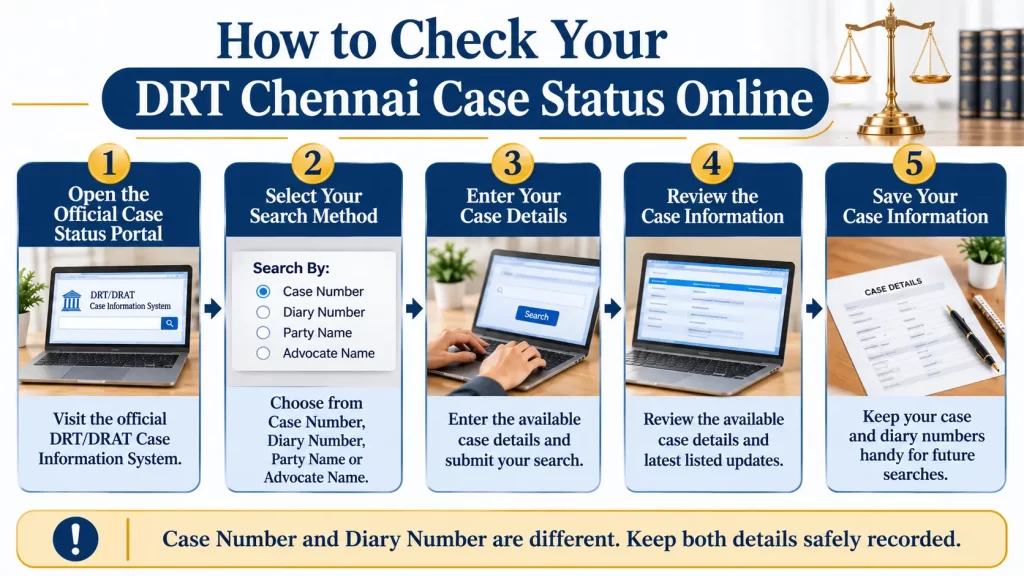
On the same e-DRT portal where you filed your case, you can check your case status. Here’s the step-by-step guide for that:
- Go to drt.gov.in and open the case status section.
- Choose the DRT location, for example DRT 1, DRT 2 or DRT 3 in Chennai, or DRAT if your matter is an appeal.
- You can generally search by diary number, case number, petitioner or respondent name, or advocate name.
- Fill in the case type, number, and year, type the captcha, and submit.
- Select the matching case to see the parties, the next hearing date, the stage, and the orders passed.
- Note the next hearing date and the date you checked, and take a screenshot.
Expert advice from our advocates: Always save the diary number from the acknowledgement. Until the case is registered, it is often the only way to find it online.
How Do I Check DRT Case Status Without a Case Number?
It is fine if you do not have the case number. You can try:
- The diary number from your acknowledgement
- The name of the petitioner or respondent, entered as it appears in the application
- The advocate’s name
Or you can ask your advocate or contact the tribunal registry, who can give you the case number.
What Do Pending, Disposed and Other Status Terms Mean?
| Term | What it generally means |
|---|---|
| Pending | The case is still alive and awaiting the next step or a decision |
| Disposed | The tribunal has finished with the case on the merits or on a procedural ground |
| Listed | The case is scheduled in the cause list for a date |
| Adjourned | The hearing has been put off to a later date |
| Reserved for orders | Hearing is complete, and the order will be pronounced later |
| Pronounced | The order has been announced |
Disposed does not mean that you have won or lost the case. Always read the complete order copy, and then you can decide your next step.
Why Is My DRT Case Not Showing Online?
There can be many reasons that your case is not showing on the portal, check these things:
- Wrong tribunal: Add the correct tribunal with jurisdiction.
- Wrong case type or year: Use the details exactly as on the acknowledgement or notice.
- Name spelling: Try the party name as written in the application, or only the first word.
- Very recent filing: It can take some time for a newly filed case to be scrutinised and registered.
How Do I Download DRT Chennai Orders?
It’s a very easy process; you can download the order copy at the portal itself:
- Open the tribunal’s website or the e-DRT portal
- Go to the orders or judgments section
- Search with the case number, party name, or order date
- There you can download a copy of the order
If an order has not been uploaded, ask your advocate or the registry for a copy, because the online record updating can take a little time.
What Happens If You Miss a DRT Hearing?
The tribunal can carry out the case hearing even in your absence and can pass an order against you without hearing you. If that happens, immediately speak to your lawyer, you might find some legal remedies. Always keep track of your hearing dates to avoid such mistakes.
What Is the Difference Between DRT and DRAT?
It’s important that you know the clear difference between DRT and DRAT because they are for different purposes. At DRT, we file a recovery application, while at the DRAT we file an appeal challenging the DRT order.
| DRT | DRAT | |
|---|---|---|
| Role | First tribunal that hears the case | Appellate tribunal that hears appeals against DRT orders |
| Typical matters | Recovery applications by banks; SARFAESI Section 17 applications by borrowers | Appeals against DRT orders |
| Time limit | SARFAESI Section 17: 45 days from the Section 13(4) measure | Appeal: 30 days from receipt of a copy of the order |
| Pre-deposit | Not applicable | 50% of the determined debt, reducible to not less than 25% for recorded reasons |
| Chennai website | DRT 1, 2 and 3 sites | drat.tn.nic.in |
Common Mistakes People Make in DRT Matters
Here are some common mistakes that you should avoid and why:
| Mistake | Why it matters |
|---|---|
| Filing in the wrong DRT | The case can be returned or delayed |
| Not saving the diary number | You may not be able to track the case |
| Ignoring a DRT summons | The case may proceed against you |
| Missing the 45-day SARFAESI limit | The challenge may be time-barred |
| Using unofficial websites or agents | They can mislead you or charge extra |
When Should You Speak to a Debt Recovery Lawyer in Chennai?
Though you can easily follow the steps and move forward with your case, you should consider consulting with a lawyer when:
- You have received a summons or a SARFAESI notice
- You want to challenge a possession notice or auction
- A bank wants to file a recovery application and needs the pleadings drafted
- You need to file or defend an appeal before the DRAT
At Kamal & Co. Advocates, our civil lawyers help with reviewing loan documents, drafting applications and replies, and representing clients before the tribunal.