


Co-Parenting Meaning in India: Custody, Visitation & Legal Framework
The Co-Parenting Meaning in India refers to a legal and practical arrangement where separated parents continue to jointly raise their child under court-recognised custody and visitation frameworks. Indian courts increasingly support co-parenting because it protects a child’s emotional stability, even when parents live apart. This approach focuses on shared responsibility rather than parental conflict.
As family structures change, particularly in urban India, parents are increasingly looking at ways to continue being an active part of the life of their child even after they are separated. Co-parenting offers an alternative to the traditional custody wars, which are child-centred and structured.
If you’re working out a co-parenting arrangement, speaking with experienced family & custody lawyers can help you formalize something that genuinely works for your child.
What Is the Co Parenting Meaning in Simple Words?
The Co-Parenting Meaning in India means that both parents share responsibility for their child even after separation. Instead of one parent managing everything alone, both parents participate in decision-making and daily involvement.
This approach has gained attention because divorce filings in metro cities like Delhi and Mumbai have increased by nearly 30–40% over the last decade. Although India’s divorce rate remains low—around 0.1 to 0.4 per 1,000 people—about 1% of marriages still end in separation, impacting a large number of children.
Why Are Parents Searching for Co Parenting Meaning in India?
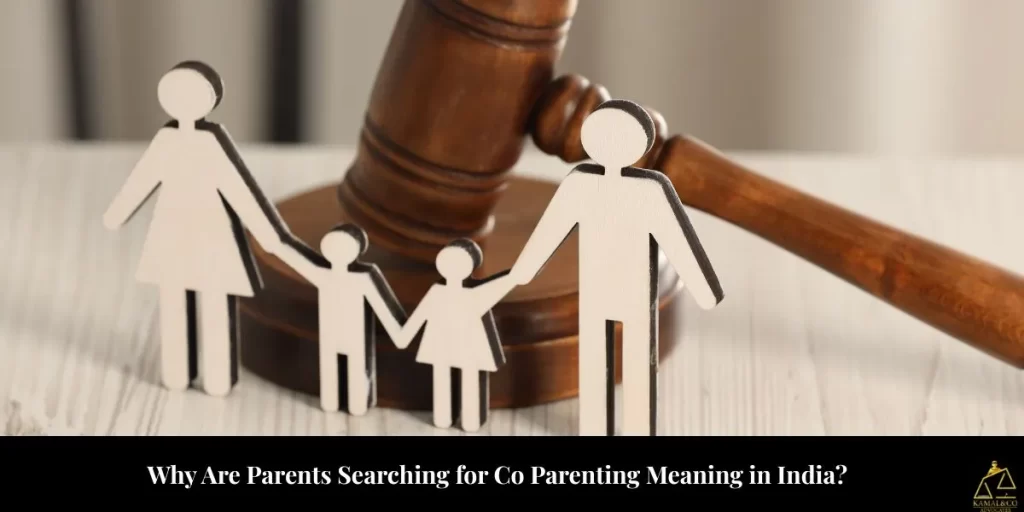
The Co-Parenting focuses on maintaining stability. Children who continue regular contact with both parents show better emotional balance, reduced anxiety, and improved academic performance. Indian courts also recognise that separation between parents should not result in the loss of a parent-child relationship.
Indian courts increasingly support co-parenting arrangements during divorce, judicial separation, or post-separation custody disputes, where continued involvement of both parents serves the child’s welfare.
How Does Co Parenting in India Work in Daily Life?
Practically, the Co-Parenting in India implies the joint responsibility in schooling, medical care, costs and holidays. Parents tend to make schedules ahead of time so that the child feels continuity and stability.
The majority of arrangements are initiated by mutual negotiation or mediation. In case of disputes, the family courts can formalise parenting arrangements and visitation arrangements. As per judicial and NCRB-linked data trends, India currently has 953 family courts, and mediation is being increasingly employed to minimise the conflict and safeguard the emotional health of a child.
Co-Parenting Legal Framework Under the Hindu Minority and Guardianship Act, 1956
| Provision | Legal Position Under the Hindu Minority and Guardianship Act, 1956 | Relevance to Co-Parenting in India |
|---|---|---|
| Section 6 – Natural Guardians | Father is the natural guardian, followed by the mother; custody of children below five years is ordinarily with the mother. | Recognises the role of both parents in a child’s upbringing and welfare. |
| Section 13 – Welfare of the Child | The welfare of the child is the paramount consideration in all guardianship and custody matters. | Forms the foundation for court-approved co-parenting and shared parenting arrangements. |
| Child Custody Decisions | Courts determine custody based on the child’s best interests rather than parental preference. | Encourages balanced parenting arrangements where both parents remain involved. |
| Visitation Rights | Non-custodial parents are generally granted visitation and access rights. | Helps maintain the child’s relationship with both parents after separation or divorce. |
| Educational Decisions | Courts may allow both parents to participate in decisions relating to schooling and education. | Supports shared responsibility for the child’s development. |
| Medical and Healthcare Decisions | Parents may jointly participate in important healthcare decisions affecting the child. | Promotes cooperative parenting and child welfare. |
| Shared Parenting Arrangements | Though not expressly defined in the Act, courts increasingly recognise shared parenting models. | Supports the practical implementation of co-parenting in India. |
| Court’s Primary Consideration | Emotional, educational, physical, and psychological well-being of the child. | Ensures that parenting arrangements focus on the child’s best interests. |
| Relationship With Both Parents | Courts generally encourage continued contact with both parents unless it harms the child. | Reduces parental alienation and strengthens family bonds. |
| Judicial Trend | Family courts increasingly favour child-centric custody and visitation arrangements. | Reflects growing acceptance of co-parenting in India. |
Is Co Parenting in India Better Than Sole Custody?
Sole custody places the primary responsibility on one parent, while the other has little to contribute. On the contrary, Co-Parenting in India guarantees the involvement of both parents in both emotional and practical terms.
Indian courts have noted that in some cases, strict custody arrangements may result in parental alienation, whereby a child is alienated from one parent. Rajeswari Chandrasekhar Ganesh v. The courts of the State of Tamil Nadu indicated the psychological harm that such alienation could cause. Co-parenting can be used to reduce such risks as it promotes cooperation instead of control.
How Does Child Custody Fit Into Co Parenting in India?
In India, child custody decisions after divorce are based on the welfare and best interests of the child, ensuring emotional, educational, and developmental needs are prioritised. According to the Hindu Minority and Guardianship Act, 1956, children under the age of five years normally remain with the mother. Nevertheless, recent developments indicate that more than 70% of custody determinations are currently based on child developmental aspects as opposed to the gender of the parent.
In Roxann Sharma v. Arun Sharma, the Supreme Court affirmed that both parents have an equal role in the upbringing of a child. Access to the other parent should be provided even in cases where one parent is in custody; this will help in supporting the Co-Parenting Meaning in India.
What Laws Support Co Parenting in India?

India does not have a single law dedicated solely to co-parenting, but several statutes support shared parenting principles. The Guardians and Wards Act, 1890, particularly Section 17, prioritises the child’s welfare above all else.
Hindu Marriage Act, 1955, section 26 gives the courts the power to determine the custody, visitation and maintenance during and after the divorce proceedings. These legislations enable the courts to organise joint responsibilities in line with the Co-Parenting in India.
Why Are Visitation Rights Important for Co Parenting in India?
Visitation rights guarantee that a non-custodial parent is in touch with the child. The Indian courts consider visitation as a right of a child and not a privilege of a parent. The schedules can be weekends, holidays, or video calls, and it depends on the situation.
Some courts, including in Kerala, have also recognised visitation rights for grandparents to preserve emotional bonds. These practices strengthen the Co-Parenting in India by keeping family relationships intact.
Is Co Parenting in India Becoming the New Normal?
The trends in urban areas indicate that close to 70% of divorce proceedings are initiated by women, which has led to the courts taking more balanced child-oriented decisions. Another change in perception of family structures was seen in India, which registered 4,515 adoptions.
These trends indicate that parenting in India is no longer following the traditional patterns. The Co Parenting in India is a viable solution that enables parents not to sever emotional bonds to their children.
When Should Parents Seek Court Support for Co-Parenting in India?
Parents should approach a family court when informal co-parenting arrangements break down, visitation is denied, or the child’s routine is disrupted. Courts can modify custody or visitation orders if co-parenting is being obstructed and the child’s welfare is at risk.
Final Thoughts on Co Parenting Meaning in India
Searching for the Co-Parenting Meaning in India will be important to parents experiencing separation. It changes the emphasis on custody cases and puts it on the emotional and mental health of the child. This child-first approach is gaining more and more backing in Indian laws and court rulings.
At Kamal & Co. Advocates, we help parents build co-parenting arrangements that hold up legally and work practically.




1 thought on “Co-Parenting Meaning in India: Custody, Visitation & Legal Framework”
Pingback: Child Custody Law in India: Rights & Court Process