How to File a Defamation Case in India? Legal Process in 2026
You wake up one morning and find out that you are being talked about by everyone on social media. A serious accusation has been made against you online by someone. You start being questioned by friends, and you begin to be doubted by colleagues. However, the claim is not true, but the harm has been done and is being spread.
This is where the defamation law steps in. If someone spreads false information that harms your reputation, you have the right to take legal action against them. This guide explains how to file a defamation case in India, and what steps you should take to protect your reputation.
What Is Defamation Under Indian Law?
Before understanding the process, let’s learn what a defamation case in India is.
Defamation can occur when a false statement about another person is spread by someone, and their reputation is harmed by that statement. The statement can be of many types. It may be in:
- Spoken words
- Written content
- A social media post
- A news article
- Image or gesture.
Defamation cases in India used to be controlled by Sections 499 and 500 of the Indian Penal Code. With the Bharatiya Nyaya Sanhita (BNS), 2023, it is under Section 356, which allows punishment of two years of jail, a fine, or both.
For a statement to qualify as defamation, a few conditions must exist:
- The statement must be false.
- It must be shared with other people.
- It must damage the person’s reputation.
- The person making the statement must know it could cause harm.
- AI-generated content or deepfakes, which are intended to deceive.
Key Fact: Under Section 356(2) of the BNS, an offender can now be sentenced to community service by the court in addition to or instead of a fine or jail time.
Examples And Types of Defamation Cases in India
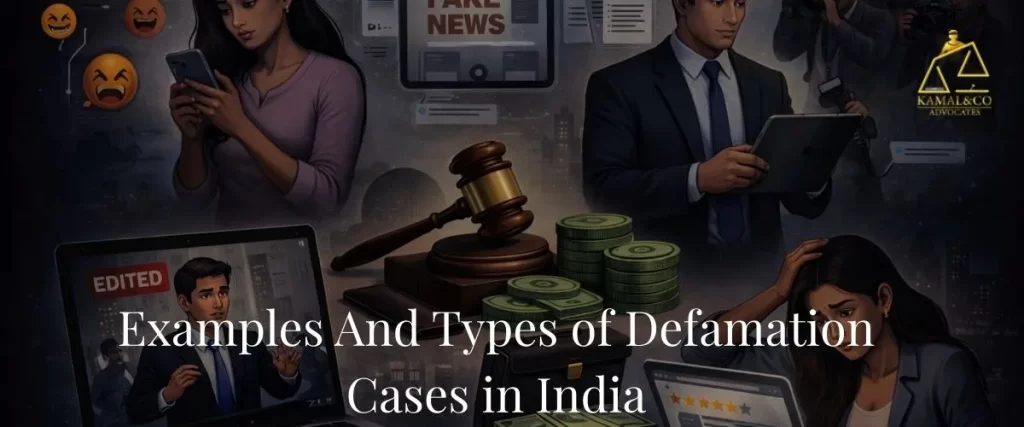
When learning how to file a defamation case in India, know that the law offers two legal paths depending on what the victim wants.
- Criminal Defamation: If the statements are false and they damage another person’s reputation, and are intentionally spread by someone, imprisonment, a fine, or both can be imposed by the court. These cases are handled in criminal courts, and punishment for the offender is sought by the people.
- Civil Defamation: Here, compensation is the goal. A civil suit can be filed by the affected person asking the court for monetary damages to cover reputation loss, mental stress, or business harm.
Common examples of defamation are:
- False accusations on social media.
- Fake news about a business.
- Manipulated or edited videos.
- Workplace allegations.
- Online reviews with false claims
How to File a Defamation Case in India: Step-by-Step Legal Process
Understanding how to file a defamation case in India becomes way easier when you look at the process step by step.
1. Collect Evidence
The first step is gathering the proof. It should show that the statement that was made harmed your reputation. Some common examples are:
- Screenshots of social media posts.
- Emails or messages.
- Articles, videos, or recordings.
- Witness statements.
2. Send a Legal Notice
A lawyer usually sends a legal notice to the person responsible. The Legal notice asks them to remove the content, stop spreading the statement, and issue an apology. Many disputes end at this stage.
3. File a Complaint in Court
If the issue continues, the next step is to determine where to file a defamation case.
- The criminal cases are filed in the Court of Judicial Magistrate.
- The civil cases are filed in the District Court or High Court, depending on the compensation amount.
Expert Insight: Today, Indian courts use “Dynamic Injunctions.” This means if a harasser tries to re-upload the same fake video on a new link or website, the law blocks it automatically without you having to file a brand-new case every single time.
4. Court Proceedings
The case is examined by the magistrate, notes are taken, and the witnesses are questioned. Summonsses are issued by the court, and the trial begins if there is enough evidence.
What is The Time Limit for a Defamation Case in India?
While learning how to file a defamation case in India, it is important to know the time limit set by the law. Filing within the correct time is important; if not, courts may dismiss the cases that are filed after the deadline.
- Criminal defamation: In most cases, a complaint should be made within three years of the crime. If the case is filed later, the court will refuse to hear it unless there is a valid reason for the delay.
- Civil defamation: The time is one year from the date the defamatory statement was published.
Common Mistakes to Avoid When Filing a Defamation Case in India
These are the common mistakes you should avoid:
- Filing a case without proof: Courts need clear proof. The statement that was made should genuinely hurt someone’s reputation.
- Not every rude comment is defamation. For a claim to be valid, the statement must be false and serious enough to hurt someone’s reputation.
- Posting emotional reactions online: People often post angry responses, which can make things worse and make the case more complicated.
- Not paying attention to the legal notice: A lot of problems can be solved without even going to court.
Before taking legal action, it is advisable to consult an experienced civil lawyer in Mumbai, civil lawyer in Delhi, civil lawyer in Hyderabad, civil lawyer in Chennai, or civil lawyer in Bangalore who can evaluate the available evidence and determine whether the claim meets the legal requirements for defamation.
Defamation in the Age of AI and Deepfakes
Nowadays, fake videos, cloned voices, or edited images can be easily generated using artificial intelligence. These are known as deepfakes. They look real but are completely false.
India’s new IT rules say that platforms must treat this kind of content as “Synthetically Generated Information (SGI),” which includes audio, images, or videos that look real but were made or changed by AI.
- Users need to know that AI-generated content is fake, so platforms need to make it clear.
- Labels must be easy to see and can’t be hidden in captions or metadata.
If a deepfake hurts your reputation, you need to know how to file a defamation case in India. You can report this in the National Cyber Crime Reporting Portal.
How to File a Defamation Case in India: Final Thoughts
If you are aware of how to file a case of defamation in India, you can save your reputation easily. If you do the right thing at the right time, you can stop things from getting worse.
People often turn to experienced lawyers like Kamal & Co. Advocates for help with these kinds of problems. It’s important you know what the options are and how to move forward with the right legal strategy.