

Suppose your company has filed an insolvency petition at the NCLT, or you are a creditor waiting for the next hearing. Your lawyer is not present at the moment, or you’re traveling and won’t be able to visit the judicial office, and you want to check: What is happening with my case?
In this situation, you don’t need to wait for your lawyer to give you updates; you can check your NCLT case status on the official NCLT website.
This blog explains how to check the NCLT case status step by step. And if you’re confused about the case procedures and how the case is moving in the court, you should get a consultation with our corporate and insolvency lawyers for guidance.
What Is NCLT Case Status and What Does It Tell You?
The National Company Law Tribunal (NCLT), established under the Companies Act, 2013, is a judicial body that handles company-related matters. It handles cases like insolvency cases under the Insolvency and Bankruptcy Code (IBC), mismanagement complaints, mergers and amalgamations, and winding up petitions.
On the NCLT website, you can check your case status online. It usually shows:
- Filing number and filing date
- Case number and the date it was registered
- Names of the petitioner and respondent
- Names of the advocates on record
- The date the case was last listed
- The current status, such as pending or disposed
How Do I Check the NCLT Case Status Online?
Here’s the complete step-by-step procedure for checking the NCLT case status online through the official NCLT website, nclt.gov.in.
Step 1: Keep your case details ready
First, collect the details using which you can search for your case, such as:
- Filing number
- Case number
- Party name
- Advocate name
Step 2: Open the official NCLT website
Open the official website and look for the Case Status or Case Information option in the menu.
Step 3: Choose how you want to search
The Case Status menu offers four options: Filing Number, Case Number, Party Name, and Advocate Name. There, you can add one of the information items from the above list with the right bench and year.
Step 4: Select the bench and year
Then you must select the right bench where the case was filed and the filing year. These are the most important details.
Step 5: Open your case
Once all details are filled, you can click on your case to see the full details. If you want to check the hearing list and orders as well.
Can I Check NCLT Case Status by Party Name or Without a Case Number?
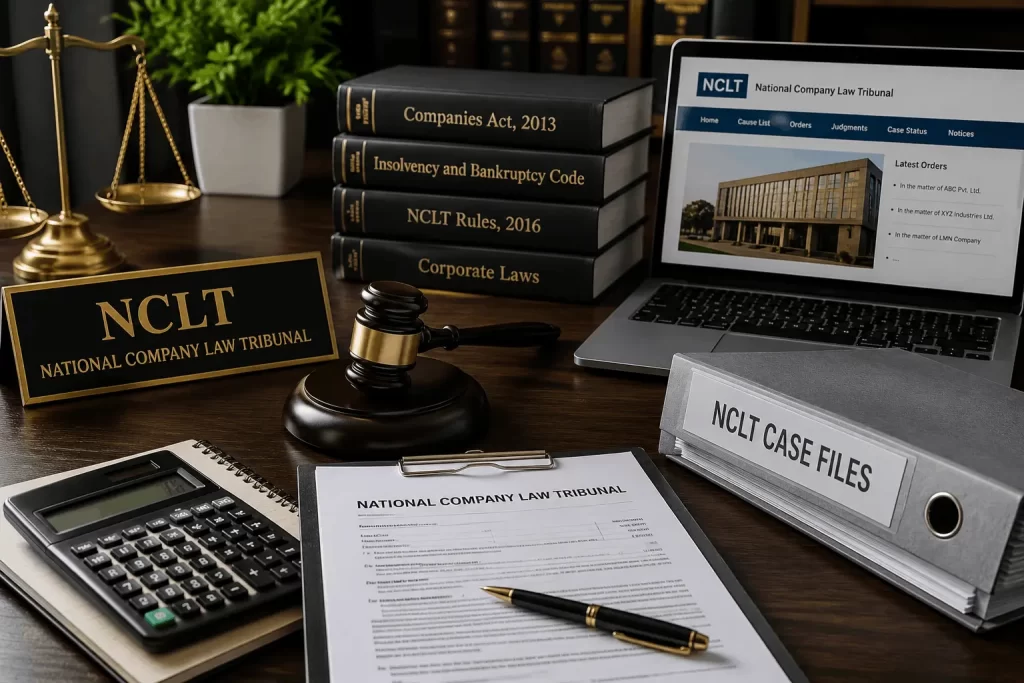
Yes, you can search your NCLT case status without a case number by using other details like:
| If you have | Use this search option | Also select |
|---|---|---|
| The filing number given at the time of filing | Filing Number | Bench and year |
| The registered case number | Case Number | Bench, case type and year |
| Only the company or person’s name | Party Name | Bench, party type and year |
| Only your lawyer’s name | Advocate Name | Bench and year |
How Do I Read an NCLT Case Number?
An NCLT case number looks complicated but follows a pattern. For example, the portal shows numbers such as C.P. (IB) – 215/2021, and cause lists show entries such as IA/1267(KB)2020 In C.P.(IB)/186(KB)2017.
Broadly, it has four parts:
- Case type: such as C.P. (IB), IA or CA
- Serial number: the number given by the registry
- Bench code: often shown in brackets, for example (KB) for Kolkata
- Year: the year of filing or registration
| Abbreviation | What it usually means |
|---|---|
| C.P. (IB) | Company petition under the Insolvency and Bankruptcy Code |
| C.P. | Company petition under the Companies Act |
| IA | Interlocutory application filed within an existing case |
| CA | Company application |
| RA | Review application |
Which NCLT Bench Should I Select?
Bench is very important to check NCLT case status, so select the bench where the case was filed, which depends on the location the company office is registered in. You can check the court’s territorial jurisdiction on the official jurisdiction page.
Sometimes the case can be transferred between the benches, for which the registry publishes a transfer notice, so check the notification section in case your case has disappeared.
What Do the Different NCLT Case Statuses Mean?
It’s important that you read the case status the right way; here’s what different statuses mean:
| Status | In simple words |
|---|---|
| Pending | The case is still going on before the bench |
| Disposed | The tribunal has decided the matter or closed it |
| Last listed date | The most recent date the case came up before the bench |
| Registered on | The date the registry gave it a case number after scrutiny |
What You Should Do If the Status Shows “Disposed”?
A disposed status does not always mean you have won or lost a case. It only means that the case is no longer pending for the bench. So before concluding anything, you should check these two things:
- Read the actual order: Only the order will help you understand the case status, whether the petition was admitted, dismissed, withdrawn, or settled, or whether a plan was approved.
- Check for appeal period: If you want to file an appeal, it needs to be filed before NCLAT, for which you need to know the time period for it. Consult with your lawyer regarding this to avoid delays. Here’s how the time period works for appeals:
| Legal provision | Appeal limitation | When the limitation begins |
|---|---|---|
| Section 61(2), IBC | 30 days + maximum 15-day condonation | Date of pronouncement of the order, subject to applicable rules on exclusion of time |
| Section 421(3), Companies Act | 45 days + maximum 45-day condonation | Date the copy of the order is made available to the aggrieved person |
How do I Download NCLT Orders and Judgments?
At the NCLT website, in the Orders & Judgements section, you can search for an order. And for official use, such as a bank, an insolvency professional, or an appeal, you can apply for an e-certified copy. The portal e-Inspection lets you view your case records online.
The portal also keeps data before 31 August 2021 in an older archive, so use the archive link if you are looking for an older case.
How to Check the Status of an Appeal Against an NCLT Order?
Appeals against the NCLT orders go to the National Company Law Appellate Tribunal (NCLAT), which has its own website. You can check the status of your appeal on the NCLAT website.
Once your appeal is filed, you can check the status of your appeal through filing number or case number. Keep in mind that an NCLT case number or filing number won’t work on NCLAT.
How to Track an IBC or Insolvency Case at NCLT?
If your case is related to an insolvency matter, then you should search with the Company’s name under Party Name to bring up the main petitions and applications filed in it. Then you should check:
- Check if the petition is admitted: Then you should check whether the petition is admitted, still pending, or rejected. Admission starts a moratorium and brings in an interim resolution professional.
- Check each application too: Open Case History and look at the status of every application. An order on one application can change a creditor’s position even when the main petition looks unchanged.
Common Mistakes People Make While Checking NCLT Case Status
Here are some common mistakes for you to avoid to be able to check your case status more efficiently and faster:
- Selecting the wrong bench: This is the common mistake; your case status will not appear even if the other details are correct.
- Mixing up the filing number and case number: Both are different; the case number is given only after registration.
- Relying on the case status for the next hearing dates: Always cross-check the cause list for accuracy.
- Ignoring the disposed status: If the status is showing disposed, then read the order and check for the appeal period.
Conclusion
Overall, checking the NCLT case status is quite easy once you know which number or name to use and which bench to select. Start with the filing or case number, move to the party name if you do not have it, and use Case History and the cause list for the full picture.
If you are unsure how to read an order or what the judgment states, what the next step in your case should be, or whether you should file an appeal, you can speak with our team. Our advocates at Kamal & Co. Advocates can review your matter and guide you on the right course of action.