
Reviewed by: Adv. Raj L Mehta
Suppose a year ago you started a bakery in Mumbai, and now it’s doing great. You have decided to protect your brand name, but you’re not sure how to register your brand’s trademark in Mumbai.
This blog explains what the Trade Marks Registry in Mumbai does, how to file an application, how to check your trademark status online, and how to respond if the Registry objects. Furthermore, if you want help with your filing or a reply, you can speak with our corporate and IP lawyers in Mumbai.
What is the Trade Marks Registry in Mumbai and what does it do?
The Trade Marks Registry is the government office where you can file your trademark registration application. It reviews your application, makes accepted marks public, listens to complaints, and keeps a list of all trademarks as the Register of Trade Marks.
There are five Registry offices in India: Mumbai, Delhi, Kolkata, Chennai, and Ahmedabad. They all work on one national register, so a mark registered through the Mumbai office gives you rights across India, not just in Mumbai.
Two things to keep in mind:
- The Registry decides if your trade mark can be registered, but it doesn’t decide who is right in an infringement dispute. That’s what the courts do.
- The Registry does not give you a legal opinion on your brand. A search or a pre-filing review from a lawyer is a separate step.
Where is the Trademark Registry office in Mumbai and how can I contact it?
The Mumbai Registry is at Bouddhik Sampada Bhawan, S.M. Road, Antop Hill, Mumbai, 400037. You can check out more details on the IP India’s Contact Us page about other locations and offices.
| Detail | Information (as listed by IP India) |
|---|---|
| Office | Trade Marks Registry, Intellectual Property Office, Mumbai |
| Address | Bouddhik Sampada Bhawan, S.M. Road, Antop Hill, Mumbai, 400037 |
| Helpline for general queries (Trade Marks) | 1800-110-989 |
| Trade Marks helpdesk email | tmr-helpdesk@nic.in |
| Mumbai Registry email | mumbai.tmr@nic.in |
How do I file a trademark application at the Mumbai Registry?
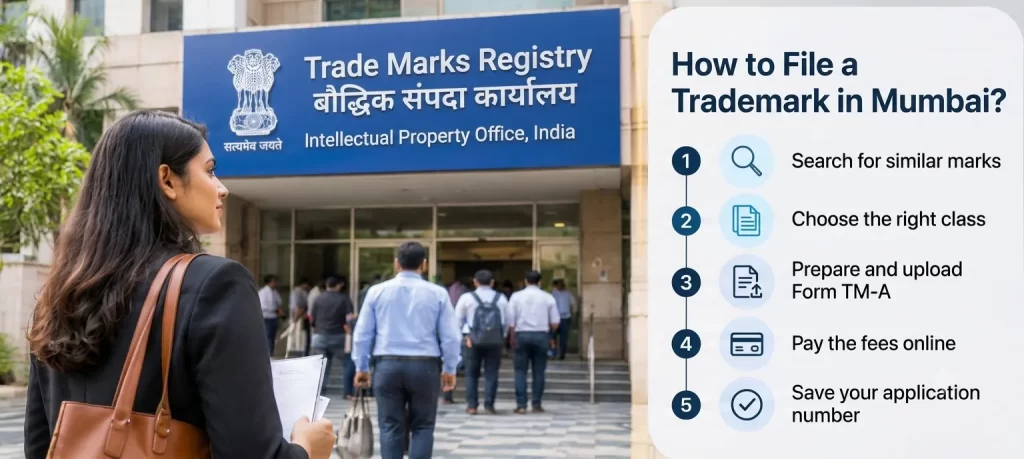
You can easily apply for your trade mark registration application on the IP India e-filing portal, here’s a step-by-step guide to the filing procedure:
Step 1: Search before you file
Use the public search tool on the IP India website to check whether a similar mark already exists in your class. Similar marks are one of the major reasons for an objection.
Step 2: Choose the right class
Trademarks are registered according to the class of goods or services, a restaurant, a clothing brand, and a software company are filed in different classes, so select the right class.
Step 3: Prepare your documents
Keep these ready:
- Applicant details (name, address, constitution of the business)
- A clear image of the mark or logo
- Details of goods or services
- Date of first use, with supporting proof
- Form TM-48 (authorisation of agent), if a lawyer or agent files for you
- Proof of Startup or Small Enterprise status, if you are claiming the lower fee
Step 4: File Form TM-A on the official portal
Log in to the IP India e-filing portal, fill in Form TM-A, upload the documents, pay the fee online, and save the application number.
Step 5: Keep the acknowledgment safe
Your application number is how you track the application. Without it, you will have to search by mark name and class, which is slow.
If you want a trademark search and class review before you file, you can visit or get an online consultation at our corporate law firm in Mumbai.
How much does it cost to file a trademark in India?
Here are the government fees listed in the First Schedule of the Trade Marks Rules, 2017 on the IP India website:
| Item | E-filing fee | Physical filing fee |
|---|---|---|
| TM-A, individual, startup or small enterprise (per class) | Rs. 4,500 | Rs. 5,000 |
| TM-A, all other applicants (per class) | Rs. 9,000 | Rs. 10,000 |
| Expedited examination (Rule 34), individual, startup or small enterprise (per class) | Rs. 20,000 | Not allowed |
| Expedited examination (Rule 34), all other applicants (per class) | Rs. 40,000 | Not allowed |
| Renewal of registration (per class) | Rs. 9,000 | Rs. 10,000 |
| Surcharge for late renewal, added to the renewal fee (per class) | Rs. 4,500 | Rs. 5,000 |
| Notice of opposition, TM-O (per class opposed) | Rs. 2,700 | Rs. 3,000 |
Do I need to visit the Trademark Registry in Mumbai in person?
You don’t need to visit a registry in Mumbai; you can easily file the application online, keep track of the status online, and receive the examination report by email or on the portal. The Registry also publishes hearing boards and runs hearings through virtual rooms, so you can often attend a hearing by video.
How long does a trademark application take in Mumbai?
There is no single fixed timeline, it can take around six months to two years, but there are a few things that often affect the procedure, like:
- If the examiner raises any objection, it can delay the process, a clear application moves faster.
- If someone opposes the mark after it is published in the Trade Marks Journal.
- The schedule of the registry can be a reason for waiting if a hearing is needed.
Be careful with agents who promise a certificate in a fixed number of days; verify their authenticity first. You can check your own application status for free, and that is the best indicator.
How do I check trademark application status in Mumbai?
On the website itself, you can check the status of your application, hearing dates, and where you can get your certificate. Here’s how you can search your case status:
- Open the official Trademark Application Status page.
- Choose the search method, such as Application Number.
- Enter your application number and the CAPTCHA.
- Open the result to view the status, the class, the applicant details, and the recent proceedings.
- Save a screenshot with the date, so you have a record.
What do the different trademark status labels mean?
Often, when an application process begins, the status shows various stages which can be confusing, so here’s a clear explanation of different stages:
| Status shown | What it generally means | What you should do |
|---|---|---|
| Formalities Chk Pass | The application has passed the initial formality check and is waiting for examination | Wait and keep checking |
| Formalities Chk Fail | A formal defect was found | Fix it within the time given in the notice |
| Objected | The examiner has raised an objection under Section 9 or Section 11 | Reply within one month of receiving the examination report |
| Ready for Show Cause Hearing | A hearing has been scheduled | Prepare and attend the hearing |
| Accepted and Advertised | The mark is accepted and published in the Trade Marks Journal | Watch for any opposition |
| Opposed | A third party has filed an opposition | Respond as per the opposition rules |
| Registered | The mark is on the Register | Keep your certificate and diarise the renewal |
| Refused | The application was refused after examination or hearing | Speak to a lawyer about an appeal |
| Abandoned | The application lapsed, usually due to a missed deadline | Speak to a lawyer; you may need to re-file |
What if my application number shows no result?
Try these checks before you worry:
- A very recent filing: It may take a little time to appear on the portal.
- A typing mistake: Re-enter the number carefully.
- The wrong search type: Make sure you selected the right option on the status page.
- The status has not been updated: Records can lag behind an order. Check your email and ask your agent for the latest order.
What is a trademark objection and why did I get one?
The registry can give a written objection stating that your mark cannot be accepted as filed. It is not the final decision; it’s like a chance given so that you can correct it, issued under Rule 33 of the Trade Marks Rules, 2017.
There are two main kinds:
| Basis | Section | What it means | Example |
|---|---|---|---|
| Absolute grounds | Section 9 | The mark itself is weak or not registrable, for instance because it is descriptive or lacks distinctiveness | A generic word that only describes the product |
| Relative grounds | Section 11 | The mark clashes with an earlier registered or applied-for mark | A name very similar to an existing brand in the same class |
Why are trademark applications commonly objected to in India?
Most common reasons why the registry objects to a trade mark are:
- A descriptive or generic name: A word that simply describes the goods, their quality or their purpose can attract a Section 9(1) objection.
- Similarity to an earlier mark: A mark that looks or sounds like a registered or earlier-filed mark for similar goods or services can attract a Section 11 objection.
- A mark the law bars outright: As per Section 9(2), it’s something that can hurt religion, cause scandal, or is prohibited under the Emblems and Names (Prevention of Improper Use) Act, 1950.
- A specification that is too wide, or the wrong class: The wider your list of goods or services, the more earlier marks you may clash with.
- A claim of use you cannot prove: If you claim use since an early date, be ready to back it up with dated documents.
What is the difference between an objection and an opposition?
They are both different, they mean:
- Objection: it is raised by the examiner before the mark is published; they give the reason for it so you can solve the issue.
- Opposition: it is raised by a third party after your mark is advertised in the Trade Marks Journal. Under Section 21(1), an opposition must be filed within three months of the advertisement, and the Registrar may allow a further period of up to one month in total on application and payment of the prescribed fee.
How do I reply to a trademark objection?
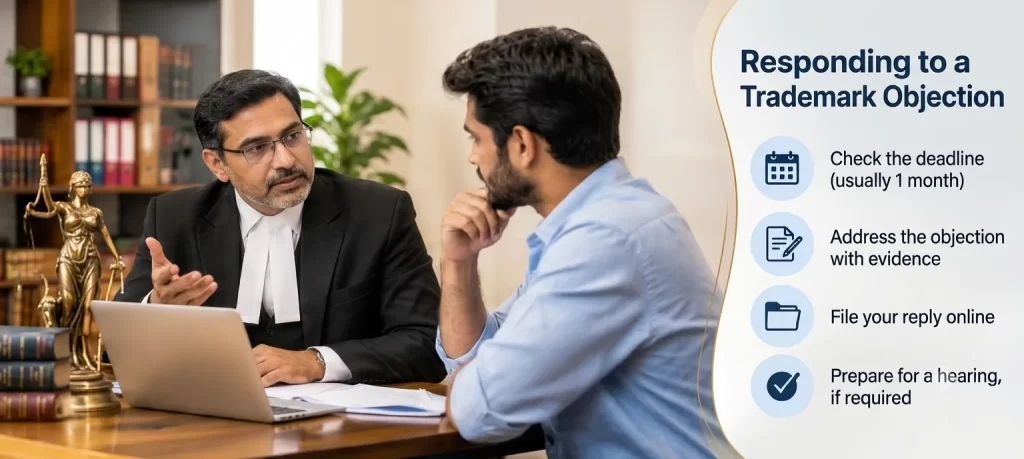
First, you must respond to the notice within 30 days from when you received it (Rule 33(4)), or the Registrar might treat the application as abandoned. After receiving the notice, read it carefully, check the reason for objection, and consult with a corporate lawyer for guidance.
Then your reply must be authoritative and answer each concern of the registry:
- It should give a direct answer to each ground raised by the examiner
- Your arguments on distinctiveness (Section 9) or on how your mark differs from the cited mark (Section 11)
- Evidence of use, if you say the mark has become distinctive
- Any amendment you offer, such as a narrower specification or a disclaimer
Expert advice from Adv. Raj L Mehta: Do not copy a sample reply from the internet. An examiner reads the same arguments again and again, and a reply that does not deal with your specific mark and the cited mark rarely succeeds.
What mistakes delay a trademark application in Mumbai?
| Common mistake | Why it matters |
|---|---|
| Filing without a prior search | A similar mark may already exist, leading to a Section 11 objection |
| Choosing the wrong class | Your actual goods or services may be unprotected |
| Missing the one-month reply deadline | The application can be treated as abandoned |
| Ignoring emails and portal notices | Hearing notices can be missed |
| Using unofficial websites and fixers | You can pay for services you could do for free, or share your details with look-alike sites |
| Copying a sample objection reply | It may not answer your specific objection |
When should you speak to a trademark lawyer in Mumbai?
Though registering a trade mark is not that complicating but objection or opposition later, or any other procedural mistakes, can delay it. So you should speak to a lawyer when:
- You are picking a brand name or logo
- You received an examination report and are not sure how to respond
- A hearing notice has been issued against your application
- Someone has opposed your mark
- Your application has been refused or treated as abandoned
Whether you are registering a new brand or responding to a trademark objection, Kamal & Co. Advocates can assist with trademark searches, filing, objection replies, hearings and appeals.