


How to File a Transfer Petition in Divorce Cases in Bangalore (2026 Guide)?
When the court notification arrived, Rahul imagined he could handle a few hearings in Chennai. However, following the second trip from Bangalore, reality began to hit home. He kept missing work, blowing money on last-minute trips, and coming home very tired. That’s when he began to carefully research about the transfer petition in divorce cases.
What had been easy slowly started becoming more stressful. His elderly mother depended on him every day, and the frequent journey started to wear on his routine and budget. Many people quietly go through this following separation. One spouse relocates, yet the divorce action continues in another location.
So, in this blog, we will understand the process of transfer petitions in Bangalore, which courts do transfer petitions, what the documentation, dates, and costs are, and what judges generally look at before accepting a transfer. Speaking with experienced divorce lawyers in Bangalore early can help you understand whether a transfer petition is realistic for your case.
What Is a Transfer Petition in a Divorce Case?
Many people get confused about this thing. A transfer petition is only about changing the court location.
For example, imagine a husband files a divorce case in Delhi, but the wife is living in Bangalore with a small child. Travelling repeatedly to Delhi may become difficult financially and emotionally. In such situations, the wife can request the court to transfer the case to Bangalore.
This type of transfer petition in the family court is very common in India today.
- The transfers within the same state are handled by the High Court.
- The interstate transfers are handled by the Supreme Court.
The legal powers mainly come from Sections 24 and 25 of the Code of Civil Procedure.
High Courts can transfer matters within the state under Section 24 CPC. Under Section 25 CPC, the Supreme Court handles transfers between the different states.
Expert Insight: In 2026, Bangalore courts are carefully adhering to the National Judicial Data Grid (NJDG) standards to give priority to “Woman-led filings” and cases involving senior citizen dependents. If your transfer includes these characteristics, your case is statistically likely to be heard 20% faster.
Who Can File a Transfer Petition in Divorce Matters?

A lot of people still think only wives can file a divorce case transfer procedure. That is not actually true. Both spouses can request a transfer if there is a difficulty involved. What matters more is the reason behind the request and whether it can be properly supported.
Can the Wife File a Transfer Petition?
Yes. In many family court matters, judges do consider the wife’s situation more carefully. This usually happens when:
- She is financially dependent on her parents or family.
- She is raising a child alone.
- Travelling repeatedly is becoming stressful or expensive.
- There are safety concerns or harassment allegations involved.
In many cases, courts also look at how practical it is for the wife to travel long distances for every hearing.
Can the Husband File a Transfer Petition?
Yes, husbands can also seek a transfer. For example:
- Work commitments may make repeated travel difficult.
- Health problems may be involved.
- Multiple cases may already be pending in another city.
- The litigation itself may become financially draining.
When Do Courts Reject Transfer Petitions?
Courts can cancel a transfer if:
- The reasons are sounding exaggerated.
- Documents or proofs are missing.
- The petition looks like a delay tactic.
- The divorce case is already close to completion.
- Video hearings can solve the issue instead.
Common Reasons Courts Allow a Transfer Petition in Divorce Cases
Every case is different, but some grounds for a transfer petition appear repeatedly in transfer of divorce proceedings matters.
Financial Hardship
Frequent travel is generally expensive. For many people, this is not a feasible option. A person may have to spend money on:
- Flights or train tickets
- Hotel stays
- Local transport
- Missed workdays
Child Custody and Parenting Responsibilities
This is one of the strongest grounds in family court matters.
Suppose a woman is living in Whitefield with a young child while the case is pending in Mysore. Travelling back and forth for every hearing may disturb the child’s schooling and daily routine. Courts often consider these kinds of situations seriously.
Health or Medical Issues
Medical conditions are also important. If someone is:
- Pregnant.
- Recovering from surgery.
- Undergoing a treatment.
- Going through mental health issues.
The court may consider a transfer in these cases, especially if it is supported by medical documents.
Threat, Harassment, or Domestic Violence Concerns
Sometimes a spouse may not be comfortable to go to another city for hearings. Where there are complaints of domestic abuse or harassment, a court may consider:
- Police complaints.
- Pending criminal cases.
- Protection orders.
- Previous incidents.
Safety concerns are taken seriously when supported by evidence.
Multiple Cases Pending in Different Courts
This situation is very common now. For example, if a person has ongoing cases of:
- Maintenance case in Bangalore.
- Child custody case in Bangalore.
- Divorce case in another state.
In such situations, courts often prefer the transfer of a petition in one place to reduce unnecessary difficulty for that person.
Which Court Handles the Transfer Petition in Divorce?
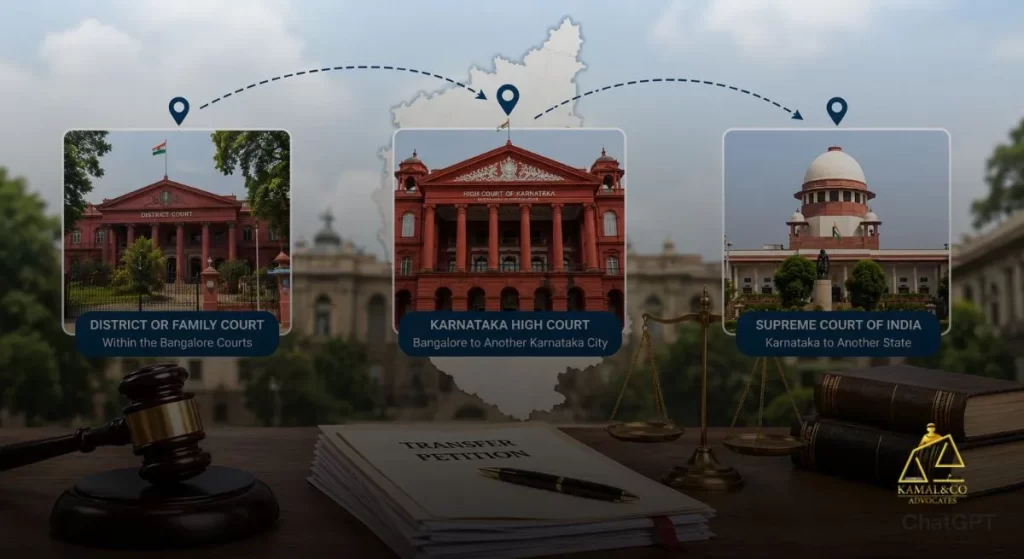
The correct court depends on where the original divorce case is pending.
| Transfer Type | Court | Official Link |
|---|---|---|
| Within the Bangalore courts | District or Family Court | e-Courts Bangalore |
| Bangalore to another Karnataka city | Karnataka High Court | Karnataka HC Official |
| Karnataka to another state | Supreme Court | Supreme Court Official |
If the matter involves an interstate transfer, it is generally filed under Section 25 of the Code of Civil Procedure.
Step-by-Step Process to File a Transfer Petition in a Divorce Case
Let’s know the divorce process in Bangalore to make it easy for you. Proper drafting is very important because courts check the reasons mentioned in the petition. For this, an experienced family lawyer in Bangalore can be useful.
Step 1: Speak to a family lawyer
The first move is usually simple: talk to a professional lawyer who handles family court cases. Understanding how to choose the best family lawyer in Bangalore can make this process easier. A good lawyer will look at your situation and tell you whether you need to file a transfer petition.
Step 2: Gather the papers
Then, collect basic documents. This includes the divorce case copy, court notices, address evidence, children’s records, medical papers, and copies of FIR if any.
Step 3: Write the petition
Then the lawyer writes the petition. The circumstances of the case, reasons for transfer and an affidavit in support should be clarified.
Step 4: File it in the proper court
When filed, the other spouse gets informed and may object.
Step 5: Await the court’s ruling
The judge hears each side and decides whether to transfer the matter. If permitted, the case continues in the new court.
How Long Does a Transfer Petition Take in Bangalore?
One of the first things people usually ask is, “How long is this going to take?” The honest answer is that it depends on the situation. In Bangalore, most transfer petitions are decided somewhere between 2 and 6 months. Some move faster, while others take time because of objections, court workload, or connected family cases already running in different courts.
If the matter is urgent, things can move surprisingly quickly. In some ex parte situations, where the other side does not appear, the petition may even get decided within 10 to 15 days or within a few weeks.
Inter-state transfer petitions, especially matters going before the Supreme Court, generally take around 2 to 3 months.
What Is the Cost of Filing a Transfer Petition in Divorce Cases?
A lot of people assume transfer petitions are extremely expensive because the matter goes to the High Court or sometimes even the Supreme Court. But the actual court fee is usually quite small.
| Expense Type | Estimated Cost (INR) |
|---|---|
| Court Fee (Stamp Paper) | ₹100 – ₹500 |
| High Court Filing/Drafting | ₹30,000 – ₹75,000 |
| Supreme Court (Inter-state) | ₹80,000 – ₹1.5 Lakh+ |
| Digital/Processing Fees | ₹2,000 – ₹5,000 |
Important Supreme Court Judgments on Transfer Petitions
Indian courts have delivered several landmark judgments on matrimonial transfer law.
- In Sumita Singh vs Kumar Sanjay, the Supreme Court remarked that the convenience of the woman, in general, should be given more weightage in marriage matters.
- In Rajani Kishor Pardeshi vs Kishor Babulal Pardeshi, the court once again recognised the practical challenges of women in litigation.
- In yet another landmark decision, N.C.V. Aishwarya vs A.S. Saravana Karthik Sha, the issue was about striking a balance between convenience, fairness, and access to justice in transfer situations.
Even now, these decisions are affecting the manner in which courts are dealing with transfer petitions under CPC processes.
Practical Tips Before Filing a Transfer Petition in Divorce
Before filing, keep all the documents properly organised. Courts prefer evidence over emotional allegations.
It is also important that you maintain a clear litigation timeline showing:
- Where the cases are pending.
- Hearing dates.
- Travel burden.
- Childcare responsibilities.
- Financial strain.
Try not to delay filing unnecessarily. Courts are more receptive when difficulty is raised early in the proceedings.
Also, most importantly, avoid copying generic petition formats from the internet. Family court litigation is highly fact-specific. A properly drafted petition with clear reasoning usually performs much better than a vague emotional application.
Pro Tip: In 2026, the speed of justice often depends on how you explain your hardship. Don’t just say ‘it’s far’, show a Google map screenshot of your 8-hour travel or a medical certificate from a licensed physician. Specificity wins cases.
Is Your Transfer Petition Strong Enough to Get Approved in 2026?
A lot of people file transfer petitions, assuming the court will automatically agree. But in reality, many petitions fail because the reasons sound vague or unsupported. Before filing, ask yourself these questions honestly.
Do you actually have proof of travel hardship?
Simply saying “I live in Bangalore” is usually not enough anymore. Travel screenshots, train timings, flight costs, or long-distance routes help more than emotional claims.
Are other family cases already running in Bangalore?
When it comes to maintenance, custody or domestic violence, courts like to keep it all in one city if there are already cases ongoing here.
Is virtual hearing really not practical?
If physical presence is necessary for evidence or cross-examination, mention that clearly.
Are you responsible for someone else daily?
Medical records, school IDs or proof of caring can really help your case.
Did you file early enough?
Waiting too long weakens the argument.
Final Thoughts on Transfer Petition in Divorce Cases
By the time most people think about filing a transfer petition, they are already exhausted. The travel, repeated hearings, missed work, managing children or family responsibilities, after a point, it all starts piling up. And honestly, that is usually when people realise the court location itself has become part of the problem.
Courts do understand genuine hardship, but they also expect proper reasons and supporting documents now. Simply saying the travel is difficult may not always work.
For people dealing with these situations in Bangalore, Kamal & Co. Advocates regularly works on divorce and family court matters involving transfer petitions and related disputes.




2 thoughts on “How to File a Transfer Petition in Divorce In Bangalore: Step-by-Step Legal Guide”
Pingback: Minimum Time for Contested Divorce in India :Timelines Explained
Pingback: Family Court Case Status in Bangalore: Check Online