

Maintenance Not Paid: 7 Legal Steps to Recover Your Money Quickly
Her phone kept ringing, but she already knew who it was. The landlord wanted the rent. The school had sent another reminder. The court had passed a maintenance order, but after one or two payments, the money stopped. Then came the usual line: “I will pay next week.” Next week turned into next month, and nothing changed.
This is the reality many people face when maintenance is not paid after a court order. The order is there, but the support is missing. And when that happens, the stress is not just legal. It is daily life, with bills, groceries, fees, and medicines waiting for money that never arrives.
The good news is that the law does give remedies. In this blog, we will discuss what happens if maintenance is not paid and what legal procedures you can take, and how to recover unpaid maintenance.
First, Understand Which Maintenance Law Applies to Your Case
Before filing anything, you need to know under which law your maintenance order was passed. This is important because the recovery process can change depending on the court and the type of order. Here are the most common situations:
| Type of Maintenance Order | Usually Filed Under | Recovery Filed Where |
|---|---|---|
| Monthly wife/child maintenance | Section 144 BNSS (earlier Section 125 CrPC) | Same Magistrate Court |
| Domestic violence maintenance | Domestic Violence Act | Same DV Court |
| Divorce-related maintenance | Family Court / Hindu Marriage Act | Family Court |
| Interim maintenance | Temporary order during the case | Same court that passed the order |
The biggest mistake people make is filing recovery proceedings in the wrong forum. That alone can waste months.
Under the new BNSS system, Section 144 now replaces the old Section 125 CrPC structure for maintenance proceedings. Courts are also expected to handle interim maintenance matters faster than before.
What Happens If No Maintenance Is Paid In India?
When a court passes a maintenance order, most people expect the payments to come regularly after that. But in reality, things do not always happen that way. After a few months, the money might stop coming in. Sometimes, excuses keep changing every week. And sometimes the other person simply starts avoiding calls and court hearings altogether.
A maintenance order cannot be ignored like a personal argument. If the payments stop for no reason, the court can take action against that person. The court can:
- Deduct the money from the salary.
- Freeze bank accounts.
- Attach property.
- Issue recovery warrants.
- Take stricter action in repeated default cases.
At the same time, courts also try to understand if you have a problem. It’s different than losing a job unexpectedly, hiding your salary, or willfully refusing to pay money that is owed.
In many unpaid maintenance cases, the pending amount keeps increasing because legal action was delayed for too long.
If your spouse denies paying maintenance, you can file a suit against them; speak with a family lawyer for help regarding this matter; they will know what your next legal step should be.
Key Legal Fact: Section 144(3) of the BNSS allows the court to step in where maintenance payments are being ignored. The Magistrate may issue a recovery warrant to recover the sum payable. If the money is not paid after that the defaulter may be imprisoned for a period of up to one month, or until the payment is made, whichever is earlier.
Why Do People Stop Paying Maintenance?
Sometimes people genuinely face financial problems. But payments often stop because the person believes the other side will give up. Some of the usual cases are:
- Quitting jobs to avoid salary deductions.
- Hiding business income.
- Shifting money into relatives’ accounts.
- Relocating without proper updates.
- Delaying payments during appeals.
- Using maintenance as emotional pressure after separation.
In many disputes involving a spouse not paying maintenance, verbal promises continue for months without any actual payment being made. That is why keeping written records is very important.
7 Legal Steps to Recover Money When Maintenance Is Not Paid
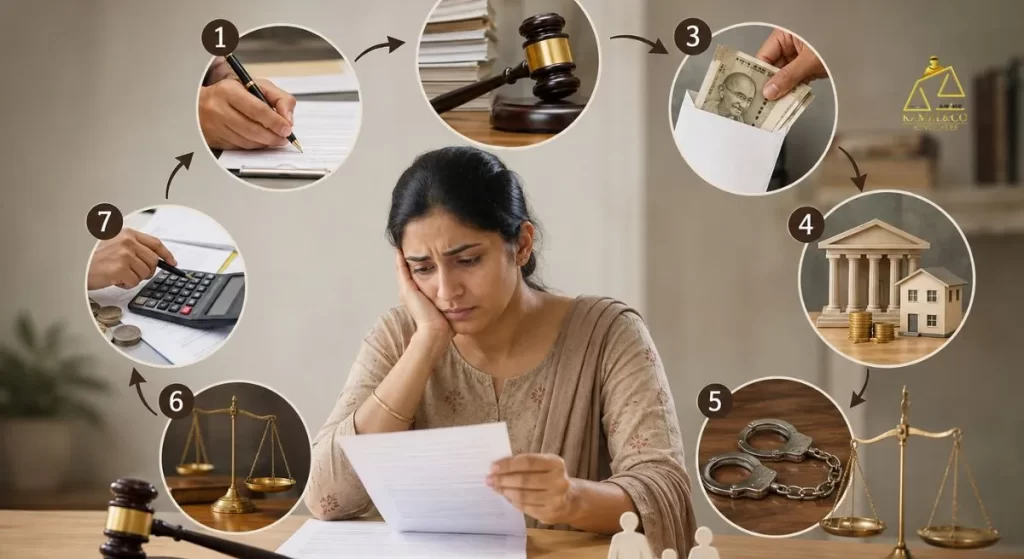
1. Send a Legal Notice Immediately
One of the first practical steps is sending a legal notice. Many people skip this because they think it is unnecessary. But a legal notice creates an official written record showing that maintenance payments have stopped, and recovery action may follow.
It also shows the court later that reasonable efforts were made before stronger proceedings started. Sometimes this step itself works.
Once a formal notice reaches the defaulter, the seriousness of the situation becomes clear. Some people restart payments because they realise enforcement proceedings may begin next.
And honestly, verbal conversations rarely help in these situations after a point. A written notice carries far more value than repeated phone calls and promises.
Timeline: 7-15 days
2. Register an Execution Petition in the Family Court
If the payments still do not, then the next step is generally the filing of an execution petition or recovery application. The purpose is simple: asking the court to enforce its earlier maintenance order.
The court normally asks for:
- A copy of the maintenance order.
- Bank statements.
- Payment history.
- Details of pending arrears.
This process forms a major part of the maintenance recovery legal process in India today. Once arrears are properly documented, courts can move toward enforcement proceedings.
Timeline: 2-6 months
3. Request Salary Attachment of the Defaulter
If the person is salaried, salary attachment can become one of the fastest recovery methods available. The court may direct the employer to deduct maintenance directly from the monthly salary.
This usually works better than waiting for voluntary payments every month. For many people dealing with the enforcement of a maintenance order, salary attachment brings consistency.
Timeline: 1-3 months
4. Demand Attachment of Bank Account or Property
Sometimes a person is self-employed, or has a business, or hides the sources of money. In such situations, courts might want an attachment of bank accounts or property.
This can include:
- Movable assets,
- Immovable property,
- bank balances,
- fixed deposits,
- Other financial assets.
In some of the cases of recovery of maintenance amount in India, courts have moved toward property-related recovery when repeated default continued despite warnings.
Usually, stronger recovery methods are used when the court feels the non-payment is deliberate rather than accidental.
Timeline: 2-4 months
5. File a Petition for Arrest on the Grounds of Willful Non-Payment
The court can do any of the following if someone keeps ignoring court orders even when they can pay:
- Bailable warrants
- Non-bailable warrants in extreme cases.
- Civil detention orders.
But courts generally do not take this step immediately. They usually see whether the person is truly not able to pay or is simply refusing to comply.
That difference matters a lot. This is why proper evidence becomes extremely important during legal action for unpaid maintenance.
Another important point people often misunderstand is this: jail does not cancel maintenance arrears. The unpaid amount usually continues even after detention.
6. Proceedings to File Contempt for Defaulter
In some cases, contempt proceedings may also be initiated. This is generally the case when court orders are ignored over and over again, when many chances are granted to the person.
Contempt procedures are higher-level than normal recovery applications, but courts do take willful disobedience seriously. Depending on the facts, consequences may be:
- Penalties.
- More strict laws.
- More legal consequences.
This step is sometimes considered in cases involving a maintenance order not followed continuously over a long period.
Timeline: 3-6 months
7. Apply for Interest and Recovery of Maintenance Arrears
Maintenance disputes often continue for years. During that time, expenses do not stay the same. School fees increase. Rent changes. Medical costs rise. Daily life becomes more expensive.
That is why courts may sometimes consider claims involving interest on unpaid maintenance arrears, depending on the facts of the case.
Applications may also be filed for lump sum recovery of pending dues. And honestly, waiting endlessly usually makes recovery harder. The longer the delay, the more complicated financial tracing and enforcement can become.
Expert Insight: Do not in believe in fake promises. Under Section 144(3) of the BNSS, you must file for an arrears recovery warrant within one year from the due date. If you do not file within this 12-month legal limit, you will lose your fast-track recovery privileges for good.
What Documents Are Needed When Maintenance Is Not Paid?
Good paperwork makes a huge difference in maintenance recovery matters. Important documents usually are:
- Maintenance order copy.
- Identity proof.
- The bank’s statements.
- Payment history.
- Calculations of arrears.
- Proof of communication.
- Employment details if available.
How Long Does Maintenance Recovery in India Take?
Some matters get resolved quickly. Others take months depending on:
- court workload,
- financial investigation,
- cooperation,
- and enforcement complexity.
| Legal Remedy | Approximate Timeline |
|---|---|
| Legal notice | 7–15 days |
| Execution petition | 2–6 months |
| Salary attachment | 1–3 months |
| Arrest proceedings | Depends on court action |
When Should You Contact a Lawyer if Maintenance Is Not Paid?
You do not always need a family lawyer for every conversation, but legal representation becomes important when:
- Payments have stopped for more than 2–3 months
- The defaulter has moved locations or changed employment
- You suspect income or assets are being concealed
- The defaulter has filed an appeal or modification application
- You want to file for contempt or arrest proceedings
- You are calculating total arrears across multiple years
Where Should You File a Maintenance Recovery Case in India?
| Your Situation | Where to File | Key Law to Cite |
|---|---|---|
| CrPC order, payments stopped | Same Magistrate Court | Section 144 BNSS (formerly Sec. 125 CrPC) |
| DV Act order, payments stopped | Same DV Court | Protection of Women from Domestic Violence Act, 2005 |
| Family Court divorce order | Family Court | HMA Sections 24/25 or HAMA |
| Muslim woman, divorced | Magistrate Court or Family Court | Section 144 BNSS |
| Defaulter has a salaried job | Magistrate / Family Court | Salary attachment order under BNSS |
| Defaulter hiding income | Magistrate / Family Court | Mandatory affidavit |
Important Judgments Which Can Help In Maintenance Recovery Cases
Some court judgments are important because they are still used even today in situations of maintenance recovery.
- In Deepa Joshi v. Gaurav Joshi (2026 INSC 370), the Supreme Court said that expenses like EMIs, home loans, and vehicle loans cannot be a ground to unreasonably cut the maintenance. The court considered the husband’s actual earning potential and not the decreased wage after deductions.
- Then came Rajnesh v Neha (2020), where the Supreme Court mandated financial disclosure affidavits in maintenance proceedings and also clarified that maintenance might be granted from the date of the first filing of the case.
- In Mohd. Abdul Samad v. State of Telangana (2024 INSC 506), the Court stated the fact that divorced Muslim women are also entitled to claim support under Section 144 BNSS.
- The Shah Bano case remains one of the most cited examples of Maintenance Case Law in India relating to maintenance rights and financial support.”
Maintenance Not Paid? Taking Action Early Can Help
When maintenance is not paid for months, the pressure slowly starts showing up everywhere else. School fees get delayed, savings start disappearing, and even small monthly expenses begin feeling stressful. A lot of people wait quietly, hoping the payments will restart on their own, but that usually makes the situation harder later.
Every case is different, but understanding your legal options can make the situation less confusing. For those looking for help in family and maintenance-related cases, Kamal and Co. Advocates works on these issues regularly and shares practical legal support for such cases.
Disclaimer: This blog provides basic information only and should not be used as legal advice. Laws and court interpretations might evolve over time. Always best to speak to a trained advocate on your individual circumstances.


1 thought on “Maintenance Not Paid: 7 Legal Steps to Recover Your Money Quickly”
Pingback: Maintenance Case Law in India: Section 125 BNSS