

Understanding Marital Rape In India and Women’s Legal Rights in 2026
Most people in India still avoid talking about forced sexual relations within marriage. Even now, many families treat it as a “private issue” between husband and wife. Some do not even believe that marital rape in India exists.
But the silence around it is slowly breaking. Over the last few years, more women have started speaking openly about what happens inside abusive marriages. Not every abusive marriage looks violent from the outside.
A woman being forced into intimacy after repeatedly saying no is still abuse.
The legal side of this issue is where things become complicated. As of 2026, marital rape laws are still not fully recognized as a criminal offence when the wife is an adult. That surprises a lot of people because many assume forced sex automatically falls under rape laws in every situation.
At the same time, women are not completely without legal protection either. So, in this blog, we will learn about the legal status of marital rape in India and look at what are the legal remedies and protections that are available for women today.
What is A Marital Rape?
In simple words, marital rape means forcing a spouse into sexual activity without their consent. And this happens through pressure, threats, emotional manipulation, or physical force.
About 29% of married women in India have experienced physical, sexual, or emotional violence from their husbands, according to the National Family Health Survey (NFHS-5).
Sometimes women give in because refusing repeatedly creates fear, emotional stress, or constant arguments at home. Many women hear things like:
- “A wife should satisfy her husband.”
- “These things happen in marriage.”
- “Don’t make it a big issue.”
And this is one such reason why sexual violence in marriage often remains hidden for years. If you are facing this in your marriage, speaking with an experienced family & matrimonial lawyer early can help you understand your legal options and fight for your rights.
Marital Rape in India and Domestic Violence Are Often Connected
People sometimes imagine domestic violence only as a physical assault. But the reality is very different than that.
A woman facing sexual abuse in marriage may also be dealing with:
- Emotional control
- Humiliation
- Threats
- Financial dependency
- or isolation from family and friends.
That is why marital rape is often talked with domestic violence cases. Moreover, many women don’t even realise that they are abused at first. They just feel like something is wrong with their marriage.
Why Consent Still Matters After Marriage?
The discussion around consent after marriage has become stronger globally over the last two decades. And India is also becoming a part of that conversation now.
Consent is not something that is permanently granted during a wedding ceremony, and marriage does not erase personal boundaries. This may sound basic, but it is heavily debated all over the world.
What is The Legal Status of Marital Rape in India Right Now?

Under the older criminal law, rape was mainly seen under Section 375 of the IPC. But the law also included the Exception 2 to Section 375 IPC, which created what people now call the marital rape exception.
The exception basically protected husbands from rape charges if the wife was above 15 years old. That protection has remained one of the most controversial parts of Indian criminal law for years.
Is Marital Rape a Crime in India?
Right now, marital rape involving an adult wife is generally not treated as rape under standard criminal rape provisions.
A husband usually cannot be prosecuted for rape against his adult wife under regular rape law. This is exactly why activists, lawyers, and women’s rights groups continue to challenge the exception in courts.
At the same time, this does not mean women have no legal remedies at all. Courts can still see abusive conduct as:
- Domestic violence law.
- Cruelty-related provisions.
- Divorce proceedings.
- Mental and emotional abuse claims.
Expert Insight: Unlike the old law, Section 67 of the BNS now explicitly punishes a husband for non-consensual sex if the couple is living separately under a court decree or “otherwise.” The punishment is rigorous imprisonment for 2 to 7 years. This is a critical legal bridge for women in the process of separation.
What Changed Under BNS?
When the Bharatiya Nyaya Sanhita (BNS) replaced the IPC, many people expected major reform on this issue. But that did not really happen.
In much the same way, the marital rape exception continued, to the frustration of many legal professionals and activists.
Important Note: One important exception already exists, though. In the Independent Thought vs. Union of India case, the Supreme Court ruled that sex with a wife below 18 years of age would amount to rape.
This judgment became important because it recognised that child marriage cannot cancel the consent and bodily rights.
How Do Marital Rape Laws Worldwide Compare With India?
Many countries now treat marital rape as a criminal offence, including:
- the UK,
- Canada,
- Australia
- and the United States.
By 1991, the law in the UK had changed and the courts made it clear that marriage is not a permanent consent to sex.
Marital rape laws across the world indicate that India still does not fully penalise marital rape of adult wives under the rape law.
There is a growing universal agreement that consent should still matter, even in marriage. That is one major reason why the Indian marital rape comparison debate keeps growing stronger today.
Why the Constitutional Debate Has Become Bigger?
The discussion over marital rape in India has transcended the legal argument. It now asks a fundamental question: Does marriage rob a woman of her right to say no?
Many attorneys and constitutional experts believe the marital rape exception is incompatible with:
- Article 14: deals with equality before the law.
- Article 21: Protection of dignity, privacy, and personal freedom.
They are making a simple point. Why, if rape outside marriage is viewed as forced sex, should it be treated differently after marriage?
Much of the topic also depends on consent under Indian criminal law. The idea is that consent must be mutual and voluntary. It should not be taken for granted forever just because two individuals are married.
Others fear the law may be misused or believe that criminal law should not become involved in private marital affairs. As a result of the different points of view, this subject remains challenging for courts and legal practitioners.
What Legal Rights Do Women Have in Marital Rape Cases in India?
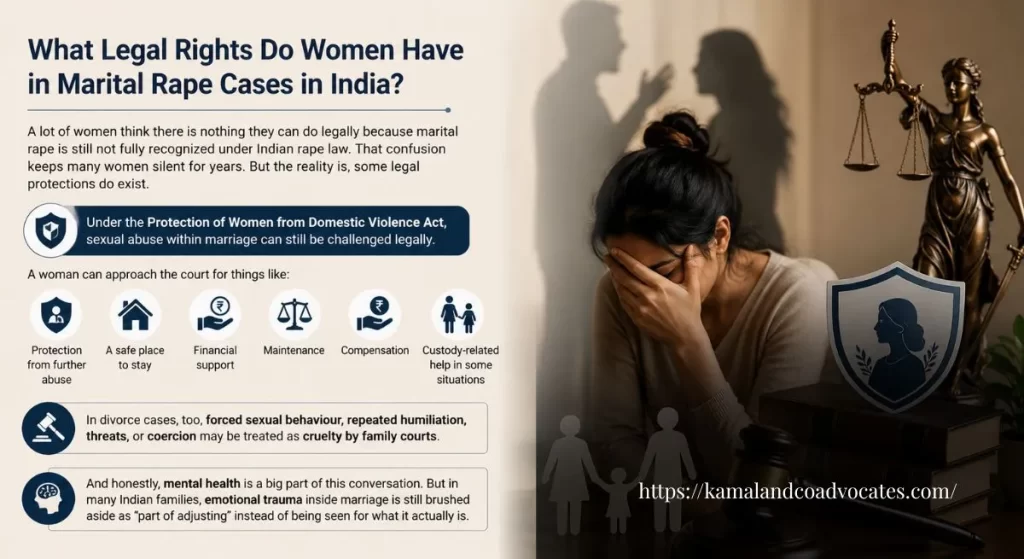
A lot of women think there is nothing they can do legally because marital rape is still not fully recognised under Indian rape law. That confusion keeps many women silent for years. But the reality is, some legal protections do exist.
Under the Protection of Women from Domestic Violence Act, sexual abuse within marriage can still be challenged legally. A woman can approach the court for things like:
- Protection from further abuse,
- A safe place to stay,
- Financial support,
- Maintenance claims,
- Compensation,
- and even custody-related help in some situations.
In divorce cases, too, forced sexual behaviour, repeated humiliation, threats, or coercion may be treated as cruelty by family courts.
Many women also seek guidance from a family lawyer in Hyderabad to understand how domestic violence laws, divorce proceedings, child custody, and maintenance claims work together legally.
And honestly, mental health is a big part of this conversation. But in many Indian families, emotional trauma inside marriage is still brushed aside as “part of adjusting” instead of being seen for what it actually is.
What Still Needs to Change in Marital Rape Laws in India?
The criminalisation of marital rape is clearly getting louder now, even though the legislation is evolving extremely slowly.
More women are talking freely about consent in marriage, coercion and violence inside marriage. And particularly younger generations are challenging the old concept of marriage giving a husband unfettered sexual privileges.
But honestly, changing the law alone will not fix everything. A woman also needs:
- people who believe her,
- access to counselling,
- proper legal guidance,
- safe support systems,
- and families that stop treating abuse as a “private matter.”
What Legal Myths About Marital Rape In India Stop Women From Seeking Help?
One thing is seen often: many women stay stuck in abusive marriages because of fear and misinformation, not lack of strength.
No injuries means no abuse
Not true. Sexual and emotional abuse can still qualify as domestic violence even without visible marks.
Marriage means permanent consent
Consent can be withdrawn anytime. Marriage does not give automatic permission forever.
Seeking help means immediate divorce
A woman can ask for protection orders and legal safety without ending the marriage.
Only medical evidence matters
Courts may also consider chats, messages, therapy records, and witness statements.
Police will ignore it
Women can approach Protection Officers and women’s support authorities directly for aid on domestic violence issues.
Understanding Marital Rape In India and Knowing Your Rights
Marital rape is a difficult and unpleasant subject to discuss in India, but it can no longer be avoided. Marriage is neither an excuse for rape nor for taking away a woman’s choice to say no. The legislation is still evolving, but the necessity for consent, dignity, and protection is plainly apparent. Women who are enduring abuse should be aware that there are legal remedies available even now.
If you want to know your rights better, then you can take assistance from a family law firm such as Kamal & Co. Advocates, which can try to bring some clarity without making matters worse.


1 thought on “Marital Rape In India: Know Your Rights and Legal Remedies in 2026”
Pingback: Understanding Legal Grounds for Divorce in India - Kamal and Co. Advocates