


Can You Break an Employment Bond in India? Legal Rules, Penalties & Employee Rights (2026)
Your offer letter finally arrives after weeks of interviews, stress, and checking your email every ten minutes. You open the PDF, look at the salary, smile for two seconds, and then suddenly notice one line hidden in the middle of the document.
“You must serve the company for 2 years.” Below that, another line: “If the employee leaves early, compensation of ₹3 lakhs must be paid.”
Now the excitement is gone. You call a friend. He says employment bonds in India are illegal. Another person says companies can ruin your career if you leave. HR tells you not to worry because “everyone signs it.” But deep down, you still feel confused.
And honestly, this happens to a lot of people in India now, especially freshers joining IT companies, hospitals, startups, aviation firms, and manufacturing companies. India’s overall corporate attrition rate in 2024 was 17.4%, with the IT industry at 15.1%, down from a peak of 19.3% in 2023, according to the Deloitte India Talent Outlook Survey 2025. One of the major reasons for firms to use employment bonds is the continual turnover of staff.
The problem is simple. Most employees sign these agreements without properly understanding what is legal, what is not, and how much power companies actually have. Always consult to an expert employment & civil lawyer, get the notice reviewed and properly drafted in a correct way.
In this blog, we will learn what an employment bond is, the legal validity of an employment bond, the employer’s rights in an employment bond, and what actually happens if someone breaks a bond.
What Is an Employment Bond in India?
An employment bond is basically a contract between an employer and an employee. If the employee leaves before the agreed period ends, compensation may be demanded by the employer.
Most companies do not introduce bonds randomly. They usually use them when money has been spent on:
- Technical training.
- Onboarding programs.
- Foreign assignments.
- Certifications.
- Project-specific learning.
For example, many IT companies train freshers for months before placing them into live client projects. Hospitals sometimes use service bonds in India after sponsoring medical training. Aviation companies also use bonds because pilot and crew training costs are extremely high.
But problems usually start when:
- The bond amount becomes unrealistic.
- Employees receive no real training.
- Contracts become one-sided.
- Companies use fear instead of fairness.
Are Employment Bonds Legal in India?
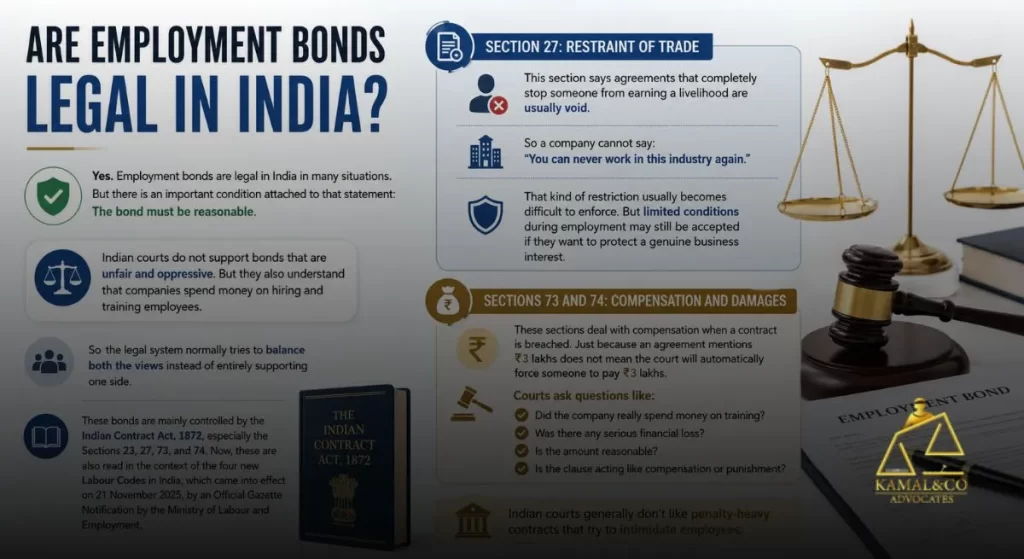
Yes. Employment bonds are legal in India in many situations. But there is an important condition attached to that statement. The bond must be reasonable.
Indian courts do not support bonds that are unfair and oppressive. But they also understand that the companies spend money on hiring and training employees.
So the legal system normally tries to balance both the views instead of entirely supporting one side. These bonds are mainly controlled by the Indian Contract Act, 1872, especially Sections 23, 27, 73, and 74. Now, these are also read in the context of the four new Labour Codes in India, which came into effect on 21 November 2025, by an Official Gazette Notification by the Ministry of Labour and Employment.
Section 27: Restraint of Trade
This section says agreements that completely stop someone from earning a livelihood are usually void. So a company cannot say: “You can never work in this industry again.”
That kind of restriction usually becomes difficult to enforce. But limited conditions during employment may still be accepted if they want to protect a genuine business interest.
Sections 73 and 74: Compensation and Damages
These sections address compensation for breach of contract. Just because an agreement mentions ₹3 lakhs does not mean the court will automatically force someone to pay ₹3 lakhs. Courts ask questions like:
- Did the company really spend money on training?”
- Was there any serious financial loss?
- Is the amount reasonable?
- Is the clause acting like compensation or punishment?
Indian courts generally don’t like penalty-heavy contracts that try to intimidate employees.
The New Labour Codes (2025): What Changes for Employees?
On November 21, 2025, India implemented four new labour codes replacing 29 existing labour laws. To better understand these reforms and their workplace impact, read our detailed guide on Latest Labour Law Changes in India (2025). They have changed the major rules of the game, hiring, pay, and rights of employees.
Employees should be up-to-date on the following key changes:
- Now, all workers need appointment letters, and the bond terms and conditions need to be mentioned in full at the beginning.
- Usually, full and final compensation should be done within two working days of the employee leaving.
- Employees are now protected by the law.
- Minor non-compliances have been decriminalised, therefore most employment disputes are still civil rather than criminal matters.
For the official consolidated compliance handbook under the new Labour Codes, see the Ministry of Labour & Employment PDF (February 2026).
When Does an Employment Bond In India Become Legally Valid?
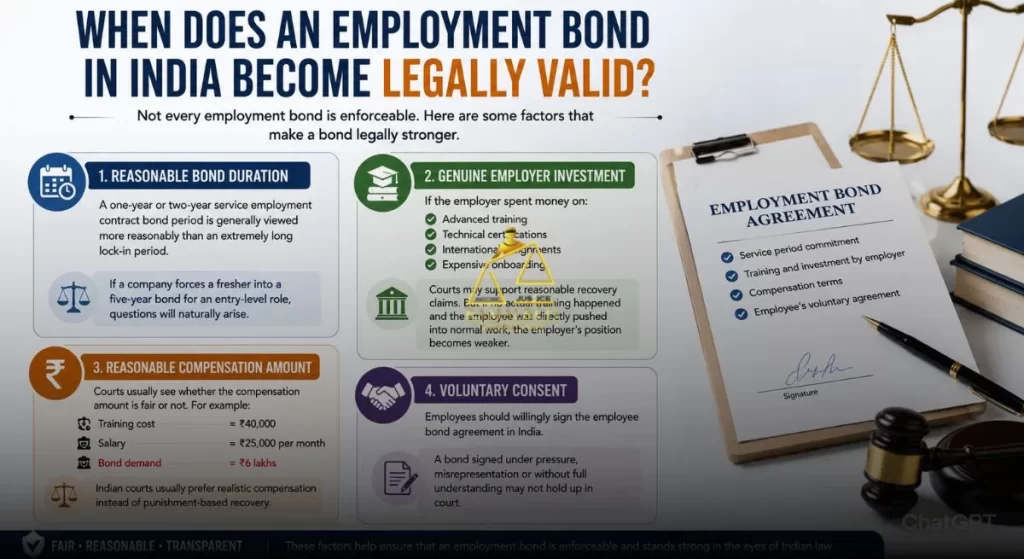
Not every employment bond is enforceable. Here are some factors that make a bond legally stronger.
Reasonable Bond Duration
A one-year or two-year service employment contract bond period is generally viewed more reasonably than an extremely long lock-in period. If a company forces a fresher into a five-year bond for an entry-level role, questions will naturally arise.
Genuine Employer Investment
If the employer spent money on:
- Advanced training.
- Technical certifications.
- International assignments.
- Expensive onboarding.
Courts may support reasonable recovery claims. But if no actual training happened and the employee was directly pushed into normal work, the employer’s position becomes weaker.
Reasonable Compensation Amount
Courts usually see whether the compensation amount is fair or not. For example, if:
- training cost = ₹40,000
- Salary = ₹25,000 per month
- Bond demand = ₹6 lakhs
Indian courts usually prefer realistic compensation instead of punishment-based recovery.
Voluntary Consent
Employees should willingly sign the employee bond agreement in India.
When Do Employment Bonds in India Become Unenforceable?
Courts may reject or reduce enforcement when:
- Penalties are excessive.
- The restrictions are unfair.
- Clauses are vague.
- No real training exists.
- Agreements become completely one-sided.
Imagine a fresher earning ₹18,000 per month being asked to pay ₹8 lakh for resigning after six months.
Most courts will carefully examine whether that amount genuinely reflects business loss or simply exists to scare employees. And honestly, many companies rely more on fear than actual litigation.
Important Court Judgments on Employment Bonds
There are several court decisions that still shape employment bond disputes in India today.
Niranjan Shankar Golikari vs Century Spinning
This remains one of the most discussed employment bond cases in India. The Supreme Court observed that reasonable restrictions during employment may be valid when they protect legitimate business interests.
Recent Court Trends (2023-2026)
Judges now see:
- Actual financial loss.
- Nature of training.
- Fairness of the contract.
- Employee freedom.
- Proportionality of damages.
Modern work culture has also changed things. Remote jobs, startup hiring, global teams, and hybrid work models have made employment agreements more complicated than they were earlier.
Essential Clauses in an Employment Bond In India
Most people only check the salary part of the offer letter and skip everything else. Here are some clauses employees should actually check and read carefully.
| Clause | Why It Matters | Possible Risk |
|---|---|---|
| Bond Duration | It defines the mandatory service period. | Excessive duration may be challenged. |
| Compensation Clause | It explains the financial liability. | Creates disputes if fines are too high. |
| Training Cost Clause | Mentions employer investment. | Weak if no proof exists. |
| Confidentiality Clause | It secures company information. | Usually enforceable. |
| Notice Period Clause | It explains the rules of resignation. | Overlapping penalties may arise. |
| Jurisdiction Clause | This decides the location of the court. | Litigation becomes difficult sometimes. |
Can Employees Resign Before Completing the Bond?
A company cannot force someone to continue to work if they don’t want to. This is one of the biggest myths around employment bonds in India. An employer may:
- Send a legal notice
- Claim compensation
- File a civil case
But forced employment is not allowed. If you are served a formal notice for breach of contract, then you need to consult civil lawyers in Bangalore and get the notice reviewed and a legal reply drafted in a correct way.
Can Companies Withhold Salary or Experience Letters?
Some employers delay:
- Relieving letters.
- Experience certificates.
- Pending salary.
- Full-and-final settlements.
Mainly to pressure employees after resignation.
In those cases, the employee still has legal options. It is a crime under many state Shops and Establishments Acts and federal labor laws in India to withhold an employee’s earned salary or key job documents because of a civil dispute.
If employees are treated in this manner, they can file a civil recovery claim or go to the local Labour Commissioner’s office.
Expert Insight: Withholding original educational certificates, especially 10th and 12th mark sheets, is something we have seen companies do to prevent employees from joining elsewhere. This is not just a civil wrong. Depending on the circumstances, it can constitute criminal intimidation. Employees in this situation should send a formal demand notice by registered post first, and if there is no response within seven days, consider filing a complaint with the police alongside a civil suit. Most companies return documents immediately once they understand the legal exposure.
Common Misconceptions About Employment Bonds In India
“Employment Bonds Are Completely Illegal”
That is not true. Reasonable employment bonds may be legally enforceable in India.
“Employees Who Break a Bond Can Go to Jail”
No. Employment bond disputes are civil matters, not criminal offences.
“Companies Can Recover Any Amount They Want”
Again, no. Courts usually examine whether the compensation amount reflects actual loss or not.
“Companies Can Stop Employees From Joining Competitors”
Post-employment restrictions are often difficult to enforce broadly in India.
Employment Bonds vs Non-Compete Agreements
People always mix these two terms; however, they are not the same.
Indian courts are generally stricter with non-compete clauses after employment ends.
| Feature | Employment Bond | Non-Compete Agreement |
|---|---|---|
| Main Purpose | Minimum service commitment | Restrict future employment |
| Usually Applies | During employment | After resignation |
| Legal Position | Can be enforceable if reasonable | Often challenged in India |
| Focus | Compensation | Restriction |
What Employees Should Check Before Signing an Employment Bond in India?
Before signing anything, slow down for a few minutes and read properly. Especially if you are a fresher. Pay close attention to:
- Bond duration
- Exit penalties
- Salary versus bond amount
- notice period
- Training details
- Vague legal wording
- Jurisdiction clause
If the bond amount feels completely disconnected from your salary, role, or training, ask questions before signing. Do not think like, “Everybody signs these contracts, so it must be normal.” No, that thinking creates problems later on. Also, keep copies of:
- Appointment letters.
- HR emails.
- Bond agreements.
- Policy documents.
What Questions Should You Ask HR Before Signing an Employment Bond?
A lot of employees stay quiet during the hiring process because they do not want HR to think they are “difficult.” So they sign the bond without asking anything and only start reading the clauses properly after problems happen.
Here are a few things you should ask before signing:
- On the bond amount: “Could you help me understand how this compensation amount was arrived at? Is it tied to a specific training cost estimate?”
- Regarding training: “Is there a formal training program linked with this bond? Could I have a copy of the training schedule?”
- On exit situations: “If I need to leave early for unavoidable personal reasons, is there a process to discuss the bond terms at that stage?”
- On jurisdiction: “I noticed the jurisdiction clause mentions [City X]. Is there flexibility on that, given I’m based in [Your City]?”
Asking these questions politely, especially over email, also creates a record. If an employer responds with threats, pressure, or avoids answering completely, that itself can become important context later if a dispute arises.
Employment Bonds in India: A Few Final Things Employees Should Remember
Employment Bonds in India are not automatically illegal, but they are not untouchable either. A company cannot simply add a huge penalty and expect courts to support it every time. What usually matters is fairness, actual training costs, and whether the agreement feels reasonable from both sides. That is why employees should read every clause carefully before signing, instead of treating it like “just another HR document.”
And if disputes around employment bonds, contracts, or workplace issues arise, experienced lawyers like Kamal and Co. Advocates help businesses and employees handle these matters legally and properly.
Disclaimer: This blog is for general informational purposes only and does not constitute any legal advice. A lawyer who has had the proper training can provide you advice that is specific to your situation.




1 thought on “Employment Bonds in India: Legal Validity, Rules, and Key Clauses Explained (2026 Guide)”
Pingback: Salary Not Paid by Employer? Legal Remedies in India 2026