
Rights of Arrested Person in India Under BNSS & CrPC: Complete Legal Guide (2026)
Being arrested can be one of the most stressful and intimidating experiences a person may face. In such situations, many individuals are unaware that the law provides important safeguards to protect their dignity, liberty, and legal interests. The Rights of an arrested person in India are guaranteed under the Constitution of India and reinforced through statutory protections under the Bharatiya Nagarik Suraksha Sanhita (BNSS), 2023, which replaced the Code of Criminal Procedure (CrPC) from July 1, 2024.
These rights ensure that no individual is subjected to arbitrary arrest, unlawful detention, custodial abuse, or unfair treatment by investigating authorities. Whether a person is arrested with or without a warrant, the law requires that they be informed of the grounds of arrest, allowed access to legal representation, informed of their bail rights, and produced before a magistrate within the prescribed time. These safeguards are not merely procedural formalities but essential protections flowing from the fundamental rights to life, liberty, equality, and due process under Articles 14, 20, 21, and 22 of the Constitution.
The Indian judiciary has further strengthened these protections through landmark judgments such as Maneka Gandhi v. Union of India, Nandini Satpathy v. State of Orissa, D.K. Basu v. State of West Bengal, Joginder Kumar v. State of U.P., and Arnesh Kumar v. State of Bihar. Together, these decisions have established important principles against arbitrary arrests and custodial violations while promoting fairness and accountability within the criminal justice system.
In this comprehensive guide, we explain the 9 fundamental rights of an arrested person in India, the constitutional and statutory safeguards available under BNSS and the erstwhile CrPC, important Supreme Court guidelines on arrest and detention, recent judicial developments, and the legal remedies available when arrest procedures are violated.
What Are The Rights of Arrested Person in India Under CrPC and BNSS?
Rights of an Arrested Person Under the CrPC
Arrested individuals must be informed as soon as may be of the grounds of arrest and are entitled to consult and be defended by a lawyer of their choice.
They must also be produced before a magistrate within 24 hours, excluding travel time, as per Article 22(1) & (2) of the Constitution and mirrored in CrPC provisions
Rights of an Arrested Person Under the BNSS
This act replaces the CrPC and retains similar protections regarding being informed of arrest grounds and prompt magistrate production
Key Differences Between BNSS and CrPC on Arrest Rights
A recent Supreme Court judgment clarified that providing an arrest memo alone does not suffice;the detained person must be informed of the grounds of arrest under Section 47 BNSS
How the Constitution Protects the Rights of Arrested Person in India?
The Indian legal system is based on the concept that a person is innocent unless proven guilty.
Also, Article 21 of the Constitution states that “no person shall be deprived of their life and personal liberty except according to the procedure established by law,” and such procedure must be fair, just, reasonable, and devoid of any arbitrariness as interpreted through various judgments. Hence, it is important to ensure that even individuals facing criminal allegations are treated with dignity and fairness and not deprived of their fundamental right to life and liberty as enshrined in the Constitution.
Therefore, when a person is arrested, the State and the Judiciary must ensure that the person so detained holds their rights. These rights of an arrested person are rooted in the principles of justice, dignity, and accountability within a legal system
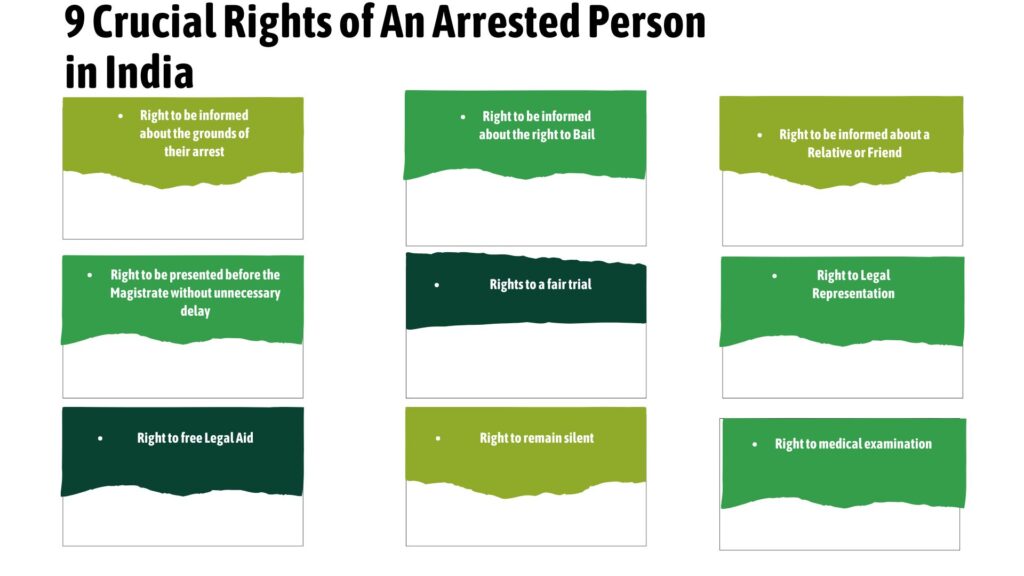
What Are The 9 Crucial Rights of An Arrested Person in India?

Some of the essential rights of an arrested person are as follows:
- Right to be informed about the grounds of their arrest
- Right to be informed about the right to Bail
- Right to be informed about a Relative or Friend
- Right to be presented before the Magistrate without unnecessary delay
- Rights to a fair trial
- Right to Legal Representation
- Right to free Legal Aid
- Right to remain silent
- Right to medical examination
1. Right to be informed about the grounds of their arrest
Every person arrested has the right to be informed about the grounds of such arrest. This is the most essential right concerning arrested persons as it allows them to know for what they have been accused of and under what grounds.
Section 50(1) of CrPC states that every police officer or other person arresting any person without a warrant shall inform him about the offence for which he is arrested and the grounds for such arrest with particulars.
Article 22(1) of the Constitution of India backs up this provision by stating that a person who is arrested shall not be detained in custody without being informed of the grounds for such arrest.
2. The right to be informed of the right to bail
Every person arrested has the right to be informed of their right to bail.
Section 50(2) of the CrPC states that when a police officer arrests a person without a warrant who has been accused of a bailable offence, he shall inform the person so arrested that he is entitled to be released on bail and that he can arrange for sureties for the same.
This is important since many people are unaware that they can obtain their release by providing a bail bond. This guarantees that a person is not detained unnecessarily if the offence is bailable.
3. Right to be informed about a Relative or Friend
The consequence of an arrest not only affects the person so arrested but also their relatives and friends.
The CrPC acknowledges this fact and requires the arresting police officer to give notice to a nominated individual about the person’s arrest. This way they will be able to know what has happened and can support them.
Section 50A of CrPC obligates the police officer to inform about the arrest of a person to his friends, relatives, or any other person of his family as nominated by the arrested person as soon as he is under custody.
4. Right to be presented before the Magistrate without delay:

Section 57 of the CrPC provides for the rights of an arrested person to be presented before a magistrate without any unnecessary delay.
It states that a police officer shall not detain in custody any person arrested without warrant for a period more than twenty-four hours, exclusive of the time necessary for the journey from the place of arrest to the Magistrate’s Court. This guarantees that your detention is checked by a judicial official promptly.
Article 22(2) of the Constitution states that every person who is arrested and detained in custody shall be produced before the nearest magistrate within a period of twenty-four hours of such arrest, excluding the time necessary for the journey from the place of arrest to the court of the magistrate.
5. Rights to a fair trial
The provision relating to the right to a fair trial is not explicitly there in the CrPC; however, such a right can be derived from the Constitution and various judgments.
In the case Maneka Gandhi v. Union of India, the court held that procedures established by law as given under Article 21 affecting personal liberty must be “fair, just, and reasonable.”
Hence, all arrested persons are entitled to a fair hearing. They are entitled to the presumption of innocence until found guilty, the right to question witnesses, and the right to produce evidence in their defence and other such rights entitled to a person in a trial following the principles of natural justice.
6. The Right to Legal Representation
Article 22(1) of the Constitution provides that an arrested person shall not be denied the right to consult, and to be defended by, a legal practitioner of his choice.
Similarly, Section 303 of the CrPC provides for the right of the person against whom proceedings are instituted to be defended.
It states that any person accused of an offence before a Criminal Court, or against whom proceedings are instituted under this Code shall have a right to be defended by a pleader of his choice.
The Constitution and the CrPC provide for your right to consult and be defended by a lawyer of your choice. This is not a privilege, but a fundamental right. A lawyer can counsel you on your legal options, defend you in court, and ensure that your rights are not trampled over.
If you cannot afford to hire a lawyer, you have the right to free legal aid. This ensures that a person who is arrested receives the assistance of a legal practitioner of their choice, ensuring a fair and just legal process.
7. Right to free Legal Aid

Justice cannot be denied because of economic limitations. Hence, the law ensures free legal aid for individuals who cannot afford representation.
Article 39A of the Constitution provides for equal justice and free legal aid. It states that the State shall provide free legal aid, by suitable legislation or schemes or in any other way, to ensure that opportunities for securing justice and equal opportunities are not denied to any citizen because of economic or other disabilities.
Also, Section 304 of CrPC provides for legal aid to the accused at the State’s expense in certain cases. It states that if in a trial before the Court of Session, the accused is not represented by a pleader, and it appears to the Court that the accused has not sufficient means to engage a pleader, the Court shall assign a pleader for his defence at the expense of the State.
The accused person’s rights cannot be refused even when they fail to apply for them. If the state fails to give legal aid to the needy accused person by providing them a lawyer, it will render the whole trial void. This right to free legal aid ensures that individuals who cannot afford legal representation are provided with assistance at the expense of the State by being represented in a court.
8. Right to remain silent
The right to remain silent takes its root from Article 20(3) of the Constitution, which states that no person accused of any offence shall be compelled to be a witness against himself.
It means the arrested person has a right to stay quiet and refuse to answer anything that could incriminate them. This right is important as it protects oneself from self-incrimination and ensures a fair trial.
9. Right to medical examination
An arrested person is also entitled to a medical checkup by a medical officer or a registered medical practitioner. The medical checkup shall aid in proving any abuse suffered by the accused. This right of an accused person to be medically examined is a crucial aspect of ensuring fair treatment, especially in cases where there are allegations of physical torture or ill-treatment.
Section 54 of the Cr. P.C. provides for the Examination of an arrested person by a medical officer, and in case of unavailability, a registered medical practitioner in the service of the Central or State Governments, soon after the arrest is made.
In case the arrested person is a female, the examination of the body shall be made only by a female medical officer or practitioner. The medical officer shall then prepare a record of such examination and furnish a copy of the report to the arrested person, mentioning any injuries or marks of violence upon the person arrested, and the approximate time when such injuries occurred.
What Are The Landmark Supreme Court Judgments On Rights Of Arrested Person In India?
Maneka Gandhi v. Union of India (1978)
Expanded Article 21 (right to life and personal liberty), insisting that any state’s procedure must be just, fair, and reasonable, and integrated Articles 14, 19 & 21 into a “golden triangle” of rights
Nandini Satpathy v. State of Orissa (1978)
While not detailed here, this case affirmed the right to silence and to legal advice, reinforcing protections against self-incrimination.
D.K. Basu v. State of West Bengal (1996)
Laid down 11 mandatory guidelines to prevent police abuse, such as informing relatives, preparing arrest memos, and conducting periodic medical checks
Recent High Court Rulings (2024–2025)
Kerala HC (Aug 2025):
Detention starts from actual loss of liberty, not merely the arrest record time, and individuals must be produced before a magistrate within 24 hours from that moment, not from recording time.
Nagpur (Bombay HC) (2025):
Reiterated that Article 21 protections apply even to suspects; arresting a woman without a woman constable, post-sunset, and without informing relatives, violated procedure, rendering the arrest illegal despite serious charges
Aurangabad Bench (July 2025)
Declared the custodial death of Somnath Suryawanshi a violation of fundamental rights, and ordered an FIR to be registered
Bombay HC (Nagpur Bench, Aug 2025)
Emphasised the right to speedy trial and bail even under MCOCA; prolonged detention without trial is a breach of Article 21
What Are The Important Changes in Arrest Procedures Under BNSS and CrPC?
- Modern Framing and Equal Rights: The rights of an arrested person are preserved by BNSS, but they are strengthened with clearer language and deadlines. These rights include the right to know the reason for the arrest, legal representation, bail information, medical examination, and production before a magistrate.
- Integration of Technology and Digital: In contrast to CrPC’s primarily physical procedures, BNSS allows processes like filing FIRs (including Zero FIRs), summonses, warrants, chargesheets, and court communications to be completed and recognized as legally valid. This speeds up processes and minimises paperwork.
- Safeguards for Arrest and Custody: The BNSS introduces more complicated custody provisions where days of police custody can be spread over longer periods within overall detention timelines (such as 60 or 90 days, depending on the severity of the offence), raising debates about liberty and oversight, whereas the CrPC allowed police custody for up to 15 days before judicial remand.
- Definitions and Language Focused on Citizens:In order to protect arrested people more clearly than under the previous CPC, BNSS adds contemporary definitions like “electronic communication” and expands procedural safeguards, such as requiring mandatory medical checks and prompt notification of friends and family.
What Are The Immediate Steps to Take After Arrest in India?
If you are arrested in India on criminal grounds, consult the nearest criminal lawyer in India immediately.
Avoid these common mistakes while choosing Criminal Lawyers
- In a hurry & fear, don’t select a general lawyer who has no specialisation in dealing with criminal cases. Time is crucial at this time.
- Choose the renowned lawyers who deal with criminal cases & have demonstrated experience in handling complicated cases.
- Don’t get confused with multiple references provided by your friends or relatives. Have a clear idea about the affordability & expertise you expect from a criminal lawyer.
Humans get scared & nervous in this situation. Hence, take 2 minutes to relax & figure out the best method to come out of the legal trouble.
Seeking timely legal advice can significantly impact the outcome of a criminal case. Whether you need a Criminal Lawyer in Bangalore, a Criminal Lawyer in Hyderabad, or a Criminal Lawyer in Mumbai, ensure that you consult a lawyer with substantial experience in criminal litigation and bail proceedings.
Understanding the nature and seriousness of the allegations against you is crucial after an arrest. To learn more about different offences and legal procedures, read our guide on Types of Criminal Cases in India Explained.