

Difference Between Alimony and Maintenance in India: Legal Rights, Amount & Court Process
Riya sat outside a lawyer’s office, scrolling through Google. Every page said something different. One said, “Ask for alimony.” Another said, “Just file for maintenance.” She didn’t know which one applied to her. Her case had just started, and money was already tight.
This kind of confusion is common. The difference between alimony and maintenance is not well-known to everyone. Both deal with financial support, but they work at different stages and under different kinds of laws.
If you don’t understand this early, speak with a family & divorce lawyer who can represent your case strongly and ensure your interests are protected during hearings. This guide explains this confusion in simple words, so you know what actually applies to you.
What Is Alimony?
Alimony is the money that one spouse may have to give to the other after a divorce. This is needed when a marriage ends, when one person can’t pay their bills on their own.
This is usually taken care of by personal rules in India, such as the Hindu Marriage Act. In real life, though, it’s not just the law that matters. What’s fair depends on the circumstances.
The alimony is calculated based on the income and financial background of the spouse. It might be a lump sum payment or amounts spread out over time.
Many times, both sides of a mutual split agree on the exact amount. And if there’s a fight, the court then steps in.
What Is Maintenance?
Maintenance is broader than alimony. It doesn’t wait for the divorce to be over. Support can be asked for much earlier, even when the marriage still exists.
A claim may be made:
- during the marriage
- after separation
- while the divorce case is pending
- and sometimes even after a divorce
It also isn’t limited to spouses. Children and dependent parents can also seek support, too. Laws like maintenance under Section 125 CrPC are often used when basic needs are being ignored.
What Is The Difference Between Alimony and Maintenance?
| Basis | Alimony | Maintenance |
|---|---|---|
| Timing | Comes into action after the divorce is finalised | Can begin during marriage, divorce, or while the case is ongoing |
| Stage of Case | Usually part of the final order | Can be claimed at any stage, even before divorce |
| Payment Type | Can be a one-time lump sum or regular payments | Mostly monthly support for day-to-day needs |
| Purpose | Focuses on long-term financial settlement after divorce | Covers immediate and ongoing financial needs |
| Scope | Limited to the spouse | Covers spouse, children, and even parents |
| Legal Provisions | Commonly linked to personal laws like HMA Section 25 | Includes Section 125 CrPC, the Domestic Violence Act, and other laws |
| Child vs Spouse Coverage | Not meant for children separately | Includes both child maintenance and spouse maintenance |
| Practical Focus | Ensures post-divorce financial stability | Ensures basic living expenses during or after marriage
|
Which Laws Explain the Difference Between Alimony and Maintenance in India?
- Hindu Marriage Act (Sections 24 & 25): Section 24 deals with expenses while a case is ongoing, whereas Section 25 is for maintenance after the divorce.
- Section 125 CrPC / BNSS: This is widely used for maintenance under Section 125 CrPC, which includes spouses, children, and parents.
- Domestic Violence Act, 2005: This applies where there is an abuse or the finances are controlled.
- Personal Laws: Muslims, Christians, and Parsis all have their own laws.
Expert Insight: India has moved from CrPC to BNSS. What was earlier Section 125 is now Section 144 under the BNSS, 2023. Courts can still order monthly support for spouses, children, and parents where neglect is clearly shown.
How Courts Decide Alimony and Maintenance Amounts?
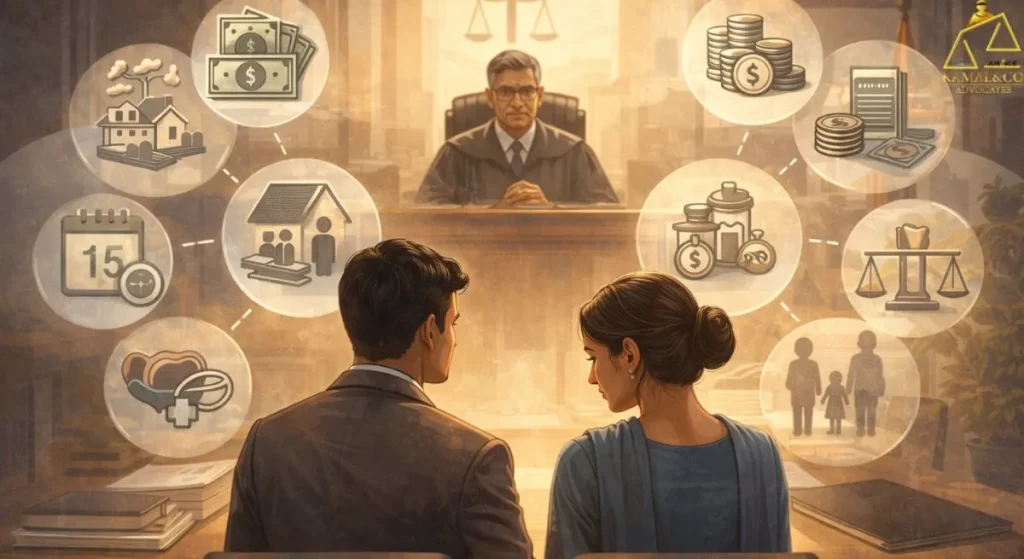
Some of the things usually looked at are:
- Income of both spouses: What each person actually earns.
- Standard of living: How the couple was living during the marriage.
- Duration of marriage: A longer marriage may lead to a different view on support.
- Child custody: The parent handling daily care usually carries more financial responsibility
- Health and age: Medical needs, age, and earning ability are all considered.
- Financial liabilities: Loans, dependents, and regular obligations are also checked.
Recent Supreme Court rulings have also made it clear that factors such as childcare duties, financial position, and the course of the marriage cannot be ignored when deciding support.
What Are The Court Process for Claiming Maintenance or Alimony in India?
Step 1: Filing Petition
It starts with filing a petition in court, where basic details of the marriage and the financial claims are shared.
Step 2: Income Disclosure
Both sides are asked to show their real income, expenses, and assets. This part is checked carefully.
Step 3: Interim Maintenance
Early support can be requested. Helps manage daily expenses during the case.
Step 4: Evidence & Hearing
The documents and records are reviewed. Both sides are heard before a view is given.
Step 5: Final Order
The court will determine the sum and the method of payment.
Types of Financial Support Awarded by The Courts
To understand the differences between alimony and maintenance, we need to see the different ways courts actually award financial support.
- Interim Maintenance: This is asked so that daily expenses don’t become a problem during the case.
- Permanent Alimony: Final support after divorce, meant to bring some long-term stability.
- Lump Sum Settlement: A one-time payment that helps close financial issues cleanly.
- Monthly Maintenance: Regular payments that cover ongoing living costs.
Practical Steps That Can Help You Stay Strong in a Maintenance Case
A few early steps can make a real difference in how the case moves.
- Apply for interim maintenance early: Rent, groceries, legal fees, they keep on coming.
- Keep your financial details clear: Show what you earn and what you spend. If something doesn’t add up on the other side, courts don’t just rely on papers, they also look at how someone actually lives.
- Use the Domestic Violence Act if needed: Monetary relief under the Domestic Violence Act can sometimes move faster and give quicker support.
Difference Between Alimony and Maintenance: Common Mistakes People Make in Legal Claims
Some mistakes don’t look serious at first, but they can quietly weaken the case.
- Thinking there’s a fixed percentage for maintenance. There isn’t, every case is judged on its own facts.
- Not being clear about income or leaving out documents. Courts notice gaps quickly.
- Treating child maintenance vs spouse maintenance as the same. They are calculated differently.
- Waiting too long to file or choosing the wrong legal route. That can slow things down and complicate the case
Understanding the Difference Between Alimony and Maintenance: Final Takeaway
The difference between alimony and maintenance is not just a legal matter. The maintenance steps in early and stays flexible, whereas alimony usually settles things after divorce. What matters most is the facts of the case, and not the assumptions.
This is easier to understand in real life when you get help from an experienced lawyer.
Firms like Kamal & Co. Advocates, which have been dealing with family issues for more than 30 years, focus on building these cases around real-life events rather than theories.
Get Clarity on Alimony and Maintenance for Your Case
FAQs Related To Alimony and Maintenance
Can a working spouse still claim maintenance in India?
Yes, it can still be claimed. If the income is not enough to maintain a similar standard of living, support may be granted. Courts look at actual financial comfort, not just whether someone has a job.
What is the legal difference between a one-time spousal payment and ongoing financial support in India?
A one-time payment is usually called a lump sum alimony. It settles things at once, so there’s no ongoing obligation. Whereas ongoing support is different. It is paid monthly as maintenance and helps cover daily expenses.
Can child support be considered maintenance or alimony under Indian law?
Child support is treated as maintenance, not alimony. Alimony is mainly meant for a spouse after divorce. Maintenance can extend to children as well.
How do legal service platforms explain alimony vs maintenance?
Maintenance is seen as ongoing support that can start even during the case. Alimony is usually explained as a final arrangement after divorce.