

When businesses sign a contract, they often include an arbitration clause inside their contract. So, when there’s any conflict going on between the parties and they are confused about how to solve it, court intervention can take a long time. For these future disputes, this clause says, “Any dispute arising out of this agreement shall be referred to arbitration.”
This clause allows you to resolve disputes under the Arbitration and Conciliation Act, 1996, which is not like mediation, and it does not require a court’s judgment. It’s one of several routes under India’s ADR system, but the only one with its own dedicated law behind it. Understanding this Act can save you a lot of time, money, and stress.
This blog will explain to you how a dispute is solved under the Arbitration Act 1996, how an arbitrator is appointed, when the court intervenes, and how you can challenge the arbitral award. Consult with a civil and commercial dispute lawyer before you send that notice.
What Is the Arbitration and Conciliation Act, 1996?
The Arbitration and Conciliation Act, 1996 was implemented in 1996, following the UNCITRAL Model Law. The Arbitration Act, 1996 is more of a private arrangement as compared to a court to solve disputes in a less adversarial, less time-consuming, and more cost-efficient way.
In this Act, a neutral third party who is known as an arbitrator is selected mutually by the parties involved in the contract, or the court refers them to the parties. Who conducts the arbitral proceedings, solves the dispute, and provides an arbitral award.
This Act applies to domestic arbitration within India, and it also allows international commercial arbitration, including Indian parties; this Act governs how foreign arbitration awards are recognised and enforced in India.
What Are the Important Sections of the Arbitration Act 1996?
Here’s a brief overview of all the important sections under the Arbitration Act 1996:
| Section | Subject | Practical significance |
|---|---|---|
| Section 5 | Extent of judicial intervention | Establishes the statutory approach of limited court intervention |
| Section 7 | Arbitration agreement | Defines the agreement by which parties submit disputes to arbitration |
| Section 8 | Reference to arbitration | Deals with reference of parties to arbitration in appropriate cases |
| Section 9 | Interim measures by court | Allows parties to seek specified interim protection from courts |
| Section 11 | Appointment of arbitrators | Provides the statutory framework where appointment mechanisms fail |
| Section 12 | Grounds for challenge | Concerns disclosures and circumstances affecting arbitrator independence/impartiality |
| Section 16 | Tribunal's jurisdiction | Recognises the tribunal's power to rule on its own jurisdiction |
| Section 17 | Interim measures by tribunal | Provides for interim measures by the arbitral tribunal |
| Section 21 | Commencement of proceedings | Addresses when arbitral proceedings commence |
| Section 29A | Time limit for arbitral award | Provides the statutory framework concerning the time for making awards |
| Section 31 | Form and contents of award | Deals with requirements concerning arbitral awards |
| Section 34 | Setting aside award | Provides limited grounds on which an award may be challenged |
| Section 36 | Enforcement | Addresses enforcement of arbitral awards |
| Section 37 | Appealable orders | Identifies specified orders against which an appeal may lie |
How Does Arbitration Work in India? Step-By-Step Process
Step 1: Arbitration Agreement
When a commercial contract is signed, the agreement must include an arbitration clause to allow the parties to solve any dispute arising in the future. Under the Arbitration Act 1996, you can send a legal notice to the defaulting party for arbitration.
Step 2: Choose an Arbitrator
The parties in the agreement can mutually select a qualified expert as their arbitrator. And if the parties approach court in the presence of an arbitration agreement, the court must refer them back to arbitration.
Step 3: Statement of the CLAIM
Here, the party initiating arbitration must present the documents and evidence in support of their claims. Demands of the claimant.
Step 4: Statement of COUNTER – CLAIM
Then the respondent is provided with full rights to present his documents and evidence in his defence.
Step 5: Arbitral Proceedings
The arbitration proceedings are conducted confidentially at the place decided in the contract, unlike public court proceedings. And under Section 29A, the arbitrator tribunal must conclude the case in 12-months timeline; this period can be extended by 6 more months by mutual consent of the parties.
Step 6: Arbitration Award
In the end, the final decision made by the arbitrator is an arbitral award, which is treated as equal to the court’s judgment. The arbitrator also has the power to grant interim relief during the legal proceedings
Practical insight: Good preparation often starts before the first hearing. Keep the contract, notices, invoices, correspondence, payment records, and a clear chronology ready from day one.
Can an Arbitral Award Be Challenged Under the Arbitration Act?
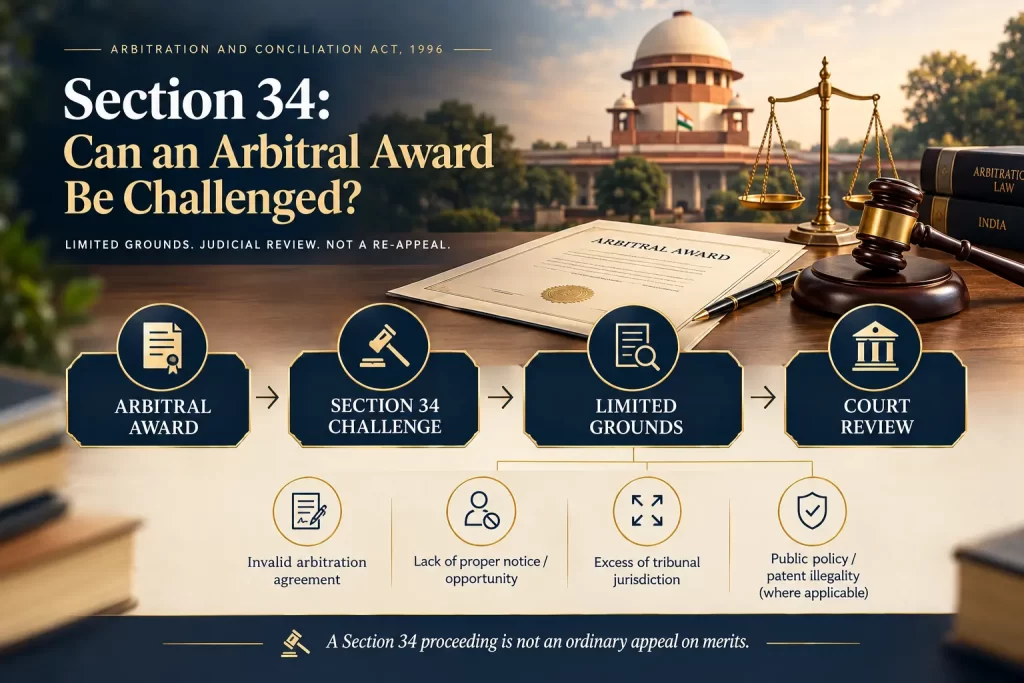
Yes, parties can challenge the arbitral award under Section 34; the court can set aside the rulings of the arbitrator on certain grounds.
The grounds for invalidation of arbitral awards are:
- The party is not eligible to enter into an arbitration agreement.
- The dispute falls outside the capacity of arbitration.
- In case of improper appointment of an arbitrator.
- If the arbitrator’s decision is biased, fraudulent, or violates public policy.
Arbitration vs. Litigation vs. Mediation: What's the Difference?
| Arbitration | Litigation | Mediation | |
|---|---|---|---|
| Decision-maker | Arbitrator(s) chosen by parties | Judge assigned by the court | No decision-maker; parties negotiate |
| Outcome | Binding award | Binding judgment | Non-binding unless formalised |
| Speed | Generally faster | Often slower | Fastest, if parties cooperate |
| Confidentiality | Private | Public record | Private |
| Best suited for | Commercial/contractual disputes | Matters needing judicial precedent or enforcement powers | Relationship-based disputes |
Where Arbitration Commonly Applies in India
Most of the contracts include an arbitration clause, which gets triggered during a dispute, such as:
- Commercial and vendor contracts
- Construction and infrastructure agreements
- Shareholder and partnership disputes
- Joint development agreements in real estate
- Employment and consultancy agreements with senior professionals
It’s there in these kinds of contracts as a safer option to avoid unnecessary long court proceedings, so it’s always good to be aware of the process and the statute of arbitration before a dispute forces the issue.
What To Do the Moment a Business Dispute Arises
When a dispute arises between parties, don’t directly go and file a petition in court; look for an arbitration clause in the contract, because court cases can take a lot of time and also publicly impact the reputation of the business. Instead, do this:
- Preserve the documents; in case of conflict, preserve the documents and evidence, like the contract, any breach of contract, payment records, delivery proofs, and everything important to the deal.
- 2. Read the arbitration agreement, consult with your lawyer, and see if there is an arbitration agreement included in the contract.
- Send a formal notice for initiating arbitration; the notice should be clear and direct about invoking the arbitration proceedings and mention your claims.
- Consider your interim relief options early; while the arbitration procedure is going on, you can seek interim relief to protect your legal rights.
- Get legal advice before you negotiate; don’t wait for things to solve informally. And consult a lawyer for the legal options and required actions.
Practical insight: Don’t rush to send a notice before checking the contract, limitation position, dispute clause, and documents. A premature or poorly drafted notice can create procedural complications later.
Key Amendments That Changed the Landscape
The Act has been amended several times to fix practical problems that emerged over the years:
- 2015 Amendment: The amendment introduced stricter timelines, under Section 29A, a 12-month timeline to conclude the case and provide an arbitral award, and added Public Policy as a ground.
- 2019 Amendment: Under this Amendment, the Arbitration Council of India (ACI) was created for grading the arbitral institutions and to handle arbitration appointment instead of court intervention.
- 2021 Amendment: This amendment addressed situations where an award was induced by fraud or corruption, allowing courts to grant an unconditional stay on enforcement in such cases while a challenge is pending.
The major reason behind these changes was to reduce delays, encourage India to become a more arbitration-friendly jurisdiction, and limit unnecessary court interference.
Practical insight: Arbitration law has changed significantly over time, so businesses should avoid relying on old templates or outdated advice when drafting or reviewing arbitration clauses.
Important Supreme Court Judgments on the Arbitration Act 1996
Case – Gayatri Balasamy v. ISG Novasoft Technologies Ltd. (2025 INSC 605)
Fact: Gayatri Balasamy, a former employee at ISG Novasoft Technologies, filed a sexual harassment complaint; the case was handled under arbitration. She received Rs. 2 crores in compensation as per the arbitral award. Unsatisfied with the award, she challenged the award in the Madras High Court under Section 34, which enhanced the compensation by roughly ₹1.6 crore. This raised questions regarding the court’s power to modify the arbitral award.
Conclusion: To answer this question, with the majority of 4:1, the Court concluded that under Section 34, courts have very limited power to modify an arbitral award, under these four situations: the case includes an invalid part separable from the valid part, to rectify clerical, computational, or typographical errors, post-award interest, and under Article 142. For complete case details, you can read this judgment copy.
Case – Bharat Aluminium Co. v. Kaiser Aluminium Technical Services Inc. (BALCO) — (2012) 9 SCC 552
Fact: BALCO and Kaiser signed a contract, which stated that any dispute in the future would be handled under the English Arbitration Act and the proceedings would be held in London. The dispute arose and was referred for arbitration in London; later BALCO challenged the award under Section 34 of the Arbitration and Conciliation Act, 1996. This raised a question: can Indian courts exercise jurisdiction over an arbitration that was seated entirely outside India? Earlier, in a similar case, Bhatia International v. Bulk Trading S.A. (2002), the court concluded that Indian courts could intervene in foreign arbitrations like this in certain cases. This created a lot of confusion for years.
Conclusion: Later, the court dissented with the Bhaitia International case and concluded that Indian Courts do not have the power to intervene when the arbitration process was handled outside India. The court clarified the distinction between “seat and venue”. Therefore, it can be understood that Part I applies only to arbitrations with their seat in India. Refer to this case copy for more details.
Practical insight: “Where the hearing happens” and “where the arbitration is legally seated” are not necessarily the same thing. Getting this distinction right can prevent expensive jurisdictional disputes later.
When Do You Actually Need a Lawyer for Arbitration?
Many businesses and individuals believe that since arbitrations don’t require court visits, they don’t need a lawyer beside them. But for smooth arbitration proceedings, you should hire a lawyer; they will help you with:
- Applying for arbitration
- During urgent interim relief
- In case of an unfavourable award
Our expert lawyers at Kamal & Co. Advocates can help you with:
- They can help in drafting and reviewing the Arbitration Act 1996 clause in commercial contracts.
- They provide you with representation during arbitral proceedings.
- They can help you with filing and challenging the award before the court.
- They help you apply for interim relief under Section 9.
- They provide the best advice for cross-border or international commercial arbitration matters.