
Suppose one day you visit your plot of land and discover that your neighbour is building a wall on your side of the boundary, which takes a part of your land. You can file a police complaint for this, but it will just give a warning; it might not stop the construction. In this situation, you need a court injunction order to stop the construction.
This guide explains the process to get an injunction order, the laws that govern it, and how you can challenge an injunction order. It is general information; if you need legal advice for your dispute, consult with a civil litigation lawyer.
What is an Injunction Order?
An injunction order is a legal remedy where the court either tells one person to stop an activity or tells them to perform an act. In this, the court preserves the situation as it is till the dispute is solved, to prevent harm or protect someone’s rights.
Types of Injunction Orders
| Types of injunction | What does the court order? |
|---|---|
| Temporary (interim) injunction | The court orders a person to stop doing something temporarily, while the case is going on. |
| Permanent (perpetual) injunction | The court permanently orders someone to stop doing something, after the case is fully decided |
| Prohibitory injunction | The court stops a person from doing something |
| Mandatory injunction | The court orders a person to do or undo something |
| Ex parte injunction | Passed without hearing the other side first, only in urgent cases |
Which Laws Govern Injunctions in India?
Here are the laws that govern injunction orders in India:
- The Specific Relief Act, 1963 (Sections 36 to 42): These are the set of sections that deal with how an injunction order can be granted, when it can be granted, and when it must be refused.
| Section | What it covers |
|---|---|
| Section 36 | Preventive relief is granted by injunction, temporary or perpetual |
| Section 37 | It governs temporary and perpetual injunctions |
| Section 38 | When a perpetual injunction is granted |
| Section 39 | Mandatory injunctions |
| Section 40 | Damages in addition to, or instead of, an injunction |
| Section 41 | When an injunction is refused |
| Section 42 | Injunction to enforce a negative agreement |
2. The Code of Civil Procedure, 1908: Order XXXIX provides the procedure for temporary injunctions, and Section 94 and Section 151 support the court’s powers.
| Provision | In simple words |
|---|---|
| Order XXXIX | The main rules for temporary injunctions: when the court can grant one, how the other side is told, and what happens if the order is ignored. |
| Section 94 | Lets the court pass interim orders, like a temporary injunction, to protect your rights while the case is going on. |
| Section 151 | It supports the inherent power of the court to still pass the order needed to do justice. |
When Will a Court Grant an Injunction? The Three-Part Test
The court will not grant you an injunction order just because you simply ask for it. To get the injunction order, you need to satisfy these three things:
1. A Prima Facie Case
There must be a real, arguable, and strong claim in your support; the court wouldn’t grant an order based on a simple allegation.
2. Balance of Convenience
The court considers which suffers more inconvenience or hardship. The court considers whether refusing the order will cause far greater harm to the applicant than it will cause to the defendant; then the balance tilts in favour of the injunction.
3. Irreparable Injury
In case the plaintiff incurs any harm that can’t be fixed in monetary terms, or that can’t be undone. For example, a heritage house is demolished, or a business loses its reputation.
When courts refuse an injunction
Section 41 of the Specific Relief Act lists situations where an injunction will not be granted. In practice, the common ones are:
- When the applicant has an equally effective alternative remedy
- When the applicant has been guilty of delay or acquiescence
- When the applicant’s own conduct is improper
- When the injunction would affect the continued provision of essential facilities or certain infrastructure projects
Common Situations Where People Seek an Injunction
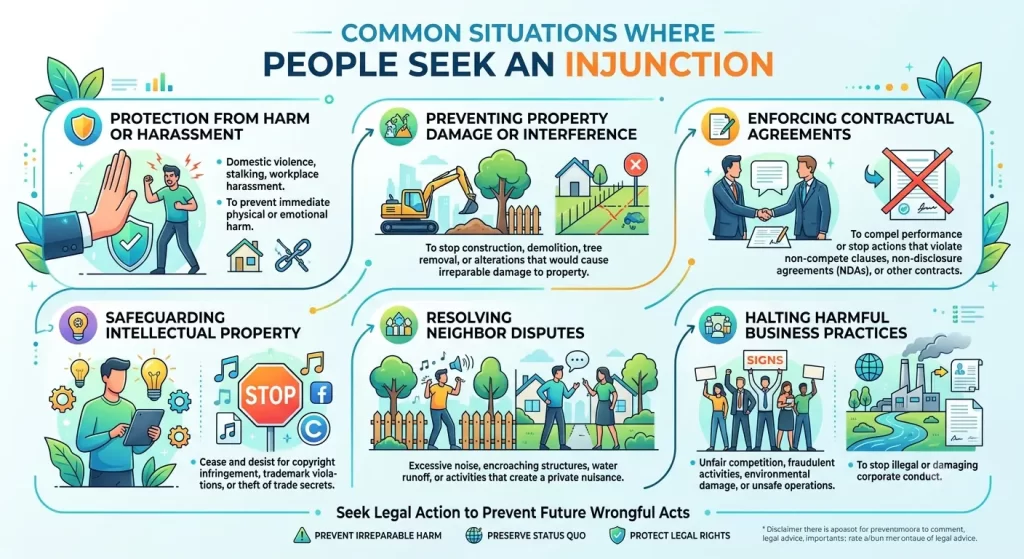
Here are some common scenarios where you might need to file an injunction order:
- Property and land disputes: In property disputes, an injunction order can stop the activities till the ownership and boundaries are decided.
- Partition suits: If a co-owner tries to take over or sell a shared property, an injunction order can freeze the transaction till you solve your disputes.
- Business and contract disputes: Businesses can use an injunction to stop others from misusing their company’s trademarks, trade secrets, or during a breach of contract.
- Family disputes: In family disputes, if one of the co-owners decides to sell joint property, you can seek an injunction order. Furthermore, here’s our complete guide on how to solve family property disputes.
How to Get an Injunction Order: Step by Step
Step 1: Identify the right court
First, identify the right court that has jurisdiction over the property or the defendant. And know that if the defendant is a government officer, Section 80 CPC may require a two-month notice before suing, but in appropriate cases, the court may allow you to file a suit without waiting.
Step 2: File the suit
The plaint mentions your case and the final relief you seek from the law, such as a declaration or permanent injunction.
Step 3: File the interim application
You should also file an application for temporary injunction under Order XXXIX Rules 1 and 2 CPC; also it must be supported by an affidavit.
Step 4: Support it with documents
Attach the documents that support your case, such as identity proof, possession proof, notices, and affidavit.
Step 5: Notice and hearing
After the suit is filed, the other side also files a reply, and both sides are heard at court. In urgent cases, the court may pass an interim order first.
Step 6: The court’s order
After the hearing, the court may grant, refuse, or pass a limited order such as maintaining status quo.
Step 7: Serve the order
After the court’s order is served, make sure the order is formally served on the other side and keep proof of that. An order that was never properly communicated is hard to enforce.
Documents Required for an Injunction Application
Here is the list of documents you will need in filing a petition for an injunction order in court:
| Document | Why it matters |
|---|---|
| Sale deed, title deed or ownership papers | It proves your legal right in the property |
| Possession proof | Tax receipts, utility bills, photographs, revenue records |
| Notices or correspondence | Shows the other side’s threat or breach |
| Photographs or site plan | Shows the existing position or the construction |
| Agreement or contract (if relevant) | For business or contractual disputes |
| Affidavit | Verifies the facts in the application |
| Vakalatnama and ID proof | Procedural requirements |
What Happens If an Injunction Order Is Violated?
If a party, despite the knowledge of the court’s order, disobeys or breaches the injunction order, then under Order XXXIX Rule 2A CPC, the court can:
- Order the property of the wrongdoer to be attached, and
Also order detention in civil prison for up to three months.
Attachment of property remains in force for one year. So, if the breach continues for more than a year, the court can order the property attached to be sold.
If you believe that the court’s order has been violated, then you can apply before the same court with the proofs of breach such as photographs, dated records, and a copy of the court’s order.
How to Challenge or Set Aside an Injunction Order
If an injunction order has been passed against you and you’re not satisfied with it, you can apply before the court challenging the order. Here are legal options for challenging an order:
- Order XXXIX Rule 4 CPC: Under this, you can apply to alter or set aside the order; you will need to provide valid grounds like a change in circumstance, or proof that the order is causing hardship.
- Order XLIII Rule 1(r) CPC: Under this, you can appeal against an order granting or refusing a temporary injunction.
Common Mistakes to Avoid When Applying for an Injunction
Here are some common mistakes people should avoid while applying for an injunction order to save time and get a solution faster:
- Waiting too long to apply can weaken your argument.
- Hiding facts can cause your appeal to be dismissed.
- Not providing proper documents can challenge your success rate.
- Treating a temporary order as a final win.
- Not communicating the order with the defendants can challenge its enforceability.
When Should You Consult a Lawyer for an Injunction Order?
Injunction applications are time-sensitive; if you wait for the matter to settle, then apply for it, then the damages can increase. You must speak to an advocate the moment someone tries to harm your property or breaches any contract.
At Kamal & Co. Advocates, we have 3 decades of experience in civil litigation, and we provide a complete assessment with injunction matters.
- We analyze your documents before providing the best legal option available for you.
- We take care of drafting and sending legal notices wherever required.
- We draft and file a plaint for an injunction order.
- We provide complete court representation, defending and challenging the appeal wherever required.