

Sometimes an FIR (first information report) can be a false allegation, an exaggeration, or registered with personal reason to harm someone. For these situations, Indian law has a judicial remedy available for the protection of innocents; quashing an FIR is a legal procedure where the High Court has the authority to cancel an FIR and terminate the criminal proceedings.
This blog is a complete guide to quashing an FIR, the new laws that govern it, the grounds for cancelling an FIR, and the procedure. Furthermore, speak with our experienced criminal lawyer; they can defend your case and help you protect yourself from a false accusation.
What is Quashing of FIR and the Laws Governing it?
Quashing of FIR means the High Court cancels the FIR and, with it, all the proceedings and investigation that began after the FIR registration.
As of 2024, the Bharatiya Nagarik Suraksha Sanhita (BNSS) replaced the CrPC; the laws that were governing the quashing of FIRs have also changed. Now an FIR can be quashed by the High Court using its inherent powers under Section 528 of the BNSS (earlier Section 482 CrPC) or through a writ under Article 226.
Let’s understand the legal provisions:
Section 528 BNSS: This section replaced the old Section 482 CrPC; it preserves the High Court’s inherent powers. Means it allows the High Court to intervene in the criminal proceedings to prevent abuse of the Court’s process and to ensure the final decision ends in justice.
Article 226 of the Constitution of India gives the High Court the power to issue directions, orders, or writs to protect fundamental rights.
Section 482 CrPC is the older code; it has been replaced by Section 528 BNSS.
What are the Legal Grounds for Quashing of FIR?
Based on the landmark judgment in the case State of Haryana v. Bhajan Lal (1990), the Supreme Court has given seven illustrative grounds that can help the High Court decide when an FIR can be quashed.
The FIR may be quashed if:
- No offence is made out: If we accept all the allegations in the FIR, but still it does not disclose any offence against the accused, the case can be quashed.
- No cognizable offence: If the FIR does not disclose any cognizable offense, police can only investigate cognizable offenses without a Magistrate’s order.
- Evidence shows no offence: The investigation has happened, and the material collected does not disclose any offense.
- Only a non-cognizable offence: If the case is non-cognizable, the police must get a Magistrate’s order before investigating. Investigation without order can be challenged.
- Absurd allegations: When the FIR is based on absurd or inherently improbable allegations.
- Legal bar: A provision of law prohibits starting or continuing the proceedings.
- Malicious prosecution: The FIR registered is malicious, filed to take revenge or settle private grudges.
When Can the Court Refuse to Quash an FIR?
When the allegations involve some serious criminal offenses or the court believes that ending the proceedings would not serve justice, the High Court might dismiss the petition for quashing of an FIR. Here are the cases where quashing can be difficult:
- Serious offenses against the person, such as murder and rape.
- Corruption offenses involving a public servant.
- Offenses against the state or society.
- Cases under special laws like the POCSO Act or NDPS Act.
When Can You File for Quashing of FIR?
Here’s an explanation of when you should apply for quashing; it can be helpful to know when and where you can file it:
1. Before or during an investigation
Because the investigation is a statutory stage, the courts are very careful here; in Neeharika Infrastructure v. State of Maharashtra (2021), the Supreme Court said that quashing at the investigation stage should be rare and taken cautiously. And recently, based on the Imran Pratapgadhi v. State of Gujarat (2025) case, the Supreme Court has held that a complaint can be quashed even during the “nascent stage of investigation” if the grounds of quashing are fulfilled.
2. After the chargesheet
The police reports are filed under Section 193 BNSS. And even after the chargesheet is filed, if the evidence or material provided under the chargesheet does not disclose any offence, the High Court can quash the chargesheet along with the FIR.
3. After cognizance
Section 528 BNSS allows quashing of a complaint even after cognizance; if the grounds of quashing an FIR are fulfilled, the High Court can quash the FIR.
4. During trials
Quashing is still possible at the trial stage, mostly through settlement. But seeking quashing of the FIR at the earliest stage is best; it causes less harm to reputation and saves time and expenses.
Step-by-Step Procedure for Quashing of FIR
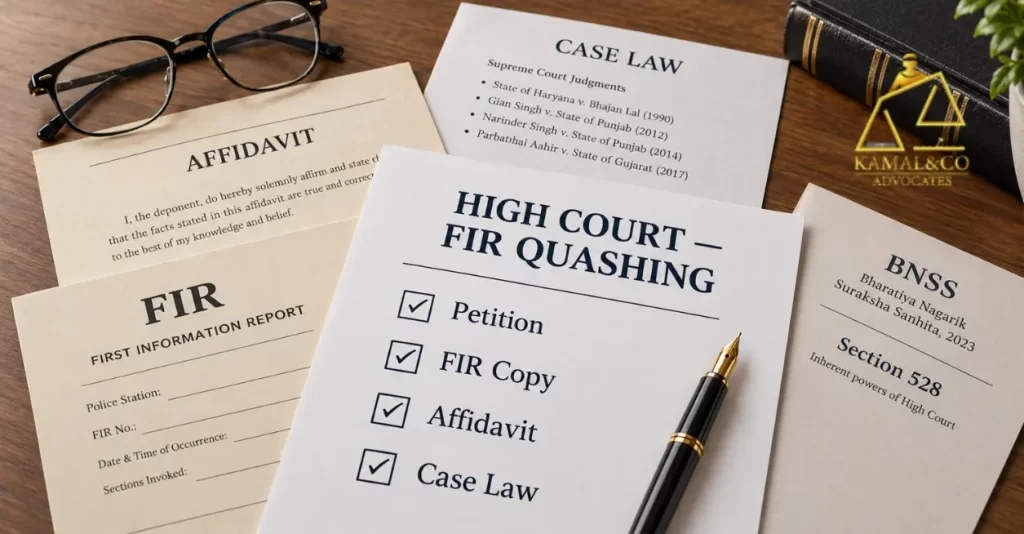
Here’s the procedure for filing a petition for quashing of an FIR and how the High Court reacts to it:
Step 1: Identify the High Court
File the petition before the High Court which has jurisdiction over the police station where the FIR is registered.
Step 2: Consult with a Lawyer
Consult with a professional who can guide you through the documents, evidence, drafting and filing of the petition, and court hearings.
Step 3: Collect the Documents
Here are the documents you will need for filing the petition:
- Copy of FIR
- Evidence or documents that support your claim
- A supporting affidavit
Step 4: Draft the Petition
Then you need to draft the petition; make sure it includes:
- List of event happened and facts
- The grounds for quashing the FIR
- Evidence in your support
- Seek reliefs
Step 5: Court Hearing
After the petition is filed with the court, the hearing begins in the High Court, where both parties are given a chance to present their case. Based on the given evidence, the High Court decides whether to keep or quash the complaint.
Step 6: Final Order
After considering the evidence and hearing the parties, the High Court may quash the FIR completely, partly, or dismiss the petition.
What Documents Can Strengthen a Quashing Petition?
Here’s a list of documents that you may need while filing an FIR quashing petition:
| Documents | Purpose |
|---|---|
| Copy of the FIR | To identify the allegations and offenses |
| Documents supporting your grounds | Such as agreements, transaction records, receipts, or documents related to the case |
| Investigation records | Chargesheet, notices, and relevant orders, where applicable |
| Settlement documents | If you and the other party have reached a mutual settlement |
| Relevant communication | Emails, messages, letters, or other communications that may help |
| Previous court orders | Orders passed in relevant proceedings, if any |
Note: Lawyers at Kamal & Co. Advocate will provide comprehensive assistance; they ensure all documents are complete and accurate to avoid delays and procedural errors.
How High Courts Actually Assess a Quashing Petition
When a quashing petition is filed at court, the court doesn’t just look at whether the person is innocent or guilty. It looks at the allegations, the legal provisions included, and whether it fulfills any grounds for quashing the FIR before they make their decision.
| What the Court Looks At | What It Means in Practice |
|---|---|
| What does the FIR disclose? | The court looks at the FIR and identifies the allegations made against the accused. |
| Whether the offence is made out | The allegations are checked against the essential ingredients of the offence. |
| A recognised ground | Then they verify whether the case falls within the grounds of quashing an FIR |
| Abuse of process | Then the court considers whether continuing the case serves any purpose. |
Can an FIR Be Quashed on Settlement?
Quashing of an FIR is possible if both parties have mutually decided to settle the matter without taking the case further, but settlement does not automatically cancel the FIR. The High Court needs to consider the nature and seriousness of the offence, the impact on the public, and whether the case has reached justice before making a final decision.
Here are some landmark judgments on settlement:
- Gian Singh v. State of Punjab (2012): High Courts can quash certain cases which are overwhelmingly civil in nature, like commercial, civil, and family disputes. However, criminal cases which harm the public, like murder, rape, dacoity, etc are generally excluded.
- Narinder Singh v. State of Punjab (2014): The High Court must also consider the seriousness of the offence, conduct of the parties, and whether the settlement is free will.
- Parbatbhai Aahir v. State of Gujarat (2017): This case brought the earlier principles together and provided a structured set of principles that settlement is important, but the court must consider the nature and impact on society of the offence.
What happens if the petition is rejected?
If the High Court sets aside your petition, then it means the FIR or criminal proceedings may continue. But the rejection does not establish the accused guilty.
The next step may include:
- The investigation may continue
- Bail or anticipatory bail may be needed in case of arrest or custody
- Court proceedings; you may need to appear before court
- During this, you can apply for other legal remedies
Quashing vs Anticipatory Bail: What’s the Difference
When the quashing petition gets rejected, and you’re afraid that you might get arrested the next moment, you can apply for anticipatory bail. Here’s the difference between the two:
| Quashing | Anticipatory bail | |
|---|---|---|
| Purpose | Ends the FIR or proceedings | Protects against arrest |
| Forum | High Court | Sessions Court or High Court |
| Provision | Section 528 BNSS | Section 482 BNSS |
| Effect on case | Case ends if granted | Case continues |
Common Mistakes to Avoid When Seeking FIR Quashing
An FIR quashing petition goes through a strict legal procedure. Avoiding these common mistakes can strengthen your case and save a lot of time:
- Hiding facts related to the case can get the petition dismissed.
- Assuming that a settlement between parties guarantees quashing of FIR.
- Using the wrong Section 482 CrPC; it has been replaced by Section 528 BNSS.
- Arguing over being innocent or guilty, rather than giving legal grounds.
- Depending on the investigation to prove your innocence.
How Can Kamal & Co. Advocates Guide You in This Process?
The overall planning for quashing an FIR starts with understanding the FIR and the facts behind this complaint. At Kamal & Co. Advocates, we start with studying the FIR and understanding your side of the story and claims. On that basis:
- We start by identifying the grounds for challenging the FIR
- Collecting the documents and evidence in your support
- Drafting the petition
- Providing representation at court
And many times when clients reach out to us at the latter stage of a criminal case, we also assist with bail procedures and further case handling.