
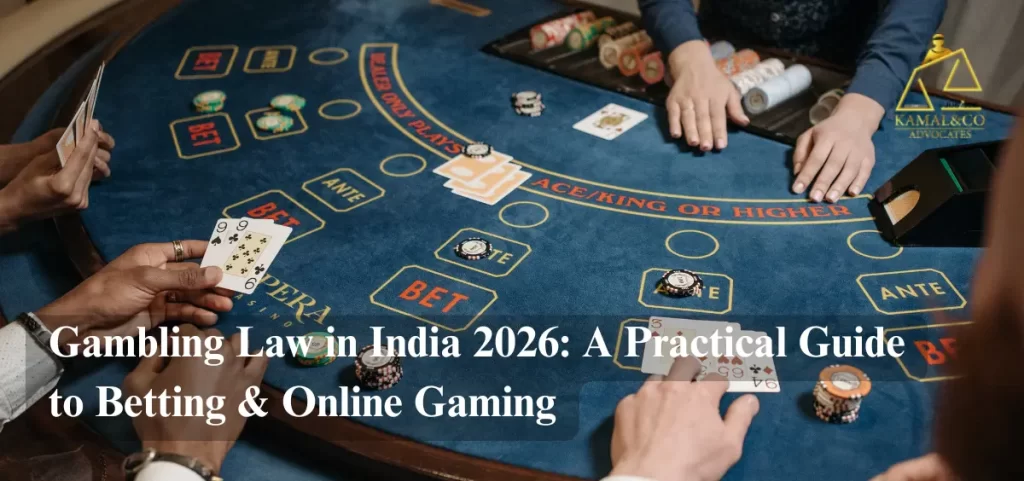

We all have that one person in our family or friend circle who says, “Put ₹1000 on the next over; this team will win. Make easy money”. Or you’re scrolling through social media and an ad pops up promising a bonus on login and to earn cash, share it with your friends.
You might be wondering, is gambling legal in India? Is betting different from gambling? You’re wondering, is it legal in your state? And do I need to pay tax if I win? A criminal lawyer for gambling cases can explain your rights, but first, let’s understand the law.
Well, this guide explains all about gambling, including the laws of gambling in India, types of gambling, penalties, and taxes on income earned from gambling.
What is Gambling and Is Gambling Legal in India?
When a person puts his money at stake over an uncertain outcome to earn money, he is considered to be gambling.
For example, you put 5k at stake over the assumption that your desired team will win; here the outcome is uncertain; the other can also win; it’s considered gambling; for many it’s an easy way to make money.
Is Gambling Legal in India?
Gambling in India is heavily restricted and under strict control. Whether it’s legal or not depends on the type of gambling, platforms, and the laws regulating it.
Like most of the gambling activities in India, they are regulated under state-level laws; that’s why there is no fixed statement on their legality. Though the Public Gambling Act, 1867, is an historical gambling law that helps in governing gambling in India.
At the same time, there are some other central laws also that help in regulating different activities. Like the Lotteries (Regulation) Act, 1998, to regulate lotteries, and the Promotion and Regulation of Online Gaming Act, 2025, for online money games.
What is the Difference Between: Gambling vs. skill-based games
People often try to separate both, gambling (a game of chance) and games of skill. A game of chance is purely based on luck, like a lottery, and a game of skill is based on experience and knowledge.
But after the State of Tamil Nadu v. Junglee Games case, the Supreme Court has clarified that a game being based on skill does not automatically make betting on that game legal. For example, even if a game involves skill, putting money on its outcome may still be regulated under the gambling laws applicable in that state.
Skill vs chance: at-a-glance comparison
| Factor | Game of Skill | Game of Chance |
|---|---|---|
| Decisions factor | Player's skill, knowledge, strategy, or judgment | Randomness or chance |
| Role of player ability | Significant influence on the outcome | Limited or no meaningful influence |
| Examples | Rummy, horse racing | Roulette, slot machines, lotteries |
| Legal relevance | May fall outside certain gambling prohibitions | More likely to fall within gambling restrictions |
| When real money is staked | Betting on the game may still be regulated as “betting and gambling” | Treated as gambling |
Types of Gambling in India and Their Legal Status
Gambling in India has a lot of different activities like horse racing, casino, poker, bingo, etc., so it’s important to distinguish them based on their laws and legal status in the whole of India. Here’s how each game is regulated in India:
1. Casino
Casino gambling in India is regulated under the Public Gambling Act, where the jurisdiction to regulate them are given to state-level laws. It is a game of chance, so many states have prohibited in most of the states. However, in states like Sikkim, Goa, and Daman and Diu, casinos are operated with licenses under their state laws.
2. Poker
What type of game is poker? While in some states it is skill-based and in some a game of chance, it is still not very clear. So the operators of poker games need to obtain a license based on their state laws.
3. Bingo
Bingo falls under the category of a lottery and a game of chance, so its legality depends on the state gaming laws. But because it’s a game of chance in most states, it’s banned.
4. Cricket Betting
As cricket betting is one of the most common forms of gambling in India, the legality of cricket betting depends on the state gaming laws. And for online cricket betting, the Promotion and Regulation of Online Gaming Act, 2025 has made the betting stricter, offering, facilitating, advertising, and promoting prohibited online money gaming services.
5. Sports / Horse Race Betting
As the Supreme Court has stated that horse racing betting is a game of skill, there are some exemptions for horse race betting under the law. But it still needs to fulfill the compliance requirements set by the state laws. Also, the clubs where horse racing will be held may impose some regulations according to the law.
6. Lotteries
Lotteries are regulated by the central government under the Lotteries (Regulation) Act 1998 along with applicable state laws. State governments can regulate how lotteries are operated, and they can prohibit the sale of lottery tickets within their territory.
Do you have to pay tax on gambling winnings?
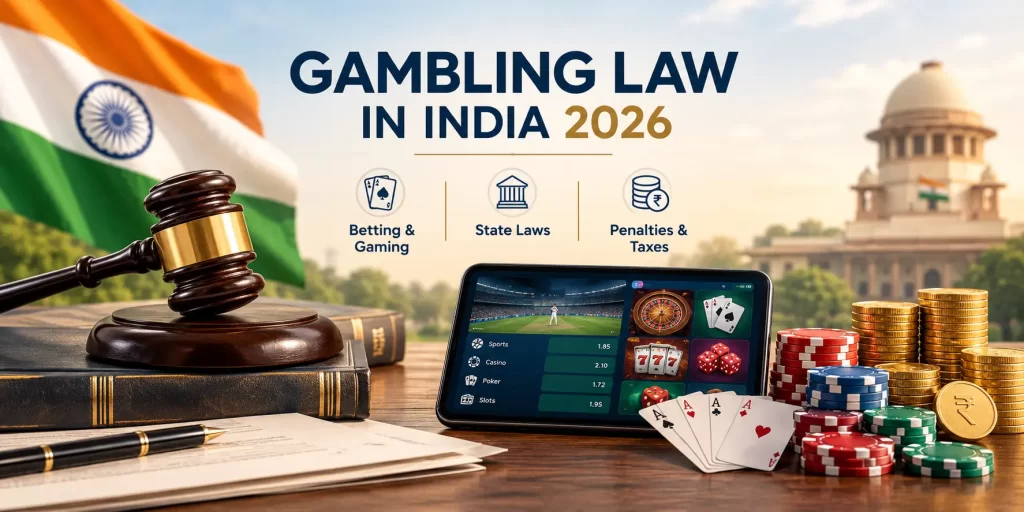
Yes, if you’re putting your money on gambling games, you have to pay tax on the winnings.
All winnings are taxable. The platforms you use for your games can deduct the tax amount before you withdraw your money.
Tax on Online Gaming
Winnings from gambling, betting, and gaming can have tax implications. So all the income earned from online gambling is taxed at a flat rate of 30% under Section 115BBJ of the Income-tax Act, 1961. Your tax is deducted at source (TDS) at 30% under Section 194BA, either at the time of withdrawal or at the end of the financial year if no withdrawal is made.
GST on Gambling
According to the new GST regime, the tax on online gambling has increased to 40% from 28% from 22 September 2025; and GST is applied on the full face value.
For more details on the exemptions, traditional gambling taxes, or final winning income, you can consult with our taxation experts for personalized tax guidance.
What Are the Penalties for Gambling and Online Money Gaming in India?
Under the framework of the Promotion and Regulation of Online Gaming Act, 2025, these are the penalties one can face for operating an online money game without fulfilling the legal requirements and doing illegal activities:
| Offence | Punishments |
|---|---|
| For offering or operating an online money game | Imprisonment up to 3 years, or a fine up to ₹1 crore, or both |
| For advertising an online money game | Imprisonment up to 2 years, or a fine up to ₹50 lakh, or both |
| Penalties for unauthorised transactions | Imprisonment up to 3 years, or a fine up to ₹1 crore, or both |
| Who repeat the offense | Minimum 3 years, extendable to 5 years, with fines of ₹1 crore to ₹2 crore |
| Repeated offenses (advertisement) | Minimum 2 years, extendable to 3 years, with fines of ₹50 lakh to ₹1 crore |
| Penalty for non-compliance with government orders | A civil penalty of up to ₹10 lakh |
Common mistakes people make about gambling laws in India
Gambling is considered very risky, so be careful while entering into it. Here are some common mistakes people make:
- Copying your friend or family member, just because it’s working for them, doesn’t necessarily mean it will work for you too.
- Considering skill games legal, they might not be legal in your state.
- Using offshore platforms for gambling, it can lead to trouble with legal compliance.
- Paying tax does not make it legal.
When Do You Need Legal Advice on Gambling or Gaming?
If you’re considering starting gambling or are already into it, it’s better to consult with a lawyer who can explain the legality. Because if you’re betting on a restricted activity, it can lead to heavy penalties and even imprisonment.
Especially if you’re an operator who operates gambling games or casinos, you must consult about the license requirements and permissions. Here’s how Kamal & Co. Advocates help their clients with gambling-related subjects:
- They will help identify whether the law allows you to gamble or operate gambling activities.
- They can help you with legal compliance and applying for a license.
- They can help you with your tax duties.
- They can help with legal notice, investigation, and regulatory communication.


6 thoughts on “Gambling Law in India 2026: A Practical Guide to Betting & Online Gaming”
Its Amazing
If you are mad at me, just curse me out
Pingback: @SEO_LINKKK in Telegram | सट्टा मटका गणना: फॉर्मूला, सिद्धांत और आम गलतियाँ – Home Build Projects
Pingback: @SEO_LINKKK in Telegram | सट्टा मटका गणना: फॉर्मूला, सिद्धांत और आम गलतियाँ - OPER'animation
Pingback: @SEO_LINKKK in Telegram | सट्टा मटका गणना: फॉर्मूला, सिद्धांत और आम गलतियाँ – WordCamp Dublin 2019
Pingback: @SEO_LINKKK in Telegram | सट्टा मटका गणना: फॉर्मूला, सिद्धांत और आम गलतियाँ - Woof Buddies