

In India, criminal and civil laws regulate dowry harassment cases, and case outcomes largely depend on how quickly women take legal action and the quality of evidence they present in court.
Women subjected to dowry-related cruelty can invoke multiple legal remedies, including criminal prosecution under the Indian Penal Code, protection orders under domestic violence laws, and claims for maintenance or compensation.
Nevertheless, courts in India have always rejected dowry harassment cases where complaints do not specify any incidents, dates, medical documentation, or independent corroboration.
Women who seek relief and accountability must take the assessment of an expert family lawyer to understand which laws to invoke, what evidence courts require, and what immediate legal actions can ensure their protection.
Why Do Dowry Harassment Cases Still Happen in India?
In 2024, the National Commission for Women documented 4,383 cases of dowry harassment, and they constituted 17% of all complaints. The number of complaints associated with dowry deaths was also 292 in the same year, which demonstrates the extent to which such harassment can be dangerous.
The state-wise statistics indicate that Uttar Pradesh registered more than 2,000 dowry deaths in 2022, the highest in India. Madhya Pradesh and Bihar were close behind. NCRB data also indicates that 13,479 cases were registered under the Dowry Prohibition Act in 2022, and only 4.5% of dowry deaths decreased compared to the prior year. These figures are based on official data published by the National Crime Records Bureau and the National Commission for Women.
Which Laws Deal With Dowry Harassment Cases?
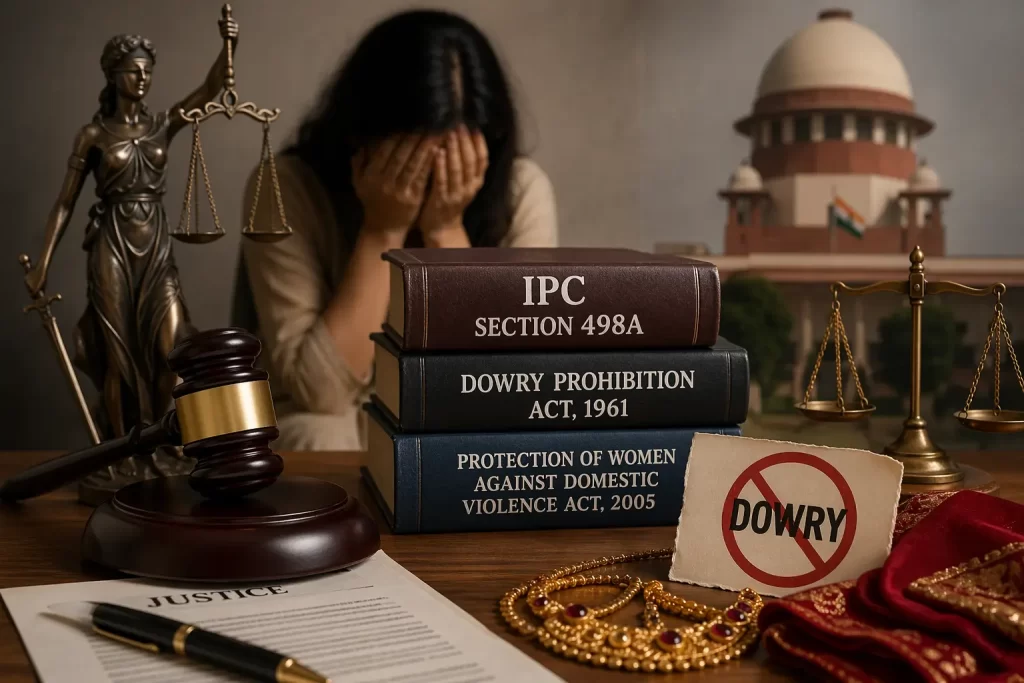
Dowry harassment cases in India may involve more than one law, depending on the nature of the allegations and the relief sought. The current criminal-law framework has applied since 1 July 2024, when the Bharatiya Nyaya Sanhita, 2023 (BNS), the Bharatiya Nagarik Suraksha Sanhita, 2023 (BNSS), and the Bharatiya Sakshya Adhiniyam, 2023 (BSA) came into force.
The Dowry Prohibition Act, 1961 and the Protection of Women from Domestic Violence Act, 2005 continue to operate alongside these laws.
Laws Governing Dowry Harassment: Section-Wise Summary
| Old Law (IPC/CrPC) | Current Law (BNS/BNSS) | What It Covers | Punishment / Remedy |
|---|---|---|---|
| Section 498A, IPC | Sections 85 & 86, BNS | Cruelty by husband or in-laws, physical or mental, including harassment for dowry | Up to 3 years imprisonment + fine |
| Section 304B, IPC | Section 80, BNS | Dowry death due to cruelty/harassment for dowry "soon before death" | Minimum 7 years imprisonment, extendable to life |
| Section 306, IPC | Section 108, BNS | Abetment of suicide, often invoked where dowry cruelty drives a woman to take her own life | Up to 10 years imprisonment + fine |
| Section 3 of Dowry prohibition Act 1961 | Unchanged, Act remains in force | Giving & taking dowry | Imprisonment of 5 years + at least 15000 fine, or dowry amount whichever is higher |
| Sections 4 Dowry Prohibition Act, 1961 | Unchanged, Act remains in force | Demanding dowry (applies to both parties) | 6 months–2 years imprisonment + fine of ₹15,000 or dowry value, whichever is higher |
| Sections 12, 18–20, Protection of Women from Domestic Violence Act, 2005 | Unchanged, Act remains in force | Civil protection: protection orders, residence rights, monetary relief, custody orders | Protection orders, residence rights, compensation |
| Section 125, CrPC | Section 144, BNSS | Maintenance for a wife (including a divorced wife who hasn't remarried), children, and parents unable to maintain themselves | Monthly maintenance, depending on income |
How Often It Lead to Convictions?
A very low conviction rate is one of the greatest problems in cases of dowry harassment. In India, the conviction rates stand between 11-17%.
In Delhi, courts secured only 20 convictions out of 180 cases, resulting in a conviction rate of just 11%. Courts in Haryana recorded a slightly higher conviction rate of 14.7%.
What Kind of Evidence Do Courts Expect ?
Courts do not tolerate vague and general allegations. The judges require explicit information like dates of events, medical history, testimonies of witnesses, and evidence of recurrent inhumanity.
A family lawyer for dowry cases can help you organise documents, witness statements, and medical records in a way that courts accept.
In 2025, the Supreme Court threw out a case on the basis that the complaint did not provide any specifics regarding the timing and manner of the cruelty.
Under Section 80 of the BNS (which has replaced Section 304B of the IPC) the court has made it clear that if a woman dies due to cruelty by her husband or in-laws and it is shown that before her death she was a victim of cruelty by her husband or any relative of her husband for the demand of dowry, it’s a dowry death.
What Immediate Protection Is Available in Dowry Harassment Cases?
An FIR is a solution to criminal responsibility, whereas the Domestic Violence Act is concerned with the immediate security, right to stay, and financial assistance.
Women do not have to select a single remedy, and most of the time, courts permit both procedures to run concurrently, depending on the facts of the case.
Dowry harassment cases begin by filing an FIR at the nearest police station.
Investigations under Section 498A normally commence within 24 hours after registration.
The Domestic Violence Act also allows women to go to a Magistrate to obtain emergency protection orders, such as no-contact orders and residence protection.
At this stage, consulting a expert family lawyer can help you take the right legal steps quickly and avoid procedural mistakes.
What Legal Options Exist Beyond FIRs in Dowry Harassment Cases?
In other cases, other than crimes, women in cases of dowry harassment may demand monthly maintenance under Section 125 of the CrPC now Section 144 of the Bharatiya Nagarik Suraksha Sanhita (BNSS). Courts usually award monthly maintenance ranging from ₹10,000 to ₹50,000, depending on the husband’s income.
The Hindu Marriage Act also allows women to divorce based on cruelty and interim alimony.
Courts can apply Section 108 of the BNS (this provision has replaced the section 306 of IPC) in serious dowry harassment cases involving suicide or attempted suicide, carrying imprisonment of up to 10 years and a fine. In a 2025 Supreme Court ruling, the Court clarified that no individual enjoys immunity from prosecution in such cases.
Why Legal Support Matters in Dowry Harassment Cases?
It must be handled with a lot of care since convictions are low and the courts are very strict on the evidence presented. Even minor mistakes, lost papers, or unclear words can undermine a case.
The knowledge of the NCRB trends and the recent Supreme Court decisions is significant in enhancing the results.
Our legal team at Kamal & Co. Advocates can help you build a strong defense and an admissible case.
Where Can You Find Authentic Data on Dowry Harassment Cases?
Government-supported sources are the best when it comes to providing accurate and non-commercial information on dowry harassment cases. Courts, policymakers and legal professionals in India regularly use data released by the National Crime Records Bureau and the National Commission for Women.



1 thought on “Dowry Harassment Cases in India: How to File, Evidence, Procedure & Legal Remedies”
Pingback: Dowry Prohibition Act Explained | Kamal & co