
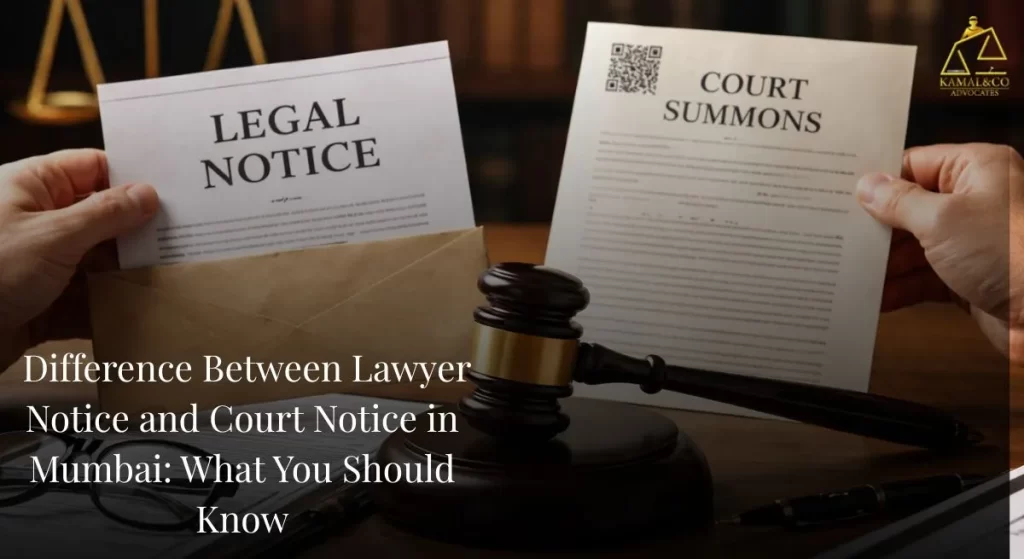

Difference Between a Lawyer Notice and a Court Notice: What It Means for You in Mumbai
It usually begins on a normal day. You open your door (or your WhatsApp), and see legal language staring back at you. You read it once, then again, trying to understand it. Is this just a warning? Or are you already expected to stand before a Judge in South Mumbai or Bandra?
In Mumbai’s high-risk environment, where rent disputes, cheque bounces, and business conflicts are daily affairs. And not knowing the difference between a lawyer’s notice and a court’s notice can cost you lakhs in legal fees.
In this blog, we’ll break down the differences between the two notices, what each one really means, and how you should deal with them.
What is a Lawyer Notice?
Definition and Purpose
A lawyer’s notice, or legal notice, is basically a formal way of saying there’s a problem and it needs attention. It’s sent by a lawyer on behalf of someone who is already in a dispute.
In plain terms, it works like a warning before legal steps begin.
- It brings the issue out clearly.
- It asks for payment, action, or correction.
This is called the pre-litigation process in India, where both sides still have a chance to solve without going to court. In some situations, like the cases which involves government, sending a notice is required before filing a case
notice is required before filing a case
Key Features of a Lawyer Notice
A lawyer’s notice is serious, but it is not a court order. You are not being asked to appear anywhere at this stage, but it is still expected that you respond.
It also puts things on record. Whatever is written in the notice can be referred to later if the matter goes ahead.
Both sides get a chance to talk, settle, or at least understand where things stand before it becomes a formal case.
Common Scenarios in Mumbai
- Rent issues, especially unpaid rent or eviction.
- Cheque bounce cases under Section 138.
- Employment problems like unpaid salary or disputes.
- Business matters involving payments or contracts.
What is a Court Notice?
Definition and Legal Authority
A court notice comes into the picture only after a case has already been filed. By then, things have moved past the informal stage. The matter is already before the court, and the legal process has started.
In civil cases, this usually shows up as a summons under the Civil Procedure Code in India. This simply means you are being informed about the case and are expected to appear and present your side.
Key Features of a Court Notice
A court notice carries legal weight, so it can’t be ignored. Under the new Bharatiya Nagarik Suraksha Sanhita (BNSS), these notices are now legally served via Email or WhatsApp.
If it is left unattended, the court may go ahead without you, and your side might not get the attention it should.
Situations Where Court Notices Are Issued
In Mumbai, court notices are issued when the case has already moved forward.
- Civil matters like property or recovery disputes.
- Criminal cases where an appearance is required.
- Family matters such as divorce or maintenance.
What Is The Difference Between A Lawyer Notice and A Court Notice?
Basis | Lawyer Notice | Court Notice |
Issued By | A Private Advocate | A Judicial Officer/Court |
Legal Status | Pre-litigation (Warning) | Legal proceeding |
Purpose | Warning or settlement | Formal legal action |
Response Requirement | Recommended (To build your defense) | Mandatory (To avoid arrest/penalties) |
Consequences of Ignoring | The case may be filed | Legal penalties or an ex parte order (The Judge decides without you) |
Common Scenarios in Mumbai Jurisdiction
Across courts like the City Civil Court or Small Causes Court, these disputes regularly lead to notices.
Cheque Bounce (Section 138)
In cheque bounce cases, sending a lawyer’s notice is required. A 15-day notice must be given before filing the case.
Redevelopment & Rent Issues
In places like Dadar or South Mumbai, disputes over Leave and License agreements are common. Notices are often sent for eviction or unpaid dues.
Corporate Dues
Small and medium businesses use legal notices to recover payments. Under the MSMED Act, recovery can be faster when proper notice is given.
What Happens If You Ignore The Notices?
Ignoring a Lawyer’s Notice
If a lawyer’s notice is ignored, nothing may happen right away. But in many cases, the matter starts moving further. The other side may go ahead and file a case. You also miss the chance to sort it out early or put your side on record before the issue becomes more formal.
Ignoring a Court Notice
Ignoring a court notice is more serious. The court may continue the case without you. This is called an ex parte proceeding. In that situation, the decision may be based only on the other party’s version
How to Respond to A Lawyer's Notice vs. Court’s Notice In Mumbai?
Response Strategy for Lawyer Notice
The safer way is to get it checked by a lawyer before doing anything. Start with the basics. Check when the notice was received, whether it came physically or digitally. Then, understand what exactly is being asked.
It’s better not to draft a reply on your own. The safer step is to let a lawyer read it and respond properly.
Response Strategy for Court Notice
The first step is to check if the details are true. Check by going to the e-Courts Services portal. This avoids confusion and helps you understand where you stand.
After that, speak to an experienced civil lawyer and get your response filed within the given time. In most cases, you’ll need to appear or have someone represent you. Delays at this stage don’t look serious at first, but they can slowly weaken your position and make things harder later.
Pro Tip from Kamal & Co.: A notice shows what the other side plans to do. Your reply shows how you stand. Simply saying “I am not wrong” doesn’t help much. In most cases, it’s better to explain your position clearly and with documents or proof. That way, things are addressed early, and the chances of the matter stretching into a long court fight are reduced.
Received a Legal Notice in Mumbai? Use This 2026 Checklist First
In 2026, receiving a notice in Mumbai is not just about reading a document. Under the Bharatiya Nagarik Suraksha Sanhita (BNSS) and recent Bombay High Court directions, a few practical checks matter before you respond.
- The WhatsApp Blue Tick: Under BNSS Section 70, a summons sent via WhatsApp is legally served. If those ticks turn blue, the legal clock has started. Do not delete the chat.
- Mediation Angle: Courts now prefer settlement first. If you show you’re open to mediation in your reply, it helps. It shows you’re not trying to drag the matter.
- QR Code Check: Many Mumbai court notices now come with QR codes. Take a moment to scan it on the e-Courts app. It’s the easiest way to check if the notice is real.
- 30-Day GST Rule: For businesses, don’t sit on notices linked to Section 43B(h). Waiting can affect your GST credits or even affect bank activity.
If you dont know what the notice means or how to respond, it’s better to get it checked early by experienced lawyers in Mumbai.
Difference Between Lawyer Notice and A Court Notice: Make the Right Move with Kamal & Co. Advocates
Understanding the difference between a lawyer notice and a court notice helps you avoid unnecessary stress and wrong decisions. One comes before things reach court. The other means the matter is already in motion.
What matters is how you read it and what you do next. A small delay or a careless reply can make things harder later.
If you’re dealing with a situation like this and aren’t sure what it really means, speaking to a team like Kamal & Co. Advocates can help you look at it clearly and decide your next step without overcomplicating it.



1 thought on “Difference Between Lawyer Notice and Court Notice in Mumbai: What You Should Know”
Pingback: Legal Notice in India : Format, How to Send & Response Timeline