
Through an NGO, you have provided educational programs in rural areas of India for several years. One day, you received a donation of five lakh from someone in Germany, which the accounting department recorded.
The Ministry of Home Affairs checked your account for the funds for six months. After the process, you were contacted by the Ministry of Home Affairs, which asked whether your NGO complied with all regulations.
Most foreign contributions received by NGOs in India are used to finance charitable activities.
According to the Ministry of Home Affairs, the FCRA has approved NGOs to receive over Rs. 22,000 crore in foreign funds in the fiscal year 2021-22.
In this blog post, let us understand what the FCRA Act is, how it was enacted, what constitutes a foreign contribution, and what its violations are.
What Is FCRA?
The Foreign Contribution (Regulation) Act, 2010 (FCRA) is a law that regulates how organizations receive and use foreign contributions.
Purpose of FCRA (Foreign Contribution Regulation Act) Law
Under the FCRA, the government has the right to monitor foreign contributions to prevent their misuse and protect national security.
- To guarantee the safe, proper, and lawful use of these funds.
- To establish the principle of transparency in both receiving and using these funds for stated purposes.
- To prevent foreign inflows of funds from influencing political activities.
- To require NGOs to verify only the intended purposes of foreign funds for each of their projects.
Evolution of FCRA in India
FCRA 1976
The original FCRA, enacted in 1976, was enacted during an emergency to safeguard India against foreign interference in its politics, media, and society.
FCRA 2010
The FCRA 2010 replaced the original 1976 law, providing a more organized compliance system, clearer rules on registration processes & definitions, and enhanced penalties.
Major 2020 FCRA Amendment
The FCRA Amendment Act 2020 made various changes of importance:
- Administrative expense threshold reduced from 50% to 20% of foreign contributions received.
- Transfer of foreign donations to other entities was prohibited.
- Made it mandatory to route all foreign contributions through an FCRA Account at the State Bank of India, New Delhi Main Branch.
- To verify their identity, office holders were required to undergo Aadhaar-based verification.
In August 2020, amendments to the FCRA changed the compliance responsibilities of many NGOs that provide funding to small local NGOs. Earlier, small local NGOs continued to receive funds through sub-grants, but now, after the amendments, all small local NGOs must apply independently for FCRA registration to receive funding.
FCRA (Amendment) Rules, 2022
The recent amendment has provided some relief to NGOs; the limit to foreign gifts from relatives that don’t need government intimation was raised from ₹1 lakh to ₹10 lakh per year, and the window to report amounts above that was extended from 30 days to 3 months.
Who Does the FCRA Act Apply To?
NGOs and Charitable Organizations: All non-profit NGOs, charitable organizations, trusts and societies, and non-profit companies that exist solely for religious, charitable, scientific, literary, and educational purposes must obtain FCRA registration before they may receive foreign contributions.
Universities and Colleges: Universities and colleges must register with the FCRA if they accept foreign contributions.
Religious Organizations: Any religious organization, including temples, churches, mosques, etc., that receives foreign donations must comply with the FCRA.
Research/Policy Organizations: Any research/policy organization receiving foreign contributions must comply with the FCRA.
Does FCRA Apply To Individuals?
Yes. Many people are surprised to learn that the FCRA can apply to individuals in some circumstances.
FCRA applies where an individual receives a foreign contribution to support a specific social, cultural, economic, educational, or religious program.
The following are examples of where FCRA may apply to individuals:
- Activists receiving foreign grants for campaigns.
- Researchers funded by international organizations.
- Consultants working with foreign agencies to assist in their social development projects.
- Some public speakers are paid by foreign think-tanks.
- Journalists also receive travel funding and support from foreign sources.
Who Is Prohibited From Receiving Foreign Contribution?
| Category | Examples |
|---|---|
| Candidates for election | Election candidates |
| Members of legislatures | MPs, MLAs, MLCs |
| Judges | Members of the judiciary covered by Section 3 |
| Public servants | Persons covered by the statutory provision |
| Political parties | Political parties and specified office-bearers |
| Organisations of political nature | Organisations notified/designated under the Act |
| Specified media-related persons | Newspaper/news/current-affairs categories specified in Section 3 |
FCRA Registration vs. Prior Permission
| FCRA Registration | Prior Permission | |
|---|---|---|
| Nature | An ongoing certificate, generally valid for 5 years | A one-time approval for a specific activity |
| Who it suits | Established organisations | Newer organisations, or a single project |
| Scope | Broader | Limited to the specific donor |
| Renewal | Required | Not applicable |
| Typical use case | Long-term foreign funding relationships | A single grant from a known donor before an organisation qualifies for full registration |
FCRA Act Provisions Every Organization Must Know
Under Sections 11 and 12 of the FCRA Act, any organization that receives foreign contributions must register and be approved under the FCRA. Violating this requirement will result in strict punishment under the FCRA.
To properly report and track all foreign contributions received by an organization, one must set up and maintain an FCRA account for those contributions. The account is maintained by the State Bank of India, and the branch code is SBIN0000691.
Under the FCRA, funds must only be used as per the agreement. Organizations cannot use foreign funds for any other purpose without the FCRA’s written consent.
Under section 8(1), no more than 20% of foreign-received funds in a financial year may go toward administrative expenses, and this must be filed under Form FC-4. Every organization must file an annual return to stop any further complications.
FCRA is one of the many legal requirements that an organization must fulfill. Most NGOs and trusts also need to manage many legal filings, board resolutions, and sector-specific regulations throughout the year. Our regulatory compliance services help organizations to manage all of this under one roof, so that nothing important is missed.
FCRA Exemptions: Who Does Not Need FCRA Registration?
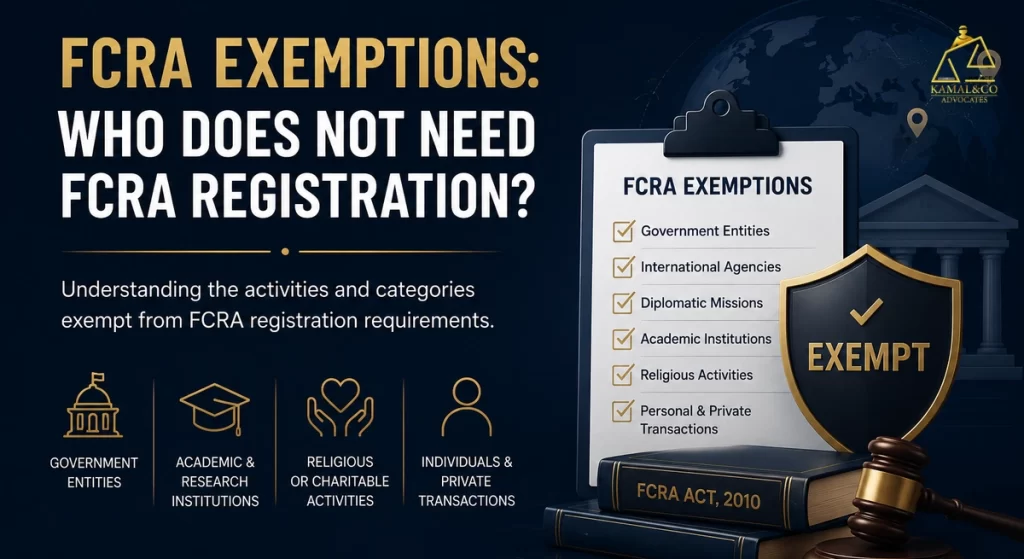
Gifts from close relatives living abroad do not require registration with the FCRA if they are below ₹10 lakh per year. But if the gift value exceeds ₹10 lakh, the recipient must inform the Ministry of Home Affairs of the amount within 3 months.
If the money is received by the Central Government and State Governments from foreign governments, it does not require registration under FCRA.
Gifts received from specific International organizations, including the United Nations organizations or any other organization specified by the Government, do not require registration under FCRA.
Any scholarships from foreign universities intended to attend an overseas educational institution do not constitute donations from abroad. But each donation will be reviewed individually.
Cancellation of FCRA Registration
The Ministry of Home Affairs has the right to cancel the FCRA registration under Section 14 of the Foreign Contribution (Regulation) Act, 2010.
The cancellation will depend on some major issues, such as:
- If the organization provides false information on the registration application.
- If the organization violates any conditions that are compulsory to fulfill under the registration.
- If the organization uses the foreign contribution for its own purposes rather than for the purpose mentioned under the FCRA.
- If they forget to file the Annual return within the required time frame, it can also lead to the cancellation of FCRA registration.
Once cancelled, an organisation will not be eligible to apply for another registration for 3 years.
A cancellation order isn’t always the end of the road. If the Ministry hasn’t followed due process, or the grounds cited don’t hold up, organizations can approach the courts to challenge it. Our guide on how to file a writ petition in India walks through what that process looks like and when it applies.
Latest FCRA Developments: FCRA 2.0 and the 2026 Amendment Rules
In mid-2026, the FCRA Act introduced certain changes, and any organisation that is planning to register or renew must be aware of these changes.
Foreign Contribution (Regulation) Amendment Rules, 2026 (notified 22 June 2026) introduced several structural changes:
- Purpose-specific registration: Any organisations who seeks registration or prior permission must select the specific purpose of their registration from a prescribed schedule of activities.
- Geography-specific registration: Registration is now tied to the specific States/Union Territories where the organisation operates; expanding to a new state requires fresh approval.
- Existing registrants must update their status: Already registered organisations must file a new Form FC-6F within one year, stating their purpose and operating location.
- A minimum-utilisation threshold: for renewal, tied to genuinely FCRA-funded activity (domestically funded work doesn’t count toward it).
- Restrictions on foreign nationals serving as “key functionaries” (a newly defined term covering directors, trustees, and office-bearers with control over the organisation), though OCI cardholders remain eligible.
- Enhanced disclosure of websites, social media accounts, publications, and where funds are routed through intermediaries to the ultimate foreign donor.
One thing we always tell our clients is to be updated on the Amendments to avoid unnecessary compliance issues. Already registered organisations must complete the FC-6F within the specified time period and confirm their registered purposes and operating states.
FCRA Compliance Mistakes We See NGOs Make
- Assuming that foreign receipt is enough because the purpose is charitable.
- Confusion between registration and prior permission.
- Filing FC-4 late or treating a Nil year as not needing to file at all.
- Leaving the renewal for the end before expiry.
- Not taking proper legal consultation before registration and returns filing.
Conclusion
Mistakes regarding the FCRA can damage your organization through costly litigation and loss of credibility in the community.
At Kamal & Co. Advocates, we work with various types of organizations: non-governmental organizations, charitable institutions, and others, to assist you with FCRA registration on the MHA FCRA portal and for renewal of international funding.
Also, we help clients with compliance audits, FCRA notices, and legal counseling and advice on FCRA issues.
If you require assistance with any FCRA-related matters, contact us.