


A Non-Disclosure Agreement in India is a contract which needs the parties involved to keep confidential information secret and controls how the information is used.
Suppose you’re a startup founder about to pitch a business idea to your investors or board of members. Or you’re an employer hiring a new employee with whom you’ll share the details of clients and internal information. So before sharing any information, you’ll need a Non-Disclosure Agreement to ensure no information slips out in public.
At Kamal & Co. Advocates, our civil & corporate lawyers help draft and review NDAs for funders, businesses, or individuals. In this blog, we explain what an NDA is, when you need it, and how to draft it.
What Is a Non-Disclosure Agreement (NDA) in India and Why Does It Matter?
An NDA is a lawful, written promise that is made to legally bind the other parties into a contract, which simply means that: I’ll share something private with you and you agree not to pass it on.
The Indian Contract Act, 1872, governs non-disclosure agreements in India; this act also covers employment agreements, sale deeds, and rental contracts. There are various similar kinds of agreements to non-disclosure agreements, like confidentiality agreements, confidential disclosure agreements (CDA), or proprietary information agreements (PIA).
Businesses, employers, traders, or freelancers use NDAs whenever there is any sensitive information that needs to be shared before the official deals are finalised, like: A business idea presented by the founder to investors, an employer onboarding staff, or a freelancer being given access to client data. In these types of situations, the NDA is an agreement that no parties will share their information with a third party who is an outsider.
Which Type of Non-Disclosure Agreement Is Right for You?
Non-Disclosure Agreements are of three types, and which one is most suited for you depends on who is sharing information, with whom, and in which direction.
1. Unilateral NDA
When two parties are discussing a deal and only one party out of them is disclosing any confidential information, and they intend to keep the information confidential, they prepare a unilateral NDA.
2. Bilateral NDA
A bilateral agreement is perfect when there are two parties in a contract, and both are sharing confidential information and want to keep it safe. This type of agreement is mostly used during a merger of companies or a joint venture.
3. Multilateral NDA
A multilateral agreement is the most preferred when there are three or more parties involved in a deal, and one or more parties are disclosing important information with the intent to keep it protected. This is commonly used during funders, investors, or board members meetings.
If you’re drafting an NDA, want legal advice on the type of agreement that is best for you, or how to draft these agreements, you can consult with the legal team for corporate advisory at Kamal & Co. Advocates.
Is a Non-Disclosure Agreement Legally Enforceable in India?
For any agreement to become legally valid in India, it needs to meet four core requirements under section 10 of the Indian Contract Act, 1872. An NDA is treated the same way, and the four requirements are:
- Offer and Acceptance: In this, one party proposes an offer and the other party has to provide its acceptance for the offer to become an agreement.
- Consideration: It means ‘something in return’, so against the NDA offer made by one party, the other party promises not to disclose any information to the third party.
- Free Consent: In the agreement, the consent should be free of coercion, misleading, or forced into signing the contract.
- Lawful Object and Lawful Consideration: The agreement should not include anything illegal; otherwise, it will void contract.
Does an NDA Need to Be Stamped in India?
Often, our clients doubt whether their agreement requires a stamp or not; the stamp duty depends on the Indian Stamp Act and the state’s stamp law. It’s always crucial to verify the transactions and jurisdiction involved in the contract to identify the legal compliance.
Apart from the legal requirements for a contract to be valid, there are a few other things that can cause trouble with the enforceability of an NDA. Here are reasons when courts decline to enforce NDAs:
- Unclear definitions: Confidential information should be defined clearly without any ambiguity.
- Unclear duration: If the contract lacks a defined duration for information to stay confidential, the court can decline to enforce it.
- Public information: When the confidential information is already in public, then the contract becomes pointless.
- Prior knowledge: The receiving party is already aware of the information.
- Improper execution: Applicable requirements relating to stamping and execution should be considered.
NDA Format in India: What Should It Include?
A non-disclosure agreement means that all parties’ confidential information, the parties’ responsibilities, and the consequences of any breach are clearly defined without ambiguity. Here are the steps for drafting an NDA:
- Identify the parties
It’s a must for any contract to be valid that it defines the full names of all the parties and their addresses. - Define confidential information
This is very important; carefully write the information that is required to be protected, make sure it’s clear and precise, not incomplete, such as business plans, customer data, pricing, source code, designs, or trade secrets. - Obligations of the receiving party
Clearly mention the obligation of receiving party whether they can share the information with any third party or not, and whether can they use it for personal purpose except for the agreed purpose. - Include standard exclusions
You must know what information is actually confidential; avoid adding information that’s already live in public, the receiving party is already aware of, and legally required to disclose. - Specify the duration
Define for how long they need to keep the information confidential and whether this duty continues even after the contract ends. - Add remedies and governing law
Explain what happens if the agreement is breached and which state’s law applies and which court has jurisdiction over any dispute. - Review and sign before disclosure
After reviewing the above details, carefully review the agreement to avoid missing any important details, and then only sign the contract.
Our experience: Once we reviewed a fully drafted NDA for a client that was not receiving approval, upon inspection we found the problem was overly detailed confidential information, which led to confusion and delayed enforcement.
When Should You Consult With a Professional
- Firstly, when the information you’re sharing is highly sensitive.
- You are not sure about the stamp duty and other legal formalities.
- Consult a legal adviser when foreign parties are involved.
- Or whenever you’re hit by a complex clause while drafting.
What Happens After a Breach of an NDA?
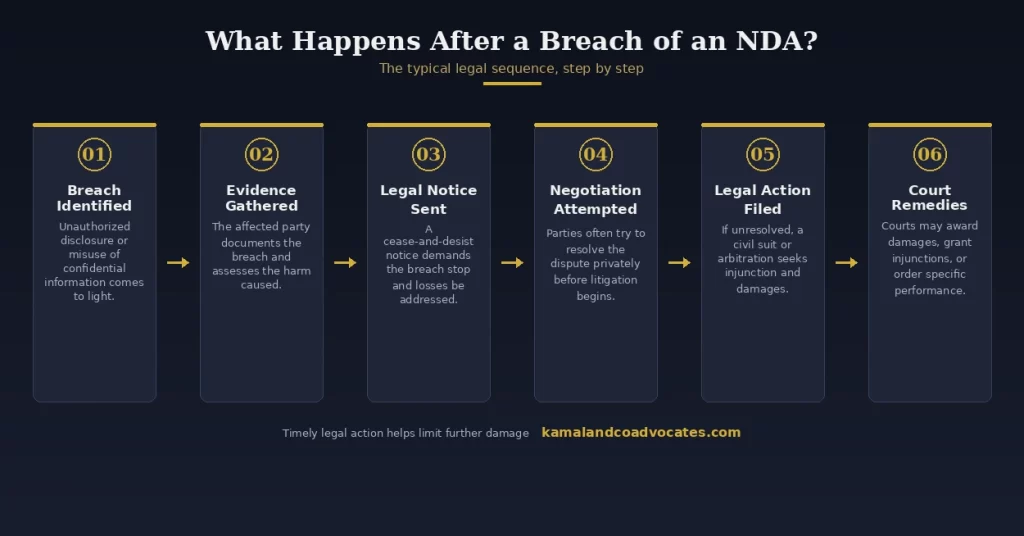
Many times we have seen the receiving parties of a non-disclosure agreement violating the terms of the agreement. They share the information or use it in such a way that is not allowed. And these actions have legal consequences that depend on the contract, the nature of the information, and the loss incurred by the owner.
Legal Remedies for Breach of an NDA
Here is the list of legal remedies for contract breach that the affected party can seek for a breach of a non-disclosure agreement.
- Injunction: The court’s stop order to prevent further misuse or sharing of confidential information.
- Damages: The affected party can seek financial compensation for the losses incurred due to breach.
- Contractual Remedies: Any penalties or obligations specifically agreed upon in the NDA.
- Other Legal Relief: Depending on the facts, courts may grant additional remedies available under applicable laws.
How to Prevent NDA Breaches
There is nothing that can eliminate risk; though we can try to reduce the chances of a breach by following good lawful practices, such as:
- Limiting who can access confidential information.
- Training our employees on their responsibilities to the organisation.
- Reviewing and updating NDAs periodically.
- Using secure systems for storing and sharing sensitive information.
- Clearly defining confidential information and the duties of the receiving parties.
Why a Longer NDA Is Not Necessarily a Stronger NDA
A common myth is that the more detailed an NDA is, the better protected the information will be. In reality, the strength of the contract is decided on whether its obligations are clear and connected to the actual transaction.
A well-drafted NDA should answer five practical questions:
- What information is actually confidential?
- Why is the receiving party being given access to it?
- How can that information be used?
- Who can access or disclose it?
- What happens if the confidentiality obligation is breached?
Common Mistakes to Avoid While Drafting an NDA
Here is a list of some mistakes that many individuals make while preparing non-disclosure agreements:
- Using vague or overly broad definitions of confidential information.
- Sharing information without the signatures of the parties on the NDA.
- Forgetting to add the duration of the NDA.
- Using templates available online without adapting them to the transaction, parties, and applicable law.
- Adding information which already known in the public.
- Allowing unrestricted access to employees or contractors.
- Using non-compete and non-solicitation clauses without legal review.
Lawyer’s perspective: We have often seen misunderstandings and disputes arising due to overly broad information; it becomes difficult to interpret the intention behind it.
NDA or Something Else? Compare the Right Agreement
| Agreement | Main purpose | Key difference from an NDA |
|---|---|---|
| NDA | Protect confidential information | Focuses on secrecy and permitted use |
| Non-compete agreement | Restrict competitive activity | Limits certain work or business activities |
| Non-solicitation agreement | Restrict solicitation | Covers employees, customers, or suppliers |
| Intellectual-property assignment | Transfers ownership of IP | Changes ownership rights |
| Data-processing agreement | Regulates personal-data processing | Focuses on privacy and data-protection duties |
The 5-Step NDA Review Checklist
Here are 5 pieces of advice from Kamal & Co. Advocates that can help you in drafting a clear and practical non-disclosure agreement.
- Always be clear when defining the information.
- Clearly explain the purpose for sharing the information and the extent to which the receiving party can use the information.
- Define the duration for which the information is retained.
- Specify the legal remedies in case the NDA is violated.
- Carefully review the contract before signing.




2 thoughts on “Non-Disclosure Agreement in India: A Complete Guide to Types, Drafting & Breach”
Pingback: Due Diligence in Mergers & Acquisitions: A Legal Checklist for Indian Businesses - Kamal and Co. Advocates
Pingback: Legal Process Outsourcing in India: How LPO Works