


Why did the government amend the IBC? Well, simply because there were a few limitations that businesses and creditors faced under the previous IBC Act.
For example, Ramesh runs a small manufacturing business in Mumbai. One of his major customers defaulted on its payment, causing a financial crisis for his company. Ramesh decided to file an insolvency proceeding. However, the overall process took 8 months, with lots of delays. By the time a resolution professional was appointed, most of the company’s money and assets were already gone, due to which he couldn’t recover much.
To address this type of issue, the government decided to bring some important changes to the Insolvency and Bankruptcy Code again on 6 April 2026. If you are a business owner, a creditor waiting for your money, or a promoter worried about personal exposure, then you need to understand what these amendments mean and how they can affect your business.
This blog explains everything about the IBC Amendment Act, 2026. And if you’re left with any doubt, you can speak with an experienced civil & corporate lawyer in Mumbai; they will guide you through the complete details.
What Is The IBC Act And Why Was The IBC Amended Again?
The government introduced the Insolvency and Bankruptcy Code, 2016, with the aim of giving businesses a time-bound framework for resolving insolvency in companies, partnership firms, and individuals. Some of its objectives are to increase the value of distressed assets, balance the interests of stakeholders, and improve the availability of credit by enabling faster and more predictable insolvency resolution.
Since it came in working, it has significantly transformed the insolvency regime of India. As per the Insolvency and Bankruptcy Board of India (IBBI), thousands of companies have gone through resolution under the IBC in the past decade.
But over time, the practical implementation of the Code revealed several challenges that people face, like:
- Cases were getting stuck in the process before the NCLT could even evaluate them.
- Courts kept encountering the same disputes over guarantor liability, avoidance transactions, and creditor rights during liquidation
- Lack of efficient legal mechanism in India for insolvencies that crossed borders
- There was no framework for group companies, where multiple entities under one promoter often needed to be resolved together
The IBC Amendment Act 2026 is precisely constructed to target these gaps and promote a faster, more effective resolution process.
The 5 Biggest Changes Under the IBC Amendment Act 2026
1. Faster Admission: The 14-Day CIRP Admission Timeline
One of the key objectives of the IBC Amendment Act was to reduce the delays in admission of insolvency proceedings.
So, this amendment ruled that the National Company Law Tribunal (NCLT) must admit or reject the application within 14 days, and if the tribunal takes longer than this, it must give the reasons for the delay.
2. Creditor – Initiated Insolvency Resolution Process
The CIIRP is a major reform brought by the Amendment Act; it’s an alternative to the traditional Corporate Insolvency Resolution Process.
Instead of the company’s management being immediately replaced by a resolution professional, the debtor stays “in possession” while creditors drive the process.
- It runs on a tighter 150-day window
- It’s designed only for specific, notified categories of debtors
- It can only be triggered by financial institutions the government has formally authorised
Important: Even though the government has already introduced CIIRP, its implementation depends on official notification by the IBBI. The process is expected to be completed within 150 days, with a possible one-time extension of up to 45 days.
3. Guarantor Provisions and the Moratorium Question
This was one of the most concerning changes as it directly impacts the promoters or directors, who provide personal guarantees for corporate borrowings. Before, there was some uncertainty regarding how the company’s insolvency moratorium would affect the personal guarantors.
The 2026 Amendment clarifies the relationship between insolvency proceedings and guarantor liability.
Based on the applicable provisions, the creditors can pursue their rights against guarantors independently of the corporate debtor’s insolvency proceedings.
We always advise promoters and directors who are giving their guarantees to check their financial exposure first. As insolvency proceedings against a company will also affect them.
4. A Longer Look-Back Period for Avoidance Transactions
If a company transferred assets, made preferential payments, or engaged in undervalued transactions shortly before going into insolvency can be investigated; then, as per the IBC Amendment Act 2026, the period that can be examined is extended to two years before the start of CIRP.
5. Group Insolvency and Cross-Border Insolvency
For the first time, Indian insolvency law formally recognises that companies within the same corporate group are often financially entangled.
A new framework allows group companies to be resolved together rather than as isolated, disconnected cases
The Act also provides a legal framework for cross-border insolvency, relevant for Indian companies with overseas assets or creditors, and for foreign creditors recovering from Indian debtors.
The IBC 2016 vs. The IBC Amendment Act 2026 - At a Glance
| Aspect | Before (IBC 2016) | Now (2026 Amendment) |
|---|---|---|
| CIRP admission | No fixed timeline; often delayed for months | Mandatory 14-day admission or rejection |
| Insolvency initiation | Debtor or creditor-led CIRP only | New creditor-driven CIIRP added |
| Guarantor moratorium | Legally ambiguous, heavily litigated | Explicitly clarified, doesn't cover guarantors |
| Avoidance transaction look-back | Shorter, less clearly defined window | Extended to 2 years before CIRP |
| Liquidator replacement | Limited power for creditors | CoC can replace liquidator with 66% vote |
| Group & cross-border insolvency | No formal legal framework | New framework introduced |
| Pre-pack eligibility | MSMEs only | Expanded to mid-market companies |
| Withdrawal after admission | Relatively flexible | Barred once resolution plans are invited |
How the IBC 2026 Amendment Transforms NCLT Proceedings?
This Amendment Act has also improved the efficiency of proceedings before the National Company Law Tribunal (NCLT).
1. Faster Admission of Cases
The amendment framework is designed to reduce the procedural uncertainty during the admission stage and to encourage better management. This allows businesses to enter the resolution process sooner, avoiding unnecessary delays.
2. Greater Power for the Committee of Creditors (CoC)
The Amendment has given huge authority to the committee of creditors by allowing a 66% voting majority to replace the liquidator in specified circumstances. This gives them the right to control the liquidation process and ensure the process is efficient and transparent.
3. Streamlined Tribunal Process
The reforms also seek to:
- Reduce procedural bottlenecks,
- Improve case management,
- Minimise unnecessary adjournments, and
- Promote time-bound disposal of insolvency matters, backed by broader regulatory compliance requirements for companies navigating these changes.
These changes are expected to improve confidence in the insolvency ecosystem by making proceedings before the NCLT more predictable and efficient.
How the 2026 Act Secures Your Resolution Plan?
The IBC Amendment Act 2026 introduces additional safeguards to make resolution plans more effective and commercially viable.
Protection of Business Licences
To protect businesses from losing their licences, permits, or approvals just because the ownership of the company has changed after the insolvency, this Act helps preserve all the value of the business and supports continuity even after resolution.
Protection for Dissenting Financial Creditors
The amendments also take care of dissenting financial creditors; they make sure that their interests are appropriately considered even if they vote against a resolution plan approved by the needed majority.
Continued Protection for Homebuyers
Homebuyers continue to be recognised as financial creditors under the IBC. This allows them to participate in the Committee of Creditors where applicable and ensures their interests remain protected during insolvency proceedings involving real estate projects.
What the IBC Amendment Act 2026 Means For You?
If You’re a Business Owner or Promoter
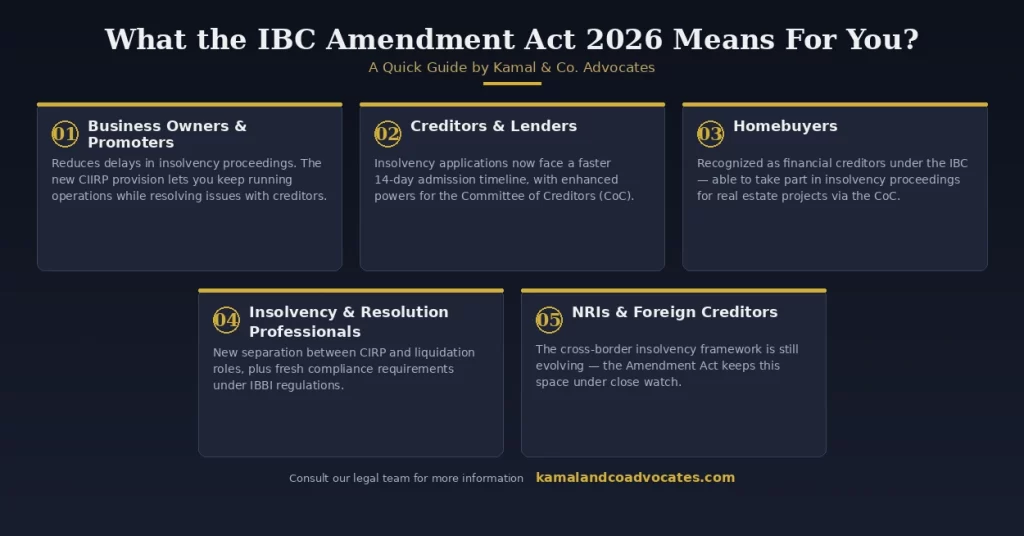
If your business is facing stressful days, this amendment allows you to reduce delays in insolvency proceedings. With new provisions like CIIRP, it allows you to continue your business operations while working with creditors on solving the problems.
For further information, you can consult with our legal team at Kamal & Co. Advocates.
If You’re a Creditor or Lender
For creditors, this amendment has been really great, as it has reduced the admission period of insolvency application to a 14-day timeline and enhanced the power of the committee of creditors (CoC).
If You’re a Homebuyer
Homebuyers are treated as financial creditors under the IBC; it allows them to take part in insolvency proceedings involving real estate projects through the committee of creditors.
If You’re an Insolvency Professional and Resolution Professional
You need to note the new separation between CIRP and liquidation roles, plus fresh compliance requirements coming through IBBI’s regulations.
If You’re an NRI and Foreign Creditor
For the cross-border insolvency framework, this amendment still keeps a close eye out to see if there are any further developments, as it’s still in progress; the Amendment Act wants to see how it turns out.
Key Takeaways: Navigating the 2026 IBC Changes
The IBC Amendment Act 2026 is most likely introduced to fix the delays, uncertainty, and gaps that have formed due to real-world experience in the last decade. The implementation of this is being carried out in phases. Some provisions are already in force, while others are waiting on final government notifications and IBBI regulations. Therefore, keeping track of all this information is important to know exactly which provision currently applies.
If you’re dealing with an insolvency matter, sitting on either side of a corporate debt dispute, or simply trying to figure out how these changes affect your business, our legal team at Kamal & Co. Advocates can walk you through what applies to your specific situation.