


Facing Mental Harassment at Workplace? Know Your Legal Rights.
Suppose every day you go to the office, complete your job on time, while getting unreasonably criticized, publicly humiliated, or threatened by your manager or a colleague.
Even though it causes no physical harm, such behaviour can leave emotional and psychological effects. Here is an example that illustrates this situation.
Every week, Priya goes through workplace bullying; her manager mocks her during meetings, takes credit for her work, and threatens to fire her over the smallest mistakes. This might not have left any physical mark, but it has caused her anxiety and made her afraid to speak up for herself.
What Priya goes through is called mental harassment at workplace. In this blog, we’ll see what workplace bullying in India looks like, what exact IPC and BNS sections apply, when you should consult workplace harassment lawyers, and how they can help you protect yourself.
What Behaviours Are Considered Mental Harassment at Workplace?
First, you need to know what workplace harassment is and what kind of behavior can cause anxiety or fear in someone. It includes:
- Repeated humiliation in front of colleagues
- Unfair treatment at work
- Not letting an employee participate in meetings or new opportunities
- Threats of termination without cause
- Continuous provoking or taunts to create a hostile work environment.
In our experience of advising employees who’ve faced workplace harassment, many clients believe that only physical abuse needs an action; however, repeated mental abuse can also lead to legal consequences, depending on the nature and intent behind the actions.
Mental Harassment at Workplace Meaning Explained Under Indian Law
You need to know that workplace bullying is not a small issue; over time, it can lead to big problems. And that’s why our lawmakers have provided us with solutions that will protect us in such situations.
Is Mental Harassment at Workplace Defined in the Constitution or Any Central Law?
In India, there is no specific law that uses the term “mental harassment at workplace” and defines it in one place.
But still some laws prohibits psychological abuse at work like the Sexual Harassment of Women at Workplace (Prevention, Prohibition and Redressal) Act, 2013, the Bharatiya Nyaya Sanhita, 2023 (Sections 351 and 352, covering intimidation and intentional insult), and the constitutional protections read into Articles 14, 15, 19(1)(g), and 21 by the Supreme Court in Vishaka & Ors. v. State of Rajasthan to protect an employee from workplace bullying in India.
What Makes Conduct Mental Harassment at Workplace?
The very first global case that brought the notice of people at violence and harassment at workplace was the ILO’s Violence and Harassment Convention (C190). It explained that any unacceptable behaviours or practices, or threats that aim to cause physical, psychological, sexual, or economic harm, whether they happen once or repeatedly is mental harassment at workplace.
In an Indian workplace, this clause covers cases like:
- Being humiliated in front of colleagues
- Criticised over unreasonable things
- Left out of a meeting or opportunity
- Threats of termination without any reason.
These are not very big issues, but if left unaddressed for a long time, it doesn’t remain harmless anymore. In our litigation experience, most mental harassment cases fail because employees preserve emotions rather than evidence. If someone repeatedly insults you to cause a reaction, that’s Section 352 BNS or if they threaten you that genuinely scares you that’s Section 351 BNS.
What Are the Applicable IPC and BNS Sections for Mental Harassment at Workplace?
In India, till July 1, 2024, any case related to workplace harassment was treated under the Indian Penal Code, 1860 (IPC), but after this date it was revoked and replaced by the Bharatiya Nyaya Sanhita, 2023 (BNS).
What’s important here is that any offences committed before July 1, 2024 are still prosecuted under the old IPC sections, while any complaint about conduct on or after July 1, 2024 is filed under the corresponding BNS sections.
IPC to BNS Comparison Table
| Provision | Old IPC Section | New BNS Section | Relevance to Workplace Harassment |
|---|---|---|---|
| Criminal intimidation | IPC Section 506 | BNS Section 351 | Threats to job, safety, or reputation |
| Intentional insult to provoke breach of peace | IPC Section 504 | BNS Section 352 | Repeated deliberate humiliation |
If you want in-depth, section-by-section details regarding the changes brought in law, then LegalKart’s IPC vs. BNS comparison guide is also a useful reference; it explains all the provisions under these acts.
Legal Provisions — POSH Act, BNS 351 & BNS 352 Explained
1. Sexual Harassment — The POSH Act
Under the POSH Act come all cases related to sexual harassment, like unwelcome remarks, gestures, or conduct of a sexual nature. In this Act, it’s compulsory for every organization with 10 or more employees to set up an Internal Committee (IC) to hear such complaints, in fact in 2025, POSH has declared penalties for almost every company incorporated under the Companies Act, 2013, for failing to disclose compliance. And if your organisation does not conduct an IC, or you’re unsure whether your situation qualifies, our team can walk you through labour compliance and workplace advisory support to figure out the right first step.
2. Criminal Intimidation — Section 351 BNS (formerly Section 506 IPC)
Under Section 351 BNS come the cases where someone threatens you for something unreasonable and that cause a fear, for example:
- A manager threatening to get you fired
- Damage your reputation
- Make your life difficult.
These kind threats should not be ignored and should be immediately informed to a legal authority; the law looks at whether it was made to cause alarm.
3. Intentional Insult — Section 352 BNS (formerly Section 504 IPC)
Under this section come cases where someone intentionally provokes, taunts or antagonizes another person to trigger a reaction, such as being mocked in front of colleagues on a regular basis, or being subjected to insults that are knowingly designed to break your composure.
POSH Act vs. General Workplace Harassment Remedies
| Aspect | POSH Act, 2013 | General Workplace Harassment (Non-Sexual) |
|---|---|---|
| Who it covers | Women employees only | Any employee, regardless of gender |
| Nature of conduct | Sexual harassment specifically | Bullying, intimidation, insult, hostile environment |
| Forum | Internal Committee (IC) mandatory for 10+ employees | HR/internal grievance policy, police (BNS 351/352), or civil suit |
| Governing law | POSH Act, 2013 | BNS 2023 (Sections 351, 352), Industrial Employment (Standing Orders) Act, civil law |
| Time limit to complain | 3 months (extendable) under POSH | Governed by general limitation law for criminal/civil complaints |
Can Male Employees File a Complaint for Mental Harassment?
The gap between male and female rights is still unfilled, and the lawmakers are being criticized for it, for the lack of a male harassment law in India. Women have the POSH Act specifically written for them, completely ignoring the men going through the same kind of mistreatment at the workplace.
But this doesn’t mean that men don’t have any option; they can raise their complaints under:
- Section 351 BNS (criminal intimidation)
- Section 352 BNS (intentional insult)
Most companies’ internal HR policies are gender neutral too, so raising a complaint is still possible. And in case a male faces mental trauma, a civil suit for damages is also available, and our team’s experience with corporate, IPR, and labour case litigation means we can help male employees build and pursue such a claim just as thoroughly.
How to Protect Yourself during Psychological Abuse at Work?
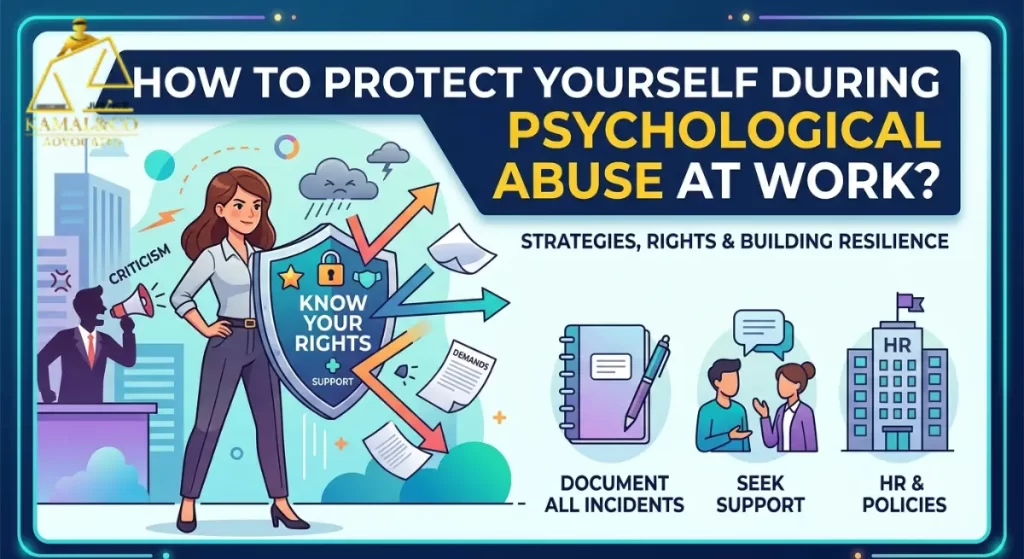
- Document everything: On facing such behaviour, your first step should be to save the emails, messages, or the testimony of the witnesses, and the dates of each incident.
- Raise an internal complaint: After that, you should raise a complaint to the HR or the Internal Committee.
- Send a legal notice: In such cases, writing a complaint is better than verbally putting it, as it creates a record and often resolves matters without litigation.
- File a police complaint: If it doesn’t resolve, you can approach an internal committee under the POSH Act or file a complaint under the BNS sections.
- Consult an employment lawyer: A lawyer will tell you better under which law your case comes and how to file a complaint.
Checklist: Are You Experiencing Mental Harassment at Workplace?
Know whether you’re going through workplace bullying or not; if the answer to most questions is “YES,” then you need to take action quickly:
- □ Do you get repeatedly humiliated or insulted in front of colleagues?
- □ Is your employer threatening you with termination or disciplinary action without a valid reason?
- □ Are you deliberately excluded from meetings, projects, or workplace communication?
- □ Does a manager or colleague frequently use abusive, intimidating, or demeaning language?
- □ Has such behaviour affected your mental well-being, confidence, or ability to perform your job?
- □ Have you reported the issue internally, but the behaviour has continued?
- □ Do you have emails, messages, or witnesses that support your concerns?
If you’re facing these situations, it’s advisable to document the incidents carefully and seek legal guidance to understand the options available under Indian law.
Conclusion
You don’t need to be afraid of going to your workplace just because of a manager’s or colleague’s behavior. In India, you’ve rights to protect yourself from mental harassment at workplace under the POSH Act, Section 351 BNS (criminal intimidation), and Section 352 BNS (intentional insult).
Our expert team at Kamal & Co. Advocates can help you understand your rights and the right course of action you can take for your specific situation.
If you or someone you know is going through this, then don’t face it silently or be afraid to speak up; immediately connect with experts



2 thoughts on “Facing Mental Harassment at Workplace? Know Your Legal Rights.”
Pingback: Workplace Harassment Act in India | Explained
Pingback: Whistleblowing in India: Laws, Process & Protection