


Whenever you’re acquiring a business or making an equity investment, you will need a share purchase agreement. Many people consider it a document to record the transactions and prices, while in practice the agreement helps with determining how the risk will be allocated among the buyer and seller long after the transaction closes.
Whether you’re a founder selling equity, an investor looking to invest, or a company restructuring its shareholding, you will need to prepare an SPA, which makes it essential to understand how to do so. Because if it’s not well drafted, the buyer might not get a clear idea of all their liabilities, or it might cause problems for the seller even after the deal closes.
This blog explains SPA, its uses, how to draft it, and the legal considerations that apply under Indian law. Further, if you have doubts regarding the construction or when you need it, you can consult with a corporate lawyer who will guide you through the process.
What Is a Share Purchase Agreement (SPA)? Meaning and Legal Purpose
A share purchase agreement is a legal contract that binds two or more parties who agree to buy and sell a company’s shares. In this, the ownership of the company transfers to the buyer through the shares. This agreement notes down the number and the nature of shares traded, at what price, the promises that each party makes regarding the company’s affairs, and the consequences of breaking the promises.
Why Does a Business Need to Prepare an SPA
- To maintain the records of share sales.
- To explain the responsibilities of all the parties.
- To avoid misunderstandings and disputes over the duties.
- To fix the purchase price and payment methods.
- To eliminate the risk through warranties and indemnities.
- To help review the overall deal, approvals, due diligence, etc.
When Do You Need a Share Purchase Agreement? Common Business Scenarios
Whenever a business deals in the buy and sell of shares of the company, it needs to prepare an SPA, such as:
- When existing partners sell their shares to another person or company.
- When new investors buy the existing shares of the company.
- When the business is acquired by another company.
- When a foreign company buys shares in an Indian startup.
- When the power/control of the company is being transferred through the shares.
The size of transactions can be different for small to mid-size enterprises, but the M&A principles remain the same; it just might need more detailed due diligence and negotiation.
Essential Share Purchase Agreement Clauses Every Business Should Include
A share purchase agreement is a legal contract that sets the terms of a share deal, like its buy and sell price, the obligations of both parties, and their rights. Therefore, it’s prepared with due diligence, and understanding the clauses that cover all the essential items of the contract can be helpful.
1. Parties in the Agreement
Carefully add the name of the buyer and seller of the shares; it can be a company itself or existing shareholders who are looking to increase their ownership in the company too.
2. Details of the Shares Sold
Mention the type, quantity, and what percentage of the overall company’s shares are being sold; also mention whether they are free of encumbrances.
3. Purchase Price and Payment Terms
Here, provide the price at which the shares are sold and the payment method; in this, the payment can be of several types: one, it can be fixed, or based on future performance, where the payment is received in stages, once at the start and after the target is achieved.
4. Representations and Warranties
In this, the seller discloses the company’s finances, health, ownership, liabilities, legal compliance, or any litigation history. This provision is one of the most negotiated clauses as it provides remedies to the buyer in case the company’s financial, legal, or operational position differs from what was represented during negotiations.
Expert Insight: Buyers usually negotiate broader warranties, while sellers seek to limit their duration and financial exposure.
5. Indemnification Clause
Apart from providing compensation during a breach, it also helps control the financial exposure after closing. Here, the buyer seeks maximum protection against any identified risk while the seller negotiates the time limits within which claims can be made, and the financial caps on liability.
6. Governing Law and Jurisdiction
It’s an essential part of the SPA; the governing law helps in resolving disputes and maintain the piece within the organisation. It provides certainty regarding dispute resolution, especially with cross-border transactions where parties can be unaware of laws related to enforceability in India.
7. Post-Closing Restrictive Covenants
These are the clauses that prevent a seller from launching a similar business within the same geography and for a period of time. It also stops the seller from approaching the business partners or customers of the company. Basically, this clause protects the goodwill of the company.
Lawyer’s Insight: We often advise our clients to add non-compete and non-solicit clauses in SPA to restrict the seller from using the goodwill of the company to start a similar business.
In case you’re looking for a professionally drafted SPA or a legal pro to review your prepared SPA, you can speak with Kamal & Co. Advocates to help you.
How to Draft a Share Purchase Agreement in India
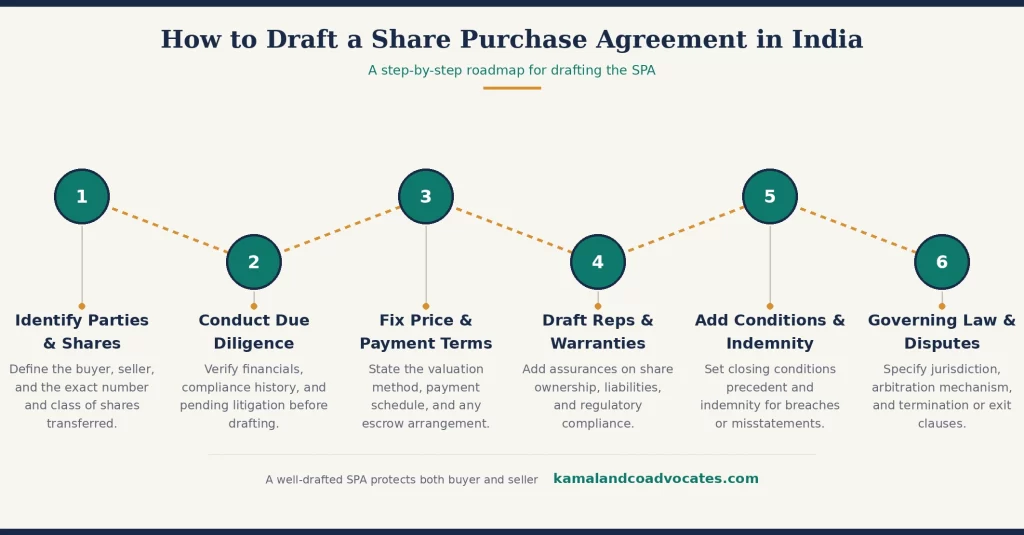
Step 1: Conduct due diligence: First, the buyer’s team thoroughly inspects the financial books of the company, legal reputation, and tax compliance before finalising the agreement.
Step 2: Negotiate commercial terms: The legal teams negotiate the price, payment structure, and key conditions.
Step 3: Draft core clauses: All necessary clauses are added, such as representations, warranties, indemnities, and closing conditions, based on the responsibilities and negotiated terms.
Step 4: Review regulatory requirements: Ensure that the agreement follows legal requirements, based on the Company Act, 2013, according to the sector and structure; foreign investment rules, or competition law may need to be factored into timelines.
Step 5: Final review and execution: Before closing the deal, both parties should review the final draft, resolve outstanding points, and execute the agreement.
There are SPA templates widely available; however, depending on a standard format without adapting it to the transaction can leave both buyers and sellers exposed to avoidable legal risks.
Share Purchase Agreement vs Asset Purchase Agreement - Key Differences
| Basis | Share Purchase Agreement (SPA) | Asset Purchase Agreement (APA) |
|---|---|---|
| What is acquired? | Shares of the company | Specific business assets |
| Ownership | Buyer acquires ownership of the company | Seller retains ownership of the company |
| Liabilities | Buyer generally assumes existing liabilities | Buyer only assumes agreed liabilities |
| Due Diligence | Comprehensive review of the entire company | Focused review of selected assets |
| Typical Use | Mergers, acquisitions, investor exits, and ownership transfers | Business restructuring, asset sales, or selective acquisitions |
Common Mistakes to Avoid When Drafting a Share Purchase Agreement
Even experienced parties get this wrong. Frequent pitfalls include:
- No proper due diligence; businesses often forget to inspect the company’s financial status, tax obligations, or any litigation. These are a type of hidden liabilities which can lead to problems in the future
- Using the templates available online; those are basically examples; they’re not perfect until you tailor them according to your business deal.
- Not properly drafting the warranties; it should clearly mention the actual business and risk
- Leaving unclear indemnity clauses; if in the future any party breaches the contract, the other party wouldn’t be able to claim compensation.
- Not adding non-compete and non-solicitation clauses to prevent the seller from stealing your clients.
Legal and Regulatory Considerations in India
If you are purchasing the shares of a company, then you must know the legal framework of share purchase in India:
- Companies Act, 2013: It controls the process of share transfer, board approvals, and statutory filings connected with the transaction
- FEMA regulations: These apply when a foreign fund is involved in buying and selling; they provide legal guidelines for cross-border share transfers.
- Stamp duty: It’s a kind of tax that is paid during the transfer of shares; its amount depends on the state and mode of transfer (physical or dematerialized).
- Income tax considerations: It’s the capital gains tax paid by the seller, and it also helps in ensuring that the price is fair to the market value.
- SEBI regulations: It’s relevant where the target is a listed company, triggering disclosure obligations and, in some cases, open offer requirements under takeover regulations.
Share Purchase Agreement Review Checklist
Before signing a Share Purchase Agreement, make sure your draft answers the following questions:
- Have all parties involved in the transaction been correctly identified?
- Are the number, class, and percentage of shares being transferred clearly mentioned?
- Is the purchase price and payment structure clearly defined?
- Have all representations and warranties been drafted according to the transaction instead of using an online template?
- Does the indemnification clause specify liability caps, claim timelines, and exceptions?
- Have you clearly mentioned all the conditions precedent and closing obligations?
- Does the SPA specify the applicable governing law and jurisdiction?
- Are confidentiality, non-compete, and non-solicitation obligations included where appropriate?
- Has the agreement been reviewed for tax implications and stamp duty requirements?
- Has a corporate legal professional reviewed the final draft before execution?
Not Sure If Your SPA Covers Everything?
For an effective share purchase agreement, you don’t just need to know the format. But you also need to understand what makes it strong and safety-proof for your company and rights. It works like risk management; never sign an SPA without giving it proper study.
If you’re unsure whether your SPA adequately protects your interests, our corporate law team at Kamal & Co. Advocates can review your agreement, identify potential risks, and recommend practical revisions before you sign.




2 thoughts on “Share Purchase Agreement: A Complete Legal Guide for Businesses and Investors”
Pingback: Legal Due Diligence for M&A in India: Key Checklist & Risks
Pingback: Tax Evasion in India: Meaning, Penalties & How to Avoid Legal Trouble - Kamal and Co. Advocates