
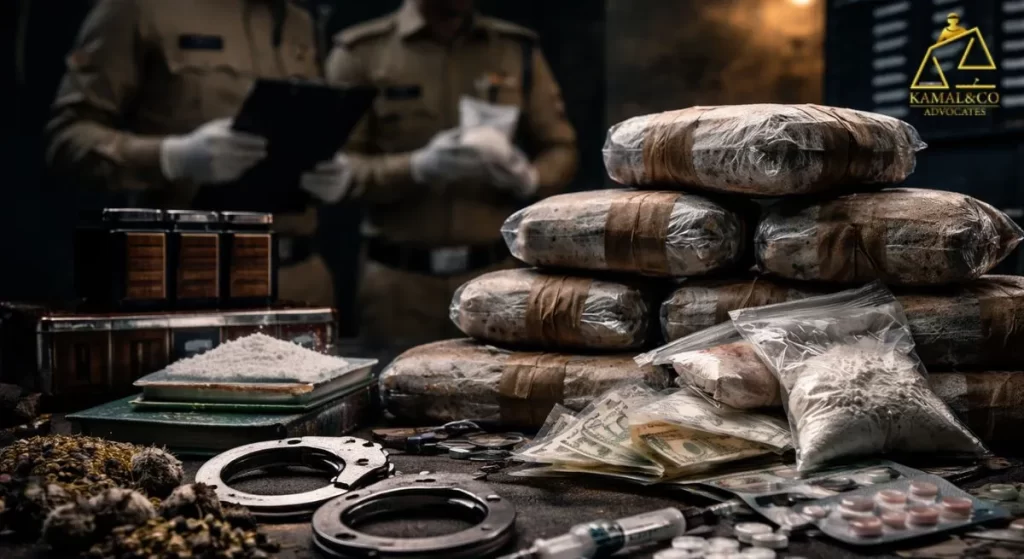

A college student was stopped one night during a regular police check. Someone found a small package in his bag, and all of a sudden he was facing an NDPS case. He thought it was a small matter, but the law saw it very differently.
Situations like this happen more often than people realise because many people don’t fully understand how strict drug laws are in India. With the Bharatiya Nagarik Suraksha Sanhita (BNSS) now in force and stronger enforcement by the Narcotics Control Bureau (NCB), cases have become more technical.
So, what is NDPS Act, and why does it carry serious consequences? This blog explains the meaning, offences, punishment, and legal process in simple terms so you clearly understand how the law actually works.
If you or someone you know is facing NDPS charges, speaking with an NDPS & criminal lawyer is essential, as these cases move very fast; details and legal assistance matter from day one.
What Is NDPS Act and Why Is It So Serious?
The full form of the NDPS Act is the Narcotic Drugs and Psychotropic Substances Act of 1985; it governs the production, possession, exchange, and usage of narcotic drugs and psychotropic substances. To use these drugs, you need to obtain permission under this law for scientific or medical reasons.
An NDPS case is considered a serious criminal offense under this Act. Ganja, Charas, Heroin, Cocaine, LSD, and MDMA are among the narcotics heavily controlled by the law. Even if you say it’s for your personal use, you could still be charged with:
- Possession: Simply having it in your bag, car, or house.
- Consumption: Being under the influence or having traces in your body.
- Financing: Providing money to drug dealers.
- Harbouring: If your property is used for drug activities.
Legal Fact: Under the NDPS Act, the “burden of proof” is rarely changed. If you are caught with drugs, the law presumes you are guilty unless you can prove otherwise.
Punishments Under the NDPS Act: Why the Law Is So Strict in 2026
India has a policy of “zero tolerance” for drugs because trafficking is often linked to organised crime and moving drugs across borders. In the past few years, increased enforcement has led to more seizures and charges.
According to the NCB 2025 Year-End Report, over 1.33 lakh kg of drugs were seized, and the conviction rate rose to 66.8%. This strict approach is reflected not only in punishment but also in the NDPS criminal procedure, which is more rigid than ordinary criminal cases.
The law is designed to be a deterrent:
- Mandatory Minimums: In commercial quantity situations, you can get at least 10 years in prison.
- Strict Bail: Section 37 of the NDPS Act says that bail is not the norm but the exception.
- No Easy Relief: Courts have limited power to reduce sentences for large-scale trafficking.
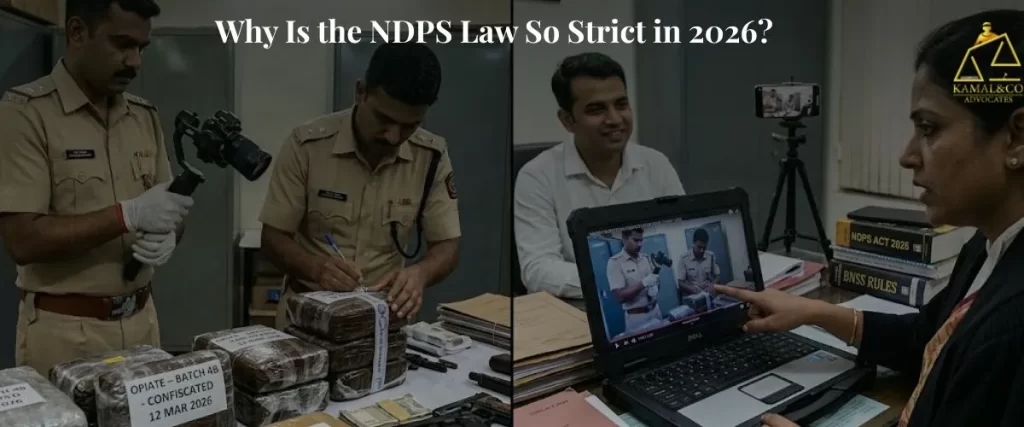
Expert Insight: “The NDPS Act is still very strict in 2026, but the new BNSS rules strongly favor the accused if the procedures are not followed.” Videotaping seizures is now your best defense; if the cops can’t follow this digital trail, the whole case usually falls apart.
What Is an NDPS Case: Types of Offences Under the NDPS Act
The NDPS Act does not apply only to drug dealers. It covers different actions connected to illegal drugs.
Possession
Having drugs with you is also an offence, even in small amounts. Proof of selling is not always required.
Consumption
Using drugs is separately punishable. Personal use can still lead to a criminal case.
Sale or Distribution
Selling, supplying, or acting as a middleman that promotes drug circulation.
Manufacturing or Cultivation
People who grow weed or make drugs without a license are also punished.
Transport, Import or Export
Trafficking narcotics between states or countries is a more serious crime.
Allowing Property or Financing
Knowingly allowing property use or funding drug activities can also result in liability.
NDPS Case Process: What Usually Happens After a Seizure?
Once drugs are found, the official process moves very fast; being aware of how an NDPS Act case works can help avoid mistakes and get legal help quickly:
- Search and seizure: Officers search the person or place and prepare a seizure memo in front of independent witnesses.
- Sealing and sampling: The quantity of drugs is measured, sealed, and samples are drawn.
- FIR and arrest: An FIR is registered, and the accused is arrested.
- Forensic testing: Samples go to the Forensic Science Laboratory (FSL) to confirm the substance and its quantity.
- Charge sheet and trial: After investigation, the charge sheet is filed in the Special NDPS Court, where the trial happens.
What Are the Types of Offences & The "Quantity" Rule in NDPS
In the NDPS law, the weight of the drug determines your fate. The law divides seizures into three categories based on the small and commercial quantity notification issued by the Central Government under the NDPS Act:
- Small quantity: A small amount, usually for personal use. For example, 1 kg of ganja or 5 grams of heroin. Punishment could be jail for up to a year of hard time, a fine of up to ₹20,000, or both.
- Intermediate quantity: more than a little but less than a lot for business. The punishment can be up to ten years in prison and a fine of up to ₹1 lakh.
- Commercial amount: A lot of drugs, like 20 kg of ganja or 250 grams of heroin, that show trafficking. Punishment must include 10 to 20 years in jail and a fine of ₹1 lakh to ₹2 lakh.
Understanding commercial quantity vs small quantity NDPS is important because sentencing becomes significantly stricter as quantity increases.
How Does BNSS Affect the NDPS Act Case Procedure?
The BNSS replaced the old CrPC in July 2024, and it brought stricter and more transparent rules on how the investigation works:
- It states that the whole process of search and seizure must be documented. This protects both the accused and the officers.
- To keep the E-FIRs, electronic summonses, and digital evidence.
- For serious offences, forensic experts are expected to visit the scene and collect evidence.
- The officers must communicate the rights of the accused.
Can Drug Users Avoid Punishments Under Section 64A of The NDPS Act?
A lot of people don’t know that the NDPS Act helps people recover instead of getting punished. Section 64A of the NDPS Act protects addicts from being charged with using or having tiny amounts of narcotics for treatment.
- The accused must willingly go to a government-approved de-addiction centre for treatment.
- Charges may be dropped if the treatment is successful.
This law only helps people once and does not apply to traffickers or anyone who has done it before.
How Does Bail Work in an NDPS Act Case?
NDPS law is very severe; bail in an NDPS Act case is almost impossible, especially if the drugs are found in commercial quantity. Let’s see how you can get bail in this Act:
- Small quantity: Bail is generally easier to get compared to under Section 37, but the bail still depends on the offense and circumstances of each case.
- Commercial quantity: Section 37 applies. The court must be satisfied that there are reasonable grounds to believe the accused is not guilty and is unlikely to reoffend on bail. This is a high bar.
- Default bail: If the charge sheet isn’t filed within the legal time limit (180 days, extendable up to one year), the accused may be entitled to bail as a matter of right.
What Happens After an NDPS Case Is Filed?
Once the drugs are seized, authorities begin a legal process that should be strictly followed. Samples are sealed and are sent to a forensic laboratory to confirm if there is any substance.
The usual steps include:
- Registration of an FIR.
- Possible arrest of the accused.
- Investigation by authorities.
- Filing of a charge sheet before a Special NDPS Court.
Because the NDPS law is technical and strict, many accused persons seek help from a criminal defence lawyer for NDPS case matters. These cases require careful handling of procedural details, forensic reports, and quantity classification.
Common Mistakes People Make in an NDPS Act Case
- They think keeping a small amount wouldn’t be a big deal.
- Signing documents without reading them.
- Ignoring Section 64A; it provides immunity from prosecution for treatment.
- Giving statements and staying under police investigation without a lawyer.
- Not utilizing your rights; you can ask to be searched in the presence of a Gazetted Officer or a Magistrate.
When Should You Consult an NDPS Lawyer?
Consulting an expert criminal lawyer in an NDPS case is essential, as these cases are uncompromising, bail is tough, and the legal process moves fast; you can’t wait for opportunity. You must consult a lawyer at the very moment.
Criminal lawyers at Kamal & Co. Advocates can help you with:
- Examine the situation and evidence connecting the accused.
- Identify legal remedies for the accused,
- Represent the accused at different stages of proceedings.
- Can assist with bail and trials.
Understanding NDPS Law: Why Legal Guidance Matters
An NDPS case isn’t just a “drug case”; it is a battle of technicalities. When people ask what an NDPS case is, they usually don’t realize how much it depends on factors like proving conscious possession, verifying FSL reports, and ensuring proper BNSS compliance.
The law is tough, but it also demands strict compliance from authorities. In a situation like this, it’s important to get good legal advice. Firms such as Kamal and Co. Advocates are experts in criminal cases, like the NDPS cases. They have experience in handling these technical legal challenges with care and precision.