
Suppose you supplied goods worth Rs.3 lakh to a trader, and after weeks of reminder finally he hands you the cheque. You feel relieved and deposit the cheque, and a few days later you get a message from the bank that the cheque was returned, funds insufficient.
This leaves you with worries about your payment: How will you get it back? How much time will it take? A cheque dishonour may give rise to a criminal complaint under Section 138 of the Negotiable Instruments Act, 1881.
This blog explains the legal procedure, the time limit, documents required, and the punishments. If you’re not sure how to file a complaint or what the right format is, you can speak with an experienced criminal lawyer for guidance.
What is a Cheque Bounce Case and What Law Governs it?
A cheque bounce means a dishonoured cheque when the bank returns it unpaid, mostly due to lack of funds or because the amount exceeds the limit with the bank. A cheque bounce case follows legal proceedings. And under Section 138 of the Negotiable Instruments Act, 1881, a dishonour of a cheque issued to fulfil a legal obligation can be an offence if it meets the required statutory conditions.
The provisions on cheque dishonour sit in Chapter XVII of the Act (Sections 138 to 148), which covers the offence, presumptions in the holder’s favour, interim compensation, compounding and appeals. This guide focuses on how to file a case. For a detailed explanation of the law behind it, you can read our guide on Section 138 of the NI Act: cheque bounce law explained.
When Can You File a Cheque Bounce Case?
A bounced cheque does not directly become a Section 138 offence. It must satisfy the statutory requirements:
- The cheque must have been drawn by the drawer to you.
- The cheque must be issued toward a legally enforceable debt or liability.
- The cheque must be presented within its validity period, meaning within 3 months of its issue date and returned unpaid.
- You have issued a written notice to the drawer for payment within 30 days from the bank’s information, and the drawer has failed to pay within 15 days of receiving the notice.
- The complaint must be filed within the limitation period under Section 142.
How to File a Cheque Bounce Case: Step-by-Step Procedure
Step 1: Present the cheque within its validity period
Firstly, you must present the cheque at the bank within 3 months from its issue date and keep the deposit slip, or any other invoice you receive, as proof.
Step 2: Collect the cheque return memo
If the cheque gets bounced, you will receive a return memo stating the date of dishonour and the reason. The date on which you receive the bank’s information about dishonour is what starts your 30-day notice period.
Step 3: Send the legal notice within 30 days
The statutory notice must be issued within 30 days of receiving the information of dishonour of the cheque to the drawer demanding the payment amount. Here’s what you must include in the notice:
- Names and addresses of the drawer and payee
- Cheque number, date, amount, and drawee bank
- Date of presentation and date and reason of dishonour
- A short description of the underlying debt or liability
- A clear demand for payment of the cheque amount within 15 days of receipt
- A statement of the consequences of non-payment
Expert Advice from Adv. Kamaluddin Ahmad: Keep the demand for only the cheque amount; don’t add any interest or bank charges into it. This helps avoid any counterclaim.
Step 4: Allow the drawer 15 days to pay
After sending the notice, you need to wait for 15 days for the drawer to make payment. If the drawer pays back the amount, then it won’t be considered an offence under Section 138, but if they don’t, then you can file a complaint against them.
Step 5: Prepare the complaint
Then you prepare to file the complaint, you can consult with a lawyer who can guide you or draft and file a complaint on your behalf. Below we have provided the list of documents that you must include in the complaint.
Step 6: Identify the correct court
Finding the right jurisdiction is a very important step; territorial jurisdiction is governed by Section 142(2) of the N.I. Act. In simple terms, where the cheque is delivered for collection, the court within whose limits the payee’s or holder’s bank branch is located generally has jurisdiction.
Expert Insight: Confirm the details from the deposit slip and return memo before you file a complaint. As a wrong jurisdiction can delay the case.
Step 7: File the complaint
After the petition and all the documents are ready, you can file the complaint. And keep track of your case through eCourt portals.
Step 8: Know what happens after filing
After filing, the court examines the complaint and, if satisfied, takes cognizance and issues summons to the accused. The accused appears, is usually granted bail, and the case moves to trial.
Cheque Bounce Case Time Limit: Important Dates to Remember
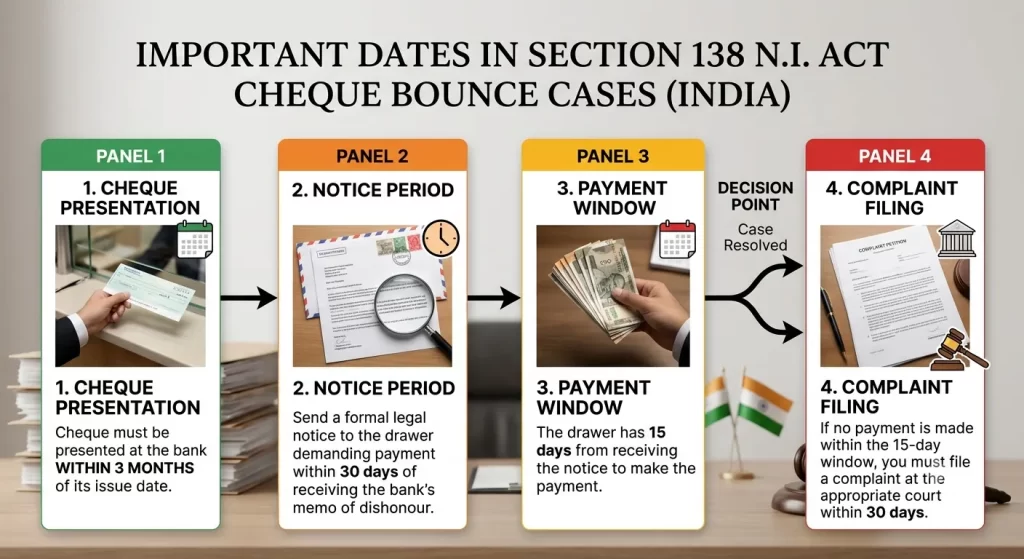
In India, filing a cheque bounce case under Section 138 of the N.I. Act follows a strict time limit. Firstly, a cheque must be presented at the bank within 3 months of its issue, and if you receive a bank message regarding dishonour of the cheque, then here’s how the procedure moves further:
- Notice Period: You must send a notice to the drawer about the cheque bounce and request them to make the payment within 30 days of receiving the bank’s memo.
- Payment Window: Once the notice is received by the drawer, they have 15 days to make the payment.
- Filing Deadline: If, within the 15 days of the payment window, the drawer does not make payment, this offends Section 138(c), then you must file a complaint in the right court within 30 days.
What if You Miss the Deadline to File a Cheque Bounce Case?
The case must be filed within the 30-day window after the payment window closes. However, if you miss the deadline, you can request a delay condonation under Section 142 of the N.I. Act if you can prove that you had a valid cause for the delay.
Documents Required to File a Cheque Bounce Case
Core documents
- Original dishonoured cheque
- Bank return memo
- Copy of the legal notice
- Postal receipts, tracking reports and delivery proof (and email records if sent)
- Proof of the underlying debt or liability
Supporting documents, as relevant
- Invoices, purchase orders or delivery challans
- Loan agreement or repayment schedule
- Account statements showing the transaction
- Messages, emails or letters acknowledging the liability
- Identity proof and, for companies, board resolution or authorisation
- Complaint, affidavit and annexures in the format the court requires
Advice from Adv. Kamaluddin Ahmad: Attach these details in the order of the story, like the amount details, the cheque, the dishonour details, the notices you sent, and the non-payment. This can help the judge understand the case in a sequence.
What is the Punishment for Cheque Bounce?
As per Section 138 of Negotiable Instrument act,1881, the punishment for cheque bounce can be:
| Punishment | What the law says |
|---|---|
| Imprisonment | Imprisonment for up to 2 years |
| Fine | Fine amount can extend to twice the cheque amount |
| Both | Or both, punishments |
One important thing to understand is that filing a cheque bounce case directly will not lead to these punishments; the court might consider the evidence, applicable legal requirements, or the defence raised before reaching its final decision.
How to Check Cheque Bounce Case Status
Once you have filed the complaint, you can check the progress of your case from the government’s eCourts service website, or its mobile app. Here’s the complete process simply explained:
1. Keep your details ready: Once you enter the website, you’ll need to provide certain details of your case, like:
- CNR number, a unique 16-character code given to every case in the district courts.
- Case number and year
- The names of the parties
2. Open eCourts Services: Go to the official eCourts Services website or open the eCourts Services app, and choose Case Status.
3. Select the court: Choose the state, district, and court complex where your complaint was filed.
4. Search using one of the options below.
5. Enter the captcha and click Search.
6. Open your case from the results to see its details.
What are the Other Legal Remedies in a Cheque Bounce?
Interim compensation under Section 143A
In Section 143A, the court may ask the accused to pay interim compensation of up to 20 percent of the cheque amount to the complainant, while the trial is pending. This is a temporary compensation and should not be confused with the final compensation or fine that the court may order if the accused is convicted.
Settlement and compounding under Section 147
As per Section 147, the offence is compoundable, so parties can settle at any stage, usually with the court’s recording of the compromise. The courts are also encouraging early settlement, and the Supreme Court has laid down guidance on compounding and costs in cheque bounce matters.
Appeals under Section 148
If the accused is convicted and appeals, then under Section 148, the appellate court may ask the accused to deposit at least 20 percent of the fine or compensation to the complainant while the appeal is still pending.
Common Mistakes That Can Weaken Your Case
Here are some common mistakes that people make during deposit or while filing a complaint:
- Presenting the cheque late: Check the date mentioned on your cheque and deposit it within that period.
- Missing out the 30 days notice period: You need to send the notice to the drawer within 30 days from when you received the bank’s information.
- Demanding the wrong amount: You can only demand the amount mentioned on the cheque, like invoices, agreements, messages, or statements.
- Not keeping sufficient evidence: Collect and maintain all relevant documents for your case.
- Filing your case at the wrong court: You can verify Section 142(2) jurisdiction using your bank branch details.
Conclusion: Act Early, Document Everything
Overall, filing a cheque bounce complaint isn’t that complicated if you know the right procedure, file it on time, with all the required documents and proofs, and in the right court.
And if you’re not sure about the deadlines or how to prepare the notice, you can speak with a lawyer who can guide you through it. Our team at Kamal & Co. Advocates can understand your case and help you with case filing and the complete procedure.