
Reviewed by – Senior Adv. Kamaluddin Ahmad
This June, we saw hundreds of young students walk into Jantar Mantar in New Delhi to protest against the education system over the leak of the NEET Exam paper.
The gathering turned into the largest student-led demonstration India has seen in recent years. And it ended with the education minister’s resignation and a new law against malpractice in the education system.
So here is the question many people are asking: Is protesting a legal right in India, and what actions government can take against it?
This guide explains the right to protest in the Constitution, the laws that govern it, what a peaceful protest is, and what the restrictions are. And if you’re considering participating in a protest, then you should consult with an experienced civil lawyer regarding your eligibility and whether it’s lawful or not.
What Is the Right to Protest in India?
The right to protest refers to the freedom to show your disagreement over any policy, present your demands, and collectively bring attention to the matters of public concern.
There are various ways to protest, such as marches, sit-ins, public meetings, candlelight vigils, and peaceful assemblies. It is to bring attention to the government over public issues so that they can provide a solution to it.
But there are some important features of a protest, such as:
- It should be peaceful, without arms
- It should not include any harmful objective
- And it should be with free will, not under any pressure
However, the Constitution does not simply give the right for everyone to protest. Instead, this right comes from a group of constitutional freedoms, like Article 19(1)(a) and 19(1)(b). These rights together allow the public to protest.
Is the Right to Protest a Fundamental Right in India?
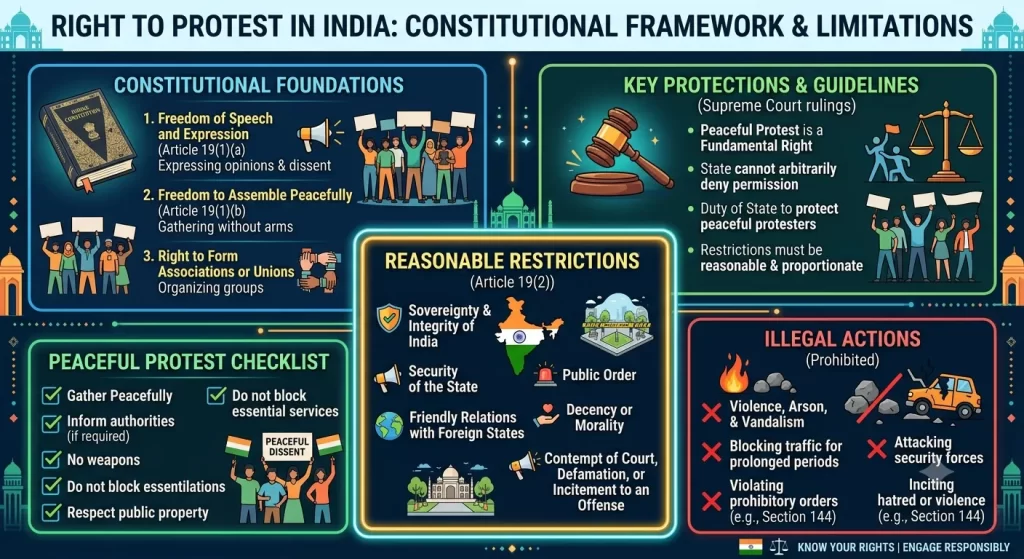
The principal constitutional protections for peaceful protest appear in Article 19 of the Constitution of India.
Article 19(1)(a): Freedom of Speech and Expression
This right gives citizens the freedom to put their opinions out and participate in discussions; it also gives them freedom to criticise and show their disagreement over policies made by the government or public authorities.
Article 19(1)(b): Right to Assemble Peaceably and Without Arms
This right ensurethat if the citizens are gathered in an assembly or protests then, it should be in a peaceful manner without arms.
Article 19(1)(c): Freedom to Form Associations and Unions
This gives the right to citizens to form associations and unions. With this right, students, workers, civil society organisations, or any group can come together in protest and organise demonstrations.
What Restrictions Apply to Peaceful Protests?
Just like how the Constitution allows the right to protest, it also sets certain restrictions on these freedoms, and it is important not to mix them up:
- Article 19(2) allows reasonable restrictions on freedom of speech and expression on specified grounds, such as the sovereignty and integrity of India, security of the State, public order, decency or morality, and incitement to an offence.
- Article 19(3) allows reasonable restrictions on the right to assemble peaceably, but only in the interests of the sovereignty and integrity of India or public order.
- Article 19(4) talks about restrictions on forming associations and unions.
For every protest, restrictions must be supported by valid legal reasons. An authority cannot prohibit a gathering simply because it is inconvenient.
In practice, restrictions usually take the form of:
- The authorities give rules on the place, time and manner of an assembly.
- They have prohibitory orders under Section 163 of the BNSS, under which they can restrict gatherings in a defined area for a defined period.
- Many cities have designated protest sites like Jantar Mantar in Delhi.
- Strict action against unlawful activities, such as violence or obstruction.
These restrictions on one protest do not make every protest unlawful. A peaceful protest does not give protesters immunity from lawful regulation.
What is the Procedure of Getting Permission to Hold a Protest?
If you’re planning to hold rallies or public gatherings with the purpose of protesting, then you need to get permission from the police authorities that have jurisdiction over the area where you’ll be protesting.
How to apply?
- Check for prohibitory orders: Check the rules and regulations like Section 163 BNSS orders or state-law prohibitions for your exact place and dates. Ask the local police station or district office for more details. If an order is in force, applying for a normal permit may be pointless until it is lifted or changed.
- Write an application: To seek the permission you need, write an application. Keep it simple, explain the purpose of the protest, when and where you will hold the protest, how many people will be present, and other relevant details.
- Find the right authority: This application goes to police departments or the Deputy Commissioner of Police (DCP) of the district.
How early should you apply?
It’s always better to seek permission as early as possible, but the government expects the application for permission at least 10 days before. You can confirm it with the DCP officer of that area.
What details you need to include in your application
Here are the details that need to be present in the permission application:
| Detail | Why it matters |
|---|---|
| Name, address and phone of organisers and the organisation | Police need someone accountable |
| Purpose of the protest, in one or two lines | Shows it is a lawful, specific cause |
| Date, start and end time | Needed for traffic and security planning |
| Exact venue or route | A vague venue invites refusal |
| Expected number of participants and volunteers | Must fit the venue and permit |
| Vehicles, loudspeaker and tent requests | Each may need separate approval |
| A named liaison person with a phone number | Makes coordination easy |
Expert advice: Our Senior lawyer Advocate Mr. Kamaluddin Ahmad states that the application for a protest plays an important part in a successful protest; it should be clear and must mention all the important clauses of the protest.
What Can Citizens Do if Protest Permission Is Denied?
If the permission to hold a demonstration is denied, here’s what you should do:
- Get the decision in writing so you can challenge it, as a verbal no can’t be challenged in court.
- Try to understand the reason for refusal to protest, like if it’s the nature of the protest or whether it’s causing inconvenience to the public.
- After this, consult with the advocate for available legal remedies, which may include representation before the authority or approaching the High Court under Article 226.
- You can also try to work on the reasons provided by the authorities.
The outcome can’t be guaranteed, but a refusal is not the final step; it can be challenged.
Landmark Judgments on the Right to Protest
Here are some landmark protest cases for study, it can help you understand the rights and restrictions for protest:
Himat Lal K. Shah v. Commissioner of Police (1973)
In this protest, the citizens have the right to form an assembly for rallies or marches, but it also expressed that these meetings should not be held on streets at any time.
For this, the states can make rules regarding the manner and place for assembly, but it should not give authorities arbitrary power to completely prohibit them.
Re-Ramlila Maidan Incident v. Home Secretary, Union of India (2012)
This case arose when the police force used their power to evict the people who were gathered at Delhi’s Ramlila Maidan for a protest in 2011. In this case, the Supreme Court held that police must have a judicious reason to revoke the permission for an ongoing peaceful protest.
Amit Sahni v. Commissioner of Police (2020)
This case is regarding the Shaheen Bagh road blockage; here in this case the Court recognised the public’s right to protest, but it also said that public ways and public space can’t be occupied in such a manner that it causes inconvenience to civilians.
The 2026 Jantar Mantar Protests Over the NEET Paper Leak
Most of the people are aware of this protest: how so many students and supporters gathered at Delhi’s Jantar Mantar to demand accountability for examination irregularities in the NEET-UG examination.
And later, on 20 July, the Delhi police imposed Section 163 BNSS when the protesters started marching toward the Parliament. This led to arrests and FIRs.
And on July 25, 2026, Mr. Dharmendra Pradhan resigned from his post as Education Minister. The government introduced some stricter measures against examination malpractices. The Supreme Court later quashed FIRs that were filed during the protest.
If an FIR has been registered against you, understanding the process of quashing an FIR can be helpful for you.
What are Your Rights if You are Detained or Arrested During Protest?
Protests can sometimes end in detention. During a protest, if you and other participants are detained or arrested, then here are your legal rights:
- Informing someone: You have the right to inform your family and friends of your arrest.
- A lawyer: You have the right to consult and be defended by a lawyer.
- Grounds of arrest: You have the right to be informed about the reason for arrest.
- Medical care: In case you got hurt, then it must be recorded in the arrest memo, and you must be provided with medical facilities.
- Bail: You have the right to seek bail in case of a bailable offence. And in a non-bailable offence, you can apply before the court for bail.
- Magistrate within 24 hours: Under Article 22(2), an arrested person must be produced before a magistrate within 24 hours, excluding travel time.
Can Police Disperse a Peaceful Protest?
Police are always present at the protest location to regulate it, and they can impose restrictions if the protest threatens public order or causes harm to the public. Of course, police do not have unlimited powers; their action must have sufficient reason for a lawful dispersal direction.
A Checklist For Organisers Holding Protests in India
This is a practical list of things that should be taken care of while holding a protest:
- Check whether you have permission from authorities to hold the protest.
- If the permission for the protest is granted, then keep the written permission with you, and check that it mentions the place, time, and purpose of the protest.
- Check whether you need separate permission to use loudspeakers and tents for the protest.
- Make sure you read the conditions applied by the authorities and follow them.
- Make proper arrangements for an ambulance, first aid, water, etc.
How Consulting With a Professional Can Help During a Protest?
A protest is a public event and also a legal one; if conducted without following the legal guidelines or ignoring the court’s order, it can lead to serious consequences.
In this, how an advocate can help you:
- They can help with understanding the state laws, drafting an application, reviewing the conditions applied, and other relevant processes.
- If the permission for protest is refused or revoked, then an advocate can help choose the right legal remedy.
- They can assist volunteers who get detained, arrested, or questioned.
- They can assist with FIRs, bail, and quashing procedures.
Like this, having an experienced advocate beside you can help avoid certain situations. At Kamal & Co. Advocates, we provide complete assistance before and during a protest, legal representation, and ensure the protest is carried out peacefully.