

Suppose one day you open your banking app and find your account frozen. You can not access your money, are not able to make transactions, and when you inquire at your bank, you find your account has been frozen on police order.
This leaves a question: Can police freeze an account? Is it legally accepted?
Well, to answer this question, Section 106 BNSS, which empowers the police to seize certain properties that are found suspicious or connected with any criminal activity.
In this blog, we explain Section 106 BNSS in simple terms, the procedure, the Supreme Court judgements, and what a person can sensibly do if their property is affected. If your property has been seized and you’re looking for legal guidance, you can speak with our experienced criminal lawyers.
What Is Section 106 BNSS?
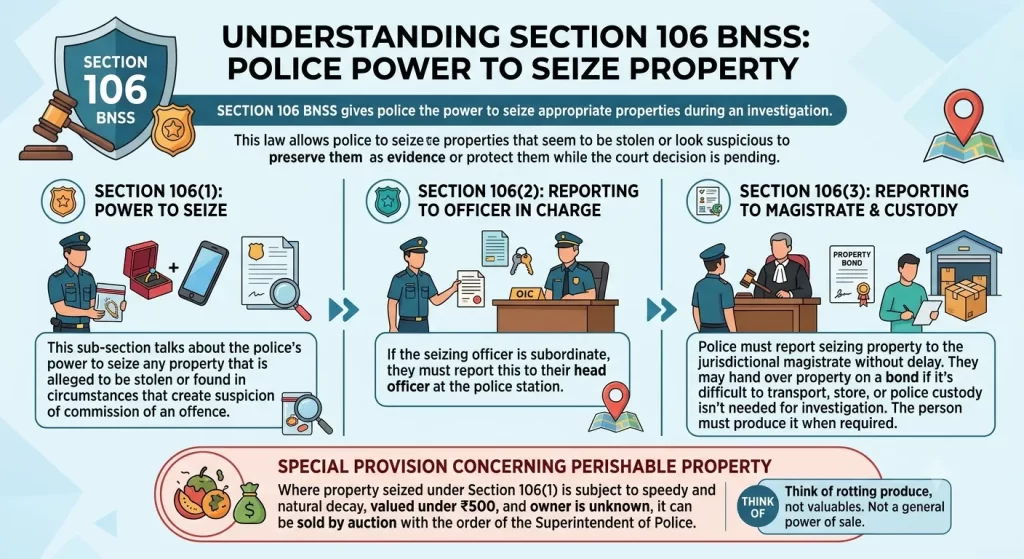
Section 106 BNSS is a power given to police to seize appropriate properties during an investigation. In simple terms, during an investigation, police find any property that seems to be stolen or looks suspicious; then this law allows police to seize these properties so they can preserve them as evidence or protect them while the court decision is still pending.
Let’s understand the subsections of Section 106 BNSS:
Section 106(1): Power to seize
This sub-section talks about the police’s power to seize any property that is alleged to be stolen or found in circumstances that create suspicion of commission of an offence.
Section 106(2): Reporting to the officer in charge
This sub-section states that if the seizing officer is subordinate to the officer in charge of the police station, then that police officer must report this to their head officer.
Section 106(3): Reporting to the Magistrate and custody
This sub-section explains the reporting duty of a police officer after seizing property to the jurisdictional magistrate without delay. This also allows the officer to hand over the property to any person on a bond, where the property cannot conveniently be transported to the Magistrate, where proper storage is difficult, or where continued police custody is not needed for the investigation. The person taking custody undertakes to produce the property when required and to follow the Magistrate’s later orders about its disposal.
Special provision concerning perishable property
In this provision, where the property seized under Section 106(1) is subject to speedy and natural decay, there is no information about the owner, and it’s valued at under ₹500, then it can be sold by action with the order of the Superintendent of Police and Sections 503 and Section 504 BNSS then apply to the net proceeds as far as practicable. Think of rotting produce, not valuables. It is not a general power of sale.
Section 106 BNSS – At a glance
| Question | Short answer |
|---|---|
| What does Section 106 BNSS cover? | Police power to seize property alleged or suspected to be stolen, or found in circumstances creating suspicion of an offence |
| Which CrPC section does it replace? | Section 102 CrPC |
| Does seizure mean the owner is guilty? | No. Seizure is an investigative step, not a finding of guilt or ownership |
| Must the seizure be reported to a Magistrate? | Yes. Sub-section (3) requires the officer to report it to the Magistrate having jurisdiction |
| Is there a punishment under Section 106 BNSS? | No. It is a power, not an offence-creating provision |
Can Police Freeze Bank Account Under Section 106 BNSS?
In case of cyber fraud or financial fraud complaints where money is traced through the account to preserve the evidence and for investigation, the police have the power to freeze the account.
As per the Supreme Court ruling in State of Maharashtra v. Tapas D. Neogy, the bank account of the accused can be frozen if it is found to have a connection with an offence. The police must report the seizure ‘forthwith’ to the magistrate.
Can the whole account be frozen for a part of the funds?
Where the disputed amount can be identified, freezing the whole account for investigation sits uneasily with the idea that seizure is a measure for preserving evidence and traced funds.
The High Courts have also addressed that where the suspected amount is identifiable, only that sum should be frozen. In this situation, a complete account freeze should not be ordered.
Important Case Laws Relevant to Bank Freeze Under Section 106 BNSS
These judgements are explained briefly here for study purposes:
1. State of Maharashtra v. Tapas D. Neogy (Supreme Court, 1999)
- Provision considered: Section 102 CrPC (predecessor of Section 106 BNSS).
- Principle: A bank account can be treated as property which police may seize if it is linked to an offence.
- Practical significance: It is the foundation of the argument that police may freeze accounts. The decision is important when assessing police action involving bank accounts under the corresponding framework of Section 106 BNSS.
2. Malabar Gold and Diamond Ltd. v. Union of India (Delhi High Court, 16 January 2026)
- Citation: W.P.(C) 4198/2025; 2026 SCC OnLine Del 297.
- Facts: Bank accounts of a jewellery company were frozen after a customer was allegedly involved in cyber fraud.
- Holding: In this case, the High Court of Delhi held that Section 106 BNSS does not authorise police to attach or debit-freeze bank accounts. Attachment or freezing can only be done under Section 107 of the BNSS, on the order of a competent Magistrate, with the prescribed safeguards. The Court also held that a blanket or disproportionate freeze of an account holder who is neither accused nor suspect is manifestly arbitrary, and ordered the accounts defrozen.
- Practical significance: Very useful for account holders in Delhi whose accounts were frozen without a Magistrate’s order. The Court relied on earlier decisions, including Headstar Global (Kerala High Court) and rulings of the Bombay High Court, and later Delhi benches have followed it.
- You can read the judgment from the Indian Kanoon order copy.
3. State of Karnataka v. JAR Gold Retail Pvt. Ltd. (Karnataka High Court, 10 August 2026)
- Facts: Police froze the bank accounts of a digital gold company in a cyber-fraud investigation. A sessions court ordered defreezing, and the State challenged that order.
- Holding: The High Court held that a debit freeze, used as an investigative and preservative measure, falls within Section 106 and needs no prior approval from the Magistrate, with its reporting without delay under Section 106(3). It reasoned that Section 106 preserves while Section 107 adjudicates attachment, forfeiture and restoration, and that treating every debit freeze as a Section 107 attachment would make Section 106 redundant.
- Practical significance: Gives investigating agencies in Karnataka stronger support, but still places weight on the Section 106(3) report to the Magistrate.
- You can read the judgment of this case on the Indian Kanoon Website.
Why the conflict matters
A decision of one High Court is binding within its own territory and persuasive elsewhere. Until the Supreme Court or a larger bench settles the question, the outcome of a challenge can be different depending on where the case is pending.
Expert Advice: As there are differences in the judgments over bank account freezing, always check whether a newer judgment has been delivered or consult with an experienced lawyer for guidance. They can help you understand the laws and how the court analyzes it.
What Can You Do if Police Freeze Your Bank Account?
The right step depends on the facts of the case, so consult with a lawyer before taking any step:
Step 1: Gather the documents
Collect these basic documents; they can help you understand the case and help you represent yourself before the police:
- The bank’s communication regarding the account freeze
- The investigating agency, police station, and FIR or complaint reference
- Which transactions are alleged to be connected with the case
- Your transaction records and proof of the source of funds
Step 2: Right to representation before the Investigating Officer
You can submit the documents and proof of transaction before the investigating officer; if the police are satisfied, they can issue a de-freezing order.
Step 3: Apply before a magistrate
You can apply for the interim custody or release of the bank account before the magistrate under Section 497 BNSS; depending on the facts, the magistrate may order:
- Partial de-freezing
- Complete de-freezing
- Restriction over the disputed amount
Step 4: File a writ petition before the High Court
If you feel the account freeze is illegal or unlawful, you can file a writ petition before the High Court under Article 226 of the Constitution challenging the freeze order.
What is the Difference Between Section 106 and 107 BNSS?
Many people are confused about Section 106 and Section 107 of the BNSS, and it is important to understand the difference between the two. Here’s a simple explanation of both sections:
Section 106 BNSS
In this, as we explained above, the police have the power to seize certain property they find to be stolen, where there is no information about the owner, or connected with an offence. This is to preserve the evidence and keep it safe while the investigation is going on.
Section 107 BNSS
This Section 107 BNSS governs the attachment, forfeiture, or restoration of property. Under this Section, the magistrate has the power to order the attachment of property; here, the police officer investigating must seek the grant from the magistrate.
| Basis | Section 106 BNSS | Section 107 BNSS |
|---|---|---|
| Subject | Seizure of certain property by police | Attachment of property believed to be proceeds of crime |
| Nature | An investigative measure taken by the police | A court-supervised process |
| Role of court | Report to the Magistrate under sub-section (3) | Application to the court or Magistrate, which decides on attachment |
| Purpose | Preserve property linked to suspected offence | Secure property believed to be derived from criminal activity |
What Rights Does a Person Have When Property is Seized?
The consequences of a seizure depend on the nature of the property involved, the investigation procedure, and the reason why the police have taken this action.
In this situation, if your property has been seized, you should not assume seizure as proof of wrongdoing. Instead, you should:
- Try to understand the legal basis on which the police have seized your property.
- The police need to report the seizure to the magistrate. After that, the court decides what happens with the property.
- During the legal procedure, you can seek interim custody or release (often called supratnama or release on a bond) from the court.
- Or you can approach a higher court if you believe seizure is unlawful or there is no link with the offence. Here you must take legal advice before taking any step.
Common Misconception About Police Seizure
Here are some common misconceptions about police seizure; understanding these is important to avoid making mistakes:
- Frozen account means guilty: No, seizure or freezing is a part of investigation; police take this step to preserve the evidence. It does not prove you guilty.
- Freezing and attachment are the same: No, they are both different and follow different mechanisms under Section 106 and 107 BNSS.
- One disputed transaction justifies freezing everything: Delhi High Court decisions stress proportionality and the position of non-accused account holders.
Conclusion
Section 106 BNSS plays a very important part in the criminal investigation framework because it allows police officers to seize certain properties that are found suspicious and connected with an offence. With this, understanding the situations under which police can exercise this power, their reporting duties, and the limitations shaped by courts is also important.
At Kamal & Co. Advocates, we believe understanding the law and its practical implications is very important to make legal decisions. You can consult with our expert lawyers regarding the seizure of property, the legal authority, the procedure, and the rights of the person affected, and seek legal advice for your case.