
The NICE Road case is one of the Karnataka High Court’s longest-running disputes. For many people, the NICE Road around Bangalore to Mysore sets a benchmark for infrastructure development in Karnataka; only a few are aware of the legal battle ongoing between the landowners, Nandi Infrastructure Corridor Enterprises (NICE), and the Karnataka Industrial Areas Development Board (KIADB).
On 29 July 2026, the division bench of the Karnataka High Court rejected the appeals made by NICE and KIADB, keeping the decision in favour of affected landowners. The court has cancelled the decades-old land acquisition.
In this blog, we will simply understand what the NICE Road Case is, its current legal status, and legal remedies available for landowners; further, speaking with a civil and property lawyer in Bangalore is the most suitable action to protect your rights and get compensated for the land acquired.
What Did the Karnataka High Court's Order/Judgment Say in the NICE Road Land Acquisition Case?
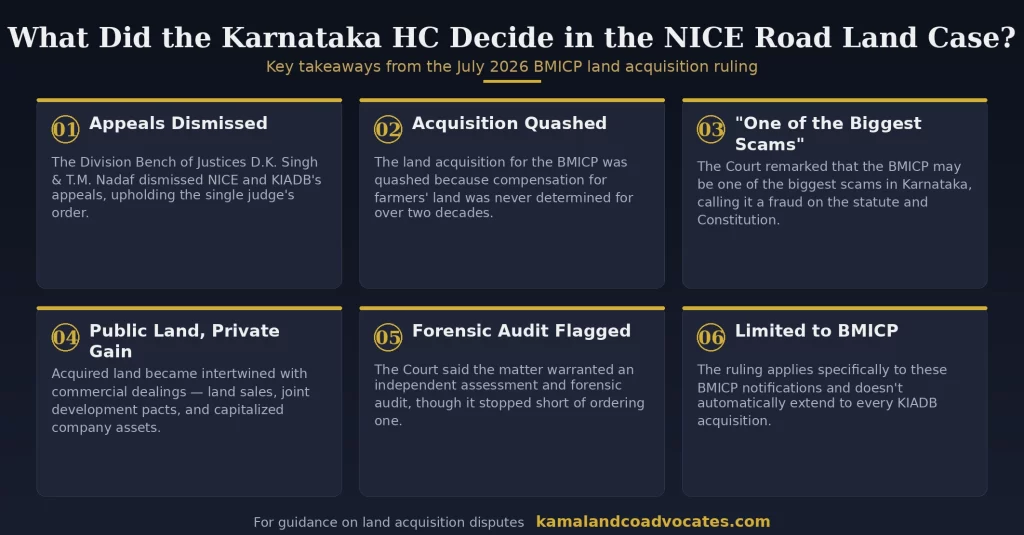
The Division Bench’s reasoning centered on a straightforward but powerful constitutional point: can the government legally own the land without determining the landowners’ compensation for over 20 years?
NICE and KIADB argued that under Section 28(5) of the KIAD Act, once the final acquisition notification is issued, the land gets legally entrusted to the state; therefore, the acquisition remains complete even if the compensation is delayed. Further, the court stated that vesting doesn’t deduct the government’s obligation under Article 300A to determine and pay fair compensation within a reasonable time, and that treating vesting as a permanent shield against that obligation would reduce a constitutional right to what the Bench called a mere formality.
The Court also rejected a separate argument from NICE that earlier Supreme Court rulings upholding the BMICP’s public purpose already settled the matter. The Bench held that the present dispute arose from subsequent events (the continued failure to pass compensation awards, and alleged deviations from how the project was actually implemented), which amounted to a fresh, independent cause of action not addressed in the earlier litigation.
In its strongest observation, the Court remarked that the state as trustee of public resources had allowed private interests to flourish in violation of constitutional obligations, adding that there was “nothing nice about the NICE project” beyond the fact that farmers had lost land and generational livelihoods without payment.
BMICP Land Acquisition Karnataka - At a Glance
| Detail | Information |
|---|---|
| Court | Karnataka High Court, Division Bench |
| Case | Nandi Infrastructure Corridor Enterprise Ltd. & Ors. v. M/s AMR Housing Development Corporation & Ors. |
| Case Copy | https://indiankanoon.org/doc/159694310/ |
| Citation | WA No. 1214/2025 & connected matters; [2026 LiveLaw (Kar) 273] |
| Bench | Justices D.K. Singh and T.M. Nadaf |
| Decision date | July 29, 2026 |
| Core issue | 20+ year delay in determining compensation after land acquisition |
| Constitutional basis | Article 300A (right to property) |
| Statute involved | Karnataka Industrial Areas Development Act, 1966 |
| Does land return automatically? | No, relief depends on each notification and case history |
| Appeal possible? | Yes, to the Supreme Court |
NICE Road Land Case Timeline: Key Events from 1997 to 2026
| Year | What Happened |
|---|---|
| Late 1990s | Framework Agreement signed; land notified under KIAD Act |
| 2004 | Partial cash compensation paid; promised sites not allotted |
| 2012 | Lokayukta probe ordered into alleged excess land allocation |
| 2025 | Single judge quashes original acquisition notifications |
| Jul 29, 2026 | Division Bench upholds quashing, dismisses NICE/KIADB appeals |
| Aug 15, 2026 | Kumaraswamy petitions CM Siddaramaiah to take over the project, halt toll collection |
| Aug 16, 2026 | State government responds it will act "as required as per law" |
| Pending | Possible Supreme Court appeal by NICE/KIADB |
Does the Karnataka High Court Judgment Mean NICE Road Is Cancelled?
No, that’s not what it means. It’s important to clear all the doubts regarding the official ruling. The 29 July, 2026 Karnataka High Court’s judgement does not mean that:
- The High Court’s order does not mean that the NICE Road is cancelled.
- It does not mean that every landowner will get their lands back automatically.
- The NICE Road court order does not cancel toll collection.
It DOES:
- It strengthens the position of affected landowners whose land is included in this acquisition.
- It allows them to seek legal compensation.
- It helps the landowners challenge similar KIADB land acquisition going on elsewhere.
Who Can Benefit from the NICE Road Land Judgment?
If your land, or land belonging to your family, was part of this or a similar KIADB acquisition, work through this before assuming anything:
- Collect your original property documents and your survey number
- Verify what was stated in the preliminary and final notification on KIADB records
- Confirm whether your land is a part of BMICP or not
- Find out whether a compensation award was ever passed separately; check if it was actually paid
- Look for any change in possession status since the notification
- Search for prior writ petitions or litigation tied to your specific survey number
- Take everything to a property or land acquisition lawyer for a proper case assessment; matching a checklist doesn’t confirm eligibility on its own.
What Is The High Court Judgment About NICE Road Toll Collection - Is It Still Legal?
On 15 August, 2026, Union Minister Mr. Kumaraswamy urged the CM D.K. Shivakumar to stop the toll collection and completely take over the NICE project. To this, the government replied, stating that “we will examine it and act according to the law” and did not confirm any suspension of tolls. Unless there is a specific judicial or executive order, the toll remains in effect.
How to Get a Copy of the NICE Road High Court Order
The Karnataka High Court’s 29 July 2026 order/judgement in Nandi Infrastructure Corridor Enterprise Ltd. & Ors. v. M/s AMR Housing Development Corporation & Ors. (WA No. 1214/2025 & connected matters, reported at [2026 LiveLaw (Kar) 273]) is a public judicial record. If you want to access the full order, you can get it through:
- Karnataka High Court Registry: You can request a certified copy with the case number mentioned for legal proceedings.
- Karnataka High Court e-Courts / official website: Or you can visit their official website once the order is uploaded there.
- Legal reporting databases: These are legal reporters or databases that publish full text or a detailed extract shortly after pronouncement, searchable by the citation.
One clarification: there is no separate High Court Order on the NICE Road toll charges. If a toll-specific order is passed in the future, it will be separate from NICE Road case order.
Legal Remedies Available to Affected Landowners
Under the Right to Fair Compensation and Transparency in Land Acquisition, Rehabilitation and Resettlement Act, 2013 (RFCTLARR Act), here is the list of legal remedies available for plaintiffs involved in the NICE road case:
- File a writ petition before the High Court claiming compensation.
- Right to claim interest over the delayed payments.
- Eligible landowners can seek housing support and payment based on the new land value.
- Special protection for scheduled caste and tribal families under the RFCTLARR Act.
What Could This Mean for Future KIADB Acquisitions?
Even though the Karnataka High Court provided its judgement over the NICE Road case, this ruling also sets a benchmark for future land acquisition under the KIAD Act. The overall process of this case empowers all the landowners who are facing something similar under other KIADB acquisitions. This case brings a few changes that help citizens to fight for their legal rights:
- If other landowners are going through the same, they have a valid reason to point out before the court. This ruling gives lawyers a strong base, an example to put before the court.
- It brings the KIADB under pressure to clear all unpaid or partial compensation to avoid any other property dispute litigation.
- In the future, the projects will move to faster payments and fulfilling legal compliance.
- The public-private infrastructure deals might face tough scrutiny to prevent any future frauds.
When Should You Seek Legal Advice?
Don’t wait for the land dispute to turn into a court case; contact a legal advisor in case:
- If your land was acquired years ago, but the payment was not received, or a partial payment was made.
- You’re not sure whether the recent High Court ruling applies to your case.
- You’ve inherited land with a land dispute running, and you don’t know how to tackle it.
- Or when the compensation for the land you are receiving is below the fair market value.
For over many years, this case has been running; it needs a specialized legal expert who has experience in property cases, administrative procedures, and court representation. At Kamal & Co. Advocates, the legal team provides practical solutions to such cases; they take care of assessment, document review, writ petition filing, and ongoing tracking of how a case develops.