

When a family member passes away, at that time dealing with bank accounts, insurance claims, or other assets can be really stressful. In some situations, a Legal Heir Certificate may be required to identify the surviving legal heirs of the deceased.
Now a lot of questions might arise in your mind, like how can I obtain this certificate? What are the documents required? Who is the right legal heir?
To answer all your queries, this guide explains the eligibility, documents required, complete procedure, and tips to avoid unnecessary delays. Furthermore, you can always consult with a property and succession lawyer for guidance.
What Is a Legal Heir Certificate?
A legal heir certificate is an official document that identifies the legal heir of a deceased person. This document mentions all the legal heirs and their relationship with the deceased. It is provided by the state authorities like the Tahsildar, Municipal Corporation, and Revenue Department.
It is required when you decide to claim the deceased person’s insurance plans, savings, pensions, or properties; the institutions ask for this certificate along with other documents.
When Do You Need a Legal Heir Certificate? Its Importance
You will need this certificate for various purposes, like claiming any asset belonging to the deceased or fulfilling legal responsibilities on behalf of the deceased. Depending on the circumstances, it can be relevant for:
- Identification as legal heir: Firstly, this certificate helps you get yourself legally verified as the legal heir of the deceased.
- Insurance claims: It will help you claim the insurance and to provide the nominee details.
- Property transfer: It is required for property transfer to the legal heir.
- Family pension: To claim the pension and provident funds, you will need this certificate.
- Bank accounts: It is required to claim the savings or bank accounts of the deceased.
- Legal security: It will protect you and all the assets from fraud and illegal claims.
One thing to keep in mind: it is not necessary that all the institutions need the same documents just because the deceased had similar kinds of assets.
Who can apply, and who counts as a legal heir?
Generally, one family member applies for a legal heir certificate on behalf of the entire family. In the list, they must mention all the legal heirs to avoid later disputes and rejected claims.
The family members eligible as legal heirs:
- Wife or husband of the deceased
- Son or daughter of the deceased
- Father or mother of the deceased
- Siblings of the deceased
- Adopted child of the deceased
Documents Required for a Legal Heir Certificate
Here’s the list of documents you will need to get this certificate:
- Death certificate of the deceased, issued by the municipality
- Applicant’s identity proof, like Aadhaar, voter ID, etc
- Applicant’s residential proof
- Proof of relationship between the deceased and applicant, like family card, ration card, etc
- Identity details of other surviving heirs
- Affidavits or self-declaration wherever needed
- Passport-size photographs
- Application form
- Other required documents were asked for during verification.
How to Apply for Legal Heir Certificate Offline
Losing your loved ones can be really heartbreaking, and in this, keeping up with the legal compliances can be difficult too. Here is the complete process of how you can obtain this certificate without any complications or forgetting any step:
Step 1: Visit the right office
To obtain a legal heir certificate, you will need to visit the Tahsildar, Taluk office, or Revenue Department of the deceased’s residential area. In some areas, the municipal corporation office or a village officer can also help.
Step 2: Fill the application form
At the office counter, you will get the application form; fill it with the details of the deceased, the legal heir, their relationship proof, and other details
Step 3: Prepare the affidavit and attach documents
Draft the affidavit and get it checked by a professional, and attach it along with other documents like:
- Death certificate
Identity proof and residential proof
Proof of relationship
Affidavit stating the list of other heirs and their signatures
Step 4: Submit the application
Submit the application at the counter, pay the prescribed fees, and ask for your application number that you can use to check the status later.
Step 5: Verification and enquiry
After this, the revenue inspector or village officer can visit your home or neighbourhood and ask you questions for an enquiry.
Step 6: Collect the certificate
Once the officers approve, the certificate is issued; you can download it online or collect it from the office.
How You Can Apply for Legal Heir Certificate Online
In a lot of states, there are e-portal websites available that let you apply for a legal heir certificate online. Here’s how the online process works:
Step 1: Visit the website and register
First, visit your state’s e-District or citizen service portal that allows you to apply for the certificate and register there with your number or email.
Step 2: Choose the service
After logging in, look for a legal heir certificate under the revenue department’s services.
Step 3: Fill the application form
There you will get the online form for the certificate; fill it with all the important information of the deceased and the legal heir.
Step 4: Upload your documents
At the portal itself, submit the scanned documents required for the verification that you are the legal heir of the deceased.
Step 5: Submit and pay fees
After completing all the details, submit the application and pay the fees online.
Step 6: Track the status and download
After all this, keep track of the status of the certificate, any further requirements for documents, or a physical visit. And once when its approved, you can download the digitally signed copy online.
Legal Heir Certificate vs Succession Certificate: What’s the Difference
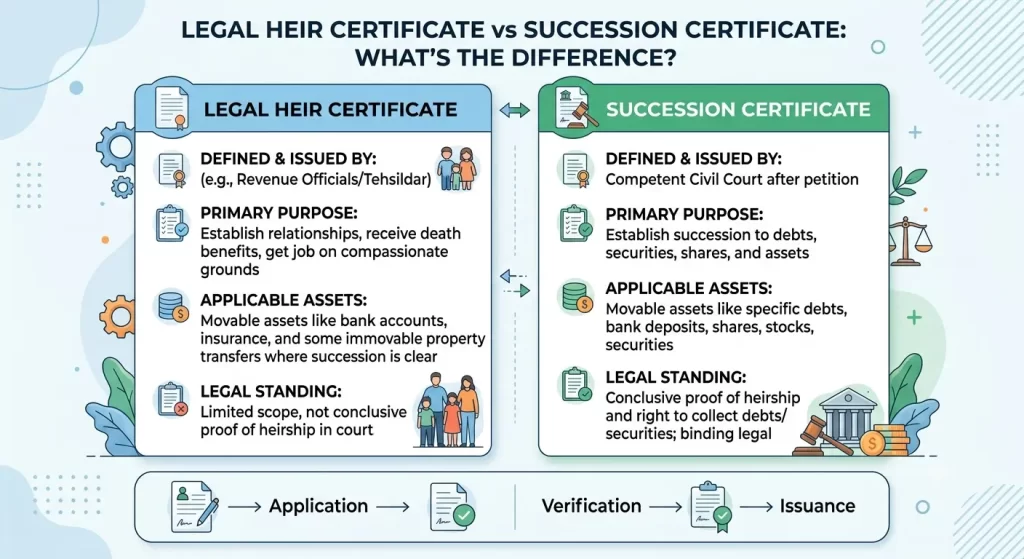
People often confuse the legal heir certificate and succession certificate; a legal heir certificate is to identify the surviving heir of the deceased, while a succession certificate is given to provide legal authority for the debts and securities of a deceased. Here’s a clear comparison between both:
| Basis | Legal Heir Certificate | Succession Certificate |
|---|---|---|
| Main purpose | Identifies the legal heir | Helps establish authority to deal with certain debts and securities |
| Issuing process | Generally administrative and state-specific | Judicial process |
| Authority | Tehsildar, Revenue Department, Taluk office, Municipal office | Issued by the Civil Court |
| Common use | Administrative and benefit-related claims | Certain debts and securities of the deceased |
| Property ownership | It does not automatically prove property ownership. | It does not automatically transfer ownership of all assets. |
| Procedure | Generally, application and verification | Court proceedings |
What Can Delay or Complicate Your Application?
Here are common mistakes that can delay the process of obtaining the certificate:
- Mismatching names across different documents.
- A surviving heir was left out of the list.
- Applying for legal heir certificate before obtaining death certificate.
- Not confirming the documents required by the institutions.
- Poor quality scans or incomplete uploads.
When Should You Consult a Lawyer?
If you have all documents collected and there are no disagreements among the family members, then you can obtain the certificate following the relevant government procedure yourself. However, in case:
- There is a dispute going on among family members.
- Any family member has been left out of the list.
- If the deceased person has left a will.
- There is a property dispute going on.
- Uncertainty about the documents required.
If there is a dispute, a will, property disputes, or uncertainty about the documents, you should get legal advice. At Kamal & Co. Advocate, we make sure that you can avoid unnecessary delays, get your certificate ready in time, and we also assist in solving property disputes.