

Understanding Patent vs Copyright vs Trademark Protection in India (2026 Guide)
Two close friends launched a small clothing brand from their room. Nothing huge in the beginning. Just oversized t-shirts, late-night packaging, Instagram reels, and orders slowly coming in. The page began to get noticed after nearly a year of hard work. Then the problem started.
Another seller popped up online with a very similar brand name. Same kind of logo. Similar designs. Even their product photos were being reposted. They got angry, obviously. But then came the bigger issue: they had no idea what actually protected their business legally.
Was it Trademark? Copyright? or Patent?
Most people think these terms mean the same thing until something gets copied. And by then, things become messy. Creators assume copyright protects everything. Startup founders think ideas automatically belong to them. Small businesses delay trademark registration because it feels “unnecessary” in the beginning.
In reality, each protection works differently, and choosing the wrong one can cost time, money, and sometimes even the brand itself.
In this blog, we are going to break down patent vs copyright vs trademark in simple language. What each one protects, where people usually get confused, and how businesses, creators, and startups can actually protect their work properly in 2026.
Why Is This Important in 2026 More Than Ever?
India’s Intellectual Property space is on a fast growth trajectory, and the figures speak for themselves. As to the IP India Annual Report 2024-25 by the CGPDTM:
- Total IP registrations are 749,946 with a growth rate of about 20% in FY 2024-25.
- The most popular category was trademark filings, which crossed 5.5 lakh. Patent applications filed 1,10,000 Indian applicants filed more than 61% of the total.
- IP filings have increased by 44% overall from 2020-21.
India has been ranked in the WIPO World Intellectual Property Indicators 2025 (Global)
- 6th in patent applications.
- And 4th, with 532,900 trademark filings in 2024.
If you’re unsure which protection your business actually needs, speaking with experienced IP & corporate lawyers early can save you from costly missteps.
What Is Intellectual Property (IP)?
Intellectual property is anything that is created by human effort, imagination and innovation. It might be an idea, a logo, a blog, software code, music, packaging design or even a tagline that people connect with your firm.
If your work is worth it because it comes from your ideas or creativity, intellectual property rules may help safeguard it. This is the easiest way to understand it.
An idea sitting in your head has no legal shield around it. The actual execution is what matters.
That is where the different types of intellectual property come in:
- Patents.
- Copyrights.
- Trademarks.
What Is a Patent?
A patent protects inventions. Not content. Not branding. Not creative work. Patents are meant for things that solve problems or introduce something technically new. For example:
- A machine.
- A manufacturing method.
- Medical gadget.
- A chemical formula.
- Some new software.
- Industrial technology.
If you invent something new and useful, a patent can restrict other people from using or selling your invention without your permission for a limited time. One reason why patents are so crucial in areas like manufacturing, medicine, electronics and technology.
In India, patent protection is given for 20 years from the date of filing on IP India’s official eFiling platform.
But getting a patent is not easy. The invention must actually be new, useful, and resourceful.
What Cannot Be Patented?
In India, these usually cannot receive patents:
- Mathematical formulas.
- Scientific theories.
- Abstract ideas.
- Pure business methods.
- Software without a technical application.
So no, a business idea alone is not patentable. That is one of the biggest differences in the whole patent vs copyright vs trademark discussion. Patents focus on functionality and innovation.
Expert Insight: Founders may share their product idea with investors, during pitch events, or even on social media before they file a patent. This public exposure may mean that you will never be able to patent the idea in India and most other countries. First, prepare a provisional patent application. It takes days, costs as little as ₹1,600, and keeps your priority date for a year while your product is being made.
What Is Copyright?
Copyright protects creative work, and it is handled by the Copyright Office, Government of India. This includes:
- Blogs.
- Books.
- Videos.
- Podcasts.
- Music.
- Films.
- Photographs.
- Artwork.
- Software code.
- Website content.
Unlike patents, copyright protection usually starts automatically once the work is created. Did you write an original article? It already belongs to you. Did you record a song? Same thing.
Patents protect how something works. Copyright protects how something is expressed. This is where the difference between patent and copyright becomes very clear.
The Commercial Impact of Section 45:
Creative work is automatically protected, but registering a copyright for an artistic design, logo or label for your products or commodities is not the same. Section 45 of the Indian Copyright Act is not satisfied with a simple copyright application. To do that, you need a Trademark Registry clearance certificate (TM-C) confirming that there is no competing brand mark. The filing fee for a government case in commercial matters has been hiked from ₹500 to ₹2,000.
For example, consider two people working on fitness apps. One developer creates a new health tracking system. That technical innovation may have to do with patents. But the app design, videos, text, graphics, and written content fall under copyright.
Copyright and AI in 2026
Things have become even messier with AI-generated content. AI tools can now generate articles, artwork, music, and videos within seconds. That has created a global debate around ownership.
Who owns AI-generated work? Can it receive copyright protection?
Most legal systems still gravitate toward one essential idea: Meaningful human involvement counts. If a person actively creates, alters or creatively delivers the finished product, it is more likely to be protected.
Purely AI-generated content without human creativity still sits in a legal grey area in many countries.
What Is a Trademark?
A trademark protects brand identity. The trademark registration in India is done through the IP India Trade Marks Registry online, which has offices at Mumbai, Delhi, Ahmedabad, Chennai and Kolkata. This includes:
- Brand names.
- Logos.
- Slogans.
- Packaging.
- Symbols.
- Sometimes even sounds.
Trademarks only work when a consumer can identify a company by its logo or name. Consider brands such as Nike or Apple. The names and logos are quite significant since clients identify these identities with the company itself. That’s why, in 2026, trademark registration in India will be even more important in the early stages of a business’s journey.
How Trademark Protection Works
Trademark registration generally involves:
- Checking existing trademarks.
- Filing an application.
- Examination.
- Publication.
- Registration.
Once approved, trademark protection usually lasts for 10 years and can be renewed. People also confuse ™ and ® all the time.
- ™ means trademark rights are being claimed.
- ® means the trademark is officially registered.
Difference Between Trademark, Copyright, and Patent With Example
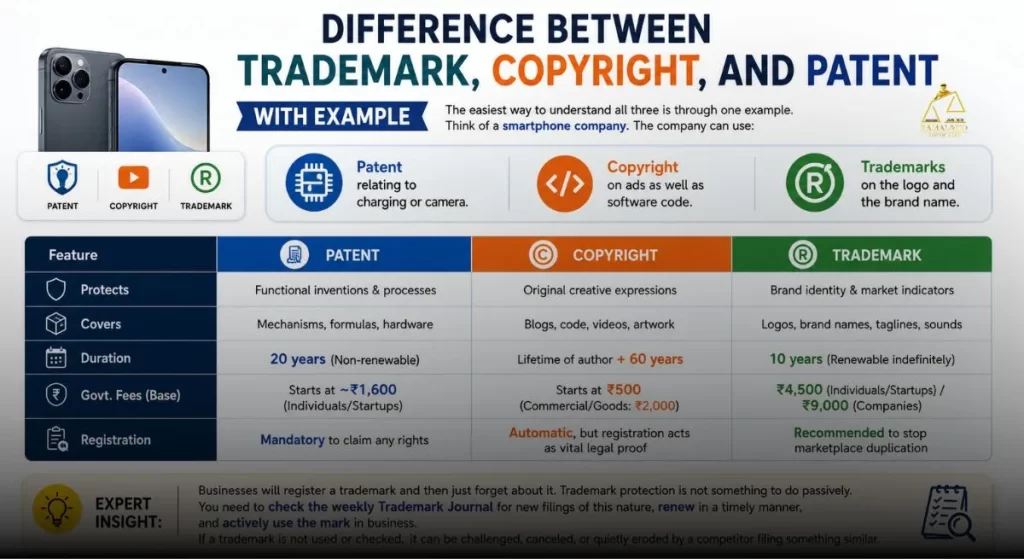
The easiest way to understand all three is through one example. Think of a smartphone company. The company can use:
- Patent relating to charging a camera.
- Copyright on ads as well as software code.
- Trademarks on the logo and the brand name.
That is the actual difference between trademark, copyright, and patent, with examples.
| Feature | Patent | Copyright | Trademark |
|---|---|---|---|
| Protects | Functional inventions & processes | Original creative expressions | Brand identity & market indicators |
| Covers | Mechanisms, formulas, hardware | Blogs, code, videos, artwork | Logos, brand names, taglines, sounds |
| Duration | 20 years (Non-renewable) | Lifetime of author + 60 years | 10 years (Renewable indefinitely) |
| Govt. Fees (Base) | Starts at ~₹1,600 (Individuals/Startups) | Starts at ₹500 (Commercial/Goods: ₹2,000) | ₹4,500 (Individuals/Startups) / ₹9,000 (Companies) |
| Registration | Mandatory to claim any rights | Automatic, but registration acts as vital legal proof | Recommended to stop marketplace duplication |
Expert Insight: Businesses will register a trademark and then just forget about it. Trademark protection is not something to do passively. You need to check the weekly Trademark Journal for new filings of this nature, renew promptly, and actively use the mark in business. If a trademark is not used or checked, it can be challenged, cancelled, or quietly eroded by a competitor filing something similar.
How to Register Patent vs. Copyright vs. Trademark Protection in India?
The registration process is going to differ depending on the type of intellectual property you want to protect.
Patent
Begin with a novelty search, then file the application with a specification and claims; the office reviews it before grant. The fees change depending on the type of applicant and the type of application.
Copyright
File Form XIV online with a copy of the work and ownership details. If no objection, the office processes it and issues the certificate. Rates start at ₹500 per work. Some Section 45 works would have higher rates.
Trademark
Public search, file the mark, wait for review and publishing, and if no objection, acquire registration. A registered mark lasts for 10 years and can be renewed.
Documents
ID proof, ownership proof, logo/work sample, and basic business details.
How Businesses Use Patent vs. Copyright vs. Trademark Protection?
Different businesses follow different IP strategies because the differences in patents, copyright, and trademarks depend on what they are trying to protect.
- E-commerce Brands: Trademark is highly significant for an e-commerce firm, since trademark counterfeiting is very common in e-commerce markets.
- Content Creators: Bloggers, YouTubers, teachers, and designers rely on copyright to safeguard their work.
- Content Creators: Content creators like bloggers, YouTubers, educators, and designers rely largely on copyright protection for their material.
- Tech and SaaS businesses often use it to protect software code, branding, contracts, and intellectual property through the right mix of trademarks, copyrights, and patent filings.
- Product manufacturers: A trademark identifies a market, and a patent typically creates a new product.
This kind of protection often works best as part of a broader corporate advisory strategy, rather than a one-off filing.
What Government Schemes Can Help You Save IP Filing Costs?
Many startups and MSMEs in India still do not know that they can get their IP registered at a lower price through government-subsidised schemes.
SIPP Plan
The Startup Intellectual Property Protection (SIPP) Scheme, launched by DPIIT in 2016, enables DPIIT-recognised startups to register patents, trademarks, and designs at a discounted cost. Some benefits include:
- 80% refund on patent filing fee.
- Trademark filing fees 50% refund.
- Professional costs of government-funded IP attorneys.
- Access to over 2,200 empanelled IP Mitras.
The scheme is valid up to FY 2025-26.
Fast Track Patent Examination
Startups, MSMEs, and individual inventors can choose a faster patent examination to speed up the process of approval.
MSME Fee Concessions
MSMEs, although outside SIPP, still have access to reduced IP filing fees as per CGPDTM rules.
How International Protection Works for Patent vs. Copyright vs. Trademark?
One thing businesses often realise too late is that intellectual property protection is territorial. A patent registered in India does not automatically protect you in Europe or the US.
The same applies to trademarks. Businesses expanding internationally often use systems like:
- The Patent Cooperation Treaty (PCT),
- The Madrid Protocol for trademarks.
Copyright works differently because international treaties like the Berne Convention allow broader recognition across member countries. And honestly, this matters more now because even small online businesses sell globally from day one.
Patent vs Copyright vs Trademark: Why Businesses Need to Get It Right
For many people, intellectual property isn’t on their list of priorities until something goes wrong. That is why understanding patent vs. copyright vs. trademark protection is important before you try to protect your work, brand, or invention. These protections are not just legal formalities. They help safeguard your work, your identity, and the ideas you spent years working on.
But if you want to start a firm, run an e-commerce brand or create digital content, understanding IP just makes greater financial sense. Firms like Kamal & Co. Advocates frequently work with businesses to help them make these decisions in a logical and business-minded manner.
Disclaimer: This blog is for information purposes only and does not constitute legal advice. You should seek the assistance of a qualified IP attorney or a business that specializes in intellectual property law for guidance specific to your own circumstances.




3 thoughts on “Patent vs Copyright vs Trademark: Key Differences and Legal Protection ”
Pingback: Due Diligence in Mergers & Acquisitions: A Legal Checklist for Indian Businesses - Kamal and Co. Advocates
Pingback: Legal Due Diligence for M&A in India: Key Checklist & Risks
Pingback: Legal Process Outsourcing in India: How LPO Works