
One missed credit card payment rarely scares anyone. That’s exactly what happened to a friend of mine. A medical expense came out of nowhere, so he skipped his credit card payment for the first time. But the next month brought even more expenses, the outstanding balance grew, and soon he was receiving calls from the bank. The temporary cash crunch slowly turned into a bigger problem than he expected.
This is how many people become credit card defaulters in India. Not because they want to avoid paying, but because life sometimes doesn’t always work out the way we want. It can be difficult to keep up with repayments if you’ve lost your job, your business is slowing down, there’s a family emergency or an unexpected expense.
The challenge is that most borrowers don’t know what happens next. Can the bank file a case? How badly will your credit score be affected? But more than that, what rights do you have?
In this blog, we will discuss the legal dangers of credit card default, the recovery process followed by banks, your rights as a borrower and the practical options at your fingertips which will help you face the situation before it becomes a big problem.
The latest data from the Reserve Bank of India (RBI) shows India had 119.44 million outstanding credit cards as of April 2026, an 8.19% rise year-on-year. Credit card spends for single month touched 1.97 trillion rupees. Scale comes with risk: NPAs in the credit card industry surged 28.42% in a single year to ₹6,742 crore as of December 2024, shows RBI data.
Can Banks Take Legal Action Against The Credit Card Defaulters in India?
Yes, banks can file a case if the borrower fails to pay back the outstanding amount, and legal action for credit card debt is a genuine option open to lenders.
Civil Recovery Proceedings
By not paying your credit card bill, you are breaking the legal contract you signed. Lending money is a legal transaction, and if the lenders want to recover their money, they can file a civil recovery claim in legal Court under Order XXXVII of the Code of Civil Procedure, 1908 (Summary claim). The goal isn’t to send someone to jail, but to get their assets or money.
Borrowers who receive court notices should understand the legal process involved. Knowing how to file a Civil Suit in Bangalore can also help individuals better understand court procedures, documentation requirements, and their rights during civil disputes.
Arbitration and Lok Adalats
Nearly all credit card cardmember agreements have an Arbitration Clause. This gives the bank the option to choose an arbitrator to handle the case outside of the regular courts, which then results in a legally binding “Arbitration Award”. Also, in the case of lower sums due, banks regularly send cases to Lok Adalats (People’s Courts) for quick, mutually accepted compromise credit card settlements.
Right of Lien on Other Accounts:
If you have a savings account, current account or Fixed Deposit (FD) with the same bank that provided your credit card, the bank can legally exercise its “Right of Lien.” That means they can freeze or directly debit money from your personal accounts to pay off your outstanding credit card debt without needing a court order first.
Can You Be Arrested for Credit Card Debt?
This is one of the most common questions people have. The answer is no. Not paying a credit card bill does not automatically lead to arrest.
If you receive a legal notice or court summons regarding unpaid credit card dues, consulting debt recovery & civil lawyers at an early stage can help you evaluate your defences and avoid unnecessary complications.
Credit Card Recovery Process for a Credit Card Defaulter in India
The credit card recovery process is often done in stages.
Payment Notification & Reminder Phone Calls
Often it starts with reminders. You could get:
- SMS Alerts
- Emails.
- Phone calls.
- App notifications.
Collection Department Follow-Up
If dues are not paid, the account may be transferred to the bank’s collection department. Officers from the collection agency may call you to talk about your situation and your options for paying back the debt.
Recovery Agent Engagement
If the account remains unpaid, the bank may appoint recovery agents. But recovery agents have to follow RBI rules. They can not threaten, abuse, intimidate or harass the borrowers.
Expert Insight: One of the most important protections for debtors under the 2026 RBI framework is the ban on recovery professionals contacting other parties regarding debt. If a credit card recovery agent calls your employer, spouse, or non-co-borrowers, you can file a formal complaint with the RBI’s CMS site. This has stopped harassment campaigns against our clients within 48 hours in some cases.
Legal Notice Issuance
If repeated follow-ups do not work, the bank may send a legal notice. The notice usually mentions:
- The outstanding amount.
- Details of the default.
- The action the bank may take if payment is not made.
Filing Recovery Proceedings
Many people ask, Can a bank file a case for a credit card default? Yes, banks have the right to take legal action to recover the dues that are not paid. But generally, legal action is a last resort after all other attempts to recover have failed.
Rights of Credit Card Defaulters Under Indian Law
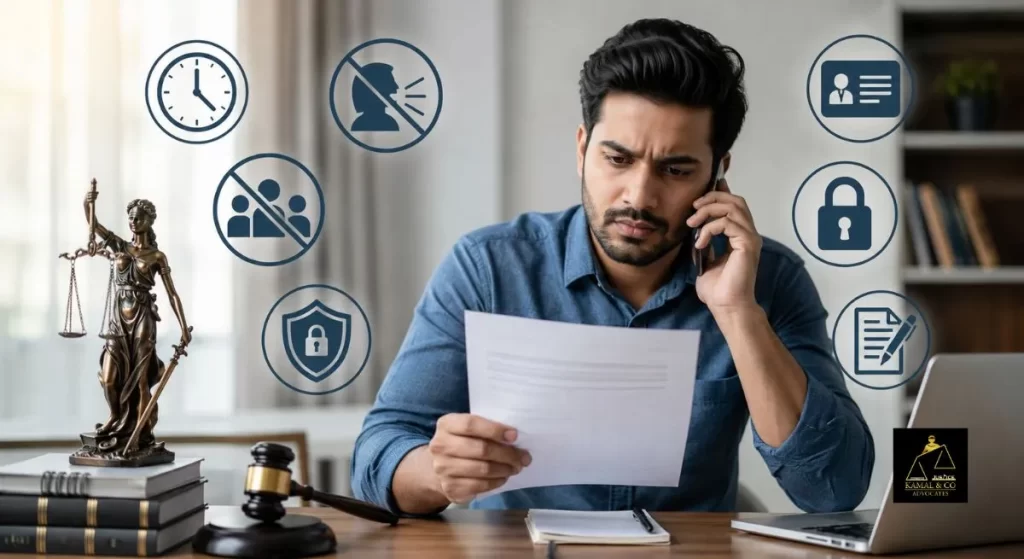
Even if you owe money, you still have the legal rights.
RBI Recovery Guidelines for Agents
The Reserve Bank of India has made some tougher rules for recovery agents from July 1, 2026. Important provisions under the Responsible Business Conduct (Second Amendment) Directions, 2026 are:
- Contact by recovery agents is limited to between 8:00 AM and 7:00 PM.
- Any form of verbal or physical harassment will not be tolerated.
- They cannot contact your friends, relatives, colleagues or neighbours about your debt.
- Always ask to see the official ID card of the agents and an authorisation letter from the bank.
Privacy Rights During Recovery
Your financial situation is private. Recovery agents should not discuss your debt with neighbours, friends, relatives, or other unrelated people.
The Right to Complain
If a recovery agent harasses, threatens, or violates time restrictions, you can take action:
Step 1: First, write a complaint to your bank’s grievance cell (banks must answer within 30 days).
Step 2: Refer problems to the RBI’s Complaint Management System (CMS), a one-stop portal under the Integrated Ombudsman Scheme. The service is free.
Step 3: Hire a civil lawyer to document and enforce the violation.
If recovery agents continue to harass you despite formal complaints, consult an experienced civil lawyer to protect your legal rights and pursue appropriate remedies.
Expert Tip: Follow up every call from a recovery representative with an email or SMS. It also creates a legal record in case you decide to make a complaint.
Who Is Considered a Credit Card Defaulter in India?
There is a clear difference between paying a few days late and not paying your dues for a long period.
Difference Between Late Payment and Default
If you miss your billing due date but pay off the sum within a few days or weeks, the bank will charge a late payment fee and heavy interest ( about 36% to 48%). However, your account remains active, and you are not termed a defaulter. True default occurs when the loan goes unpaid for a long time, making the bank designate it as high-risk.
When Does A Credit Card Account Become NPA?
Banks track overdue payments using a system called Days Past Due (DPD).
| DPD Stage | Meaning | Bank Response |
|---|---|---|
| 30 DPD | Payment is overdue by 30 days | Reminder calls, SMS alerts, emails, and payment notifications |
| 60 DPD | Payment is overdue by 60 days | Collection department follow-up and increased recovery efforts |
| 90+ DPD | Payment is seriously overdue | Account classified as a Non-Performing Asset (NPA) and recovery proceedings may begin |
Note: If the Minimum Amount Due remains unpaid after 90 days, the bank classifies it as a Non-Performing Asset (NPA). This is the official trigger point when you are classified as a credit card defaulter in India.
How Banks Categorise Defaulters
A borrower’s experience of paying back loans is usually used by banks to decide what kind of borrower they are. People who miss a payment once in a while are dealt with differently from people who haven’t paid in months.
If an account turns into an NPA for a few months, banks have the discretion to “Write Off” the debt in their books of accounts to clean up their balance sheets. Many borrowers believe that “written off” status indicates the loan has been forgiven. Fact is that the bank simply moves the bad debt from its active records. You still owe it, in full, and they will come after you for it.
What Happens If You Become a Credit Card Defaulter in India?
A credit card default in India can affect your finances in several ways.
Interest Accumulation And Penalty Charges
Interest will be applied to the remaining debt if you don’t pay. The credit card agreement says the banks can charge late payment fees and other costs. So the amount you owe could climb really fast.
For example, if you have a debt of ₹50,000 and don’t pay it for a few months, the interest and penalties may add to the amount you have to pay.
Impact on Your Credit Score
The TransUnion CIBIL score after a credit card default is often a major concern for borrowers. Here’s what the data tells us:
- One missed payment will instantly drop your CIBIL score by 50-100 points.
- CIBIL scores are now refreshed every 15 days (as of 2025 revisions), so damage is reflected faster – but so is recovery, once you start repaying.
- Negative default entries stay on your credit report for 7 years with all four Indian credit bureaus (CIBIL, CRIF High Mark, Experian, and Equifax) from the date of the first missed payment.
A poor credit score can make it harder to get personal loans, home loans, car loans, and new credit cards.
Reduction or Blocking of Credit Limits
Your credit limit may be reduced, your card may be suspended, or your account may be frozen until the amount is paid off.
How to Recover Financially After Credit Card Default?
A credit card default does not mean your financial life is over. You can rebuild your financial position step by step.
Start by clearing the outstanding dues as much as possible. Next, work on improving your credit profile by:
- Pay all future bills on time, even a month of regular repayment can fix your profile.
- Check your credit report often at the official website of CIBIL or through the credit bureau framework of RBI.
- Keep your credit use below 30% of your limit.
- Don’t get several new loans at once.
Credit Card Default vs. Personal Loan Default :Key Differences
Here’s a quick comparison:
| Factor | Credit Card Default | Personal Loan Default |
|---|---|---|
| Type of Debt | Unsecured, revolving | Unsecured, fixed-term |
| NPA Trigger | 90 days of non-payment of the Minimum Amount Due | 90 days of missed EMIs |
| Interest Rate Risk | Extremely high (36%–48% p.a.) | Moderate (12%–24% p.a.) |
| Collateral | None | Usually none |
| Right of Lien | Yes, on same-bank accounts | Yes, on same-bank accounts |
| Legal Recourse | Civil suit, arbitration, Lok Adalat | Civil suit, arbitration |
| Settlement Possibility | Yes (One-Time Settlement/OTS) | Yes (One-Time Settlement/OTS) |
| CIBIL Impact | Severe, reflected quickly | Severe |
Common Myths About Credit Card Defaulters in India
There are a lot of myths surrounding credit card defaults.
- A popular myth is that borrowers automatically go to jail after defaulting. But the truth is, ordinary non-payment is usually a civil issue.
- Another myth is that recovery agencies can take everything you own whenever they want. Recovery actions must follow legal procedures.
- Some people believe unpaid debt disappears automatically after a few years. This is not true. The debt and its impact on your credit history can remain for a long time.
- There is also a belief that the bank settlement of credit card debt improves your credit score. While a settlement may close the account, it can still affect future loan approvals.
What Every Credit Card Defaulter in India Should Know?
Nobody plans to become a credit card defaulter in India. Most of the time, it happens because something unexpected throws the budget off track. The mistake many people make is waiting too long and hoping the problem will somehow sort itself out.
If you have dues on your credit card, get it done early. Talk to the bank. See what you can do. Usually, the sooner you go after the problem, the easier it is to handle. And if the issue is already problematic, getting the correct legal assistance from experienced professionals like Kamal & Co. Advocates can assist you understand your rights and the best way to proceed.
Disclaimer: This article is for informational purposes only and does not constitute legal advice. Please consult a qualified legal professional for guidance specific to your situation.