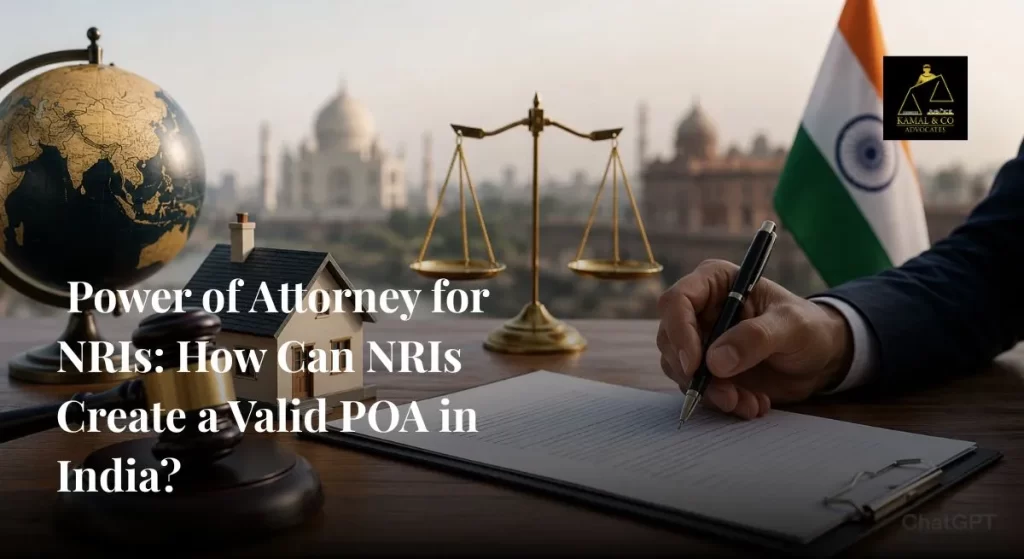

Rahul had been living in the UK for years when he finally found a buyer for the Bangalore apartment he had been trying to sell. Everything looked ready until the real problem showed up. The deal required signatures, document checks, and a visit to the office in India. He could not just drop everything and fly down for every step.
That is the reality for many NRIs. Property work, bank formalities, legal issues, and tenant matters do not pause just because someone lives abroad. A power of attorney for NRIs helps solve that. It lets a trusted person in India handle specific tasks when the owner cannot be there.
According to figures published by the Ministry of External Affairs (MEA), Government of India, Indians living outside India as of January 2026 number about 35.4 million, making it the world’s largest diaspora. Of these 15.85 million are considered as NRIs (Non-Resident Indians) with strong legal and financial links with India. So, in this blog, we will look at how a valid Power of Attorney works, which type to choose, what the legal steps are, and the mistakes that can create trouble later.
What Is a Power of Attorney (POA)?
A Power of Attorney is a legal document that permits one person (the principal) to give another person (the attorney-in-fact or agent) the authority to act on their behalf. Under the Indian law, it is governed by the Powers of Attorney Act, 1882, and it applies to the whole of India.
The powers of the agent are those clearly laid down in the contract and no more and no less. This is why careful drafting is not a luxury, but the foundation of a legal POA.
Why NRIs Need a Power of Attorney?
A large number of NRIs still have strong financial and emotional links with India. They buy houses, invest money, support family members, or operate businesses.
Now imagine having to deal with all that while living far away. A power of attorney (POA) allows someone you trust to do anything for you.
Legal work, tax work, banking work, and property control are all the same way. A well-written NRI power of attorney India document can help you manage things when you are not in the place where your duties are.
When Is a Power of Attorney for NRIs Needed in India?
Every NRI’s situation is different, but some are almost the same.
Buying or Selling Property
Many property deals include multiple steps. Documents have to be signed, authorities may require verification, and registration procedures have to be followed.
When you are unable to be physically present, a properly designed POA for NRI property sale enables a trusted agent to handle the legalities.
Property Management and Rental Collection
Many NRIs have residential or business properties in India, which they rent out.
The holder of the POA can speak with renters, collect rent, arrange repairs, settle maintenance charges, and sort out day-to-day difficulties that happen.
When handling a POA for NRI property sale, consulting property lawyers for NRIs can help ensure compliance with registration and documentation requirements.
Banking and Investment Transactions
Some banking services need you to provide documents in person or to have a local agent present.
As per RBI’s Master Directions on NRI Accounts (FEMA 5(R)/2016-RB, amended October 2025), an NRE account can be operated by a resident POA holder, but operations would be restricted to local payments or remittances to the NRI account holder.
Legal and Court Proceedings
A power of attorney can be a technique to make sure there is someone to deal with lawyers and take care of the legal procedure in case of a property disagreement, document verification or any other legal concern.
Business and Corporate Matters
NRIs who own businesses in India often need help with tasks that have to do with operations and compliance. Having a power of attorney (POA) can help you sign papers, interact to the Ministry of Corporate Affairs (MCA), and run your business as usual.
Types of Power of Attorney for NRIs Available in India
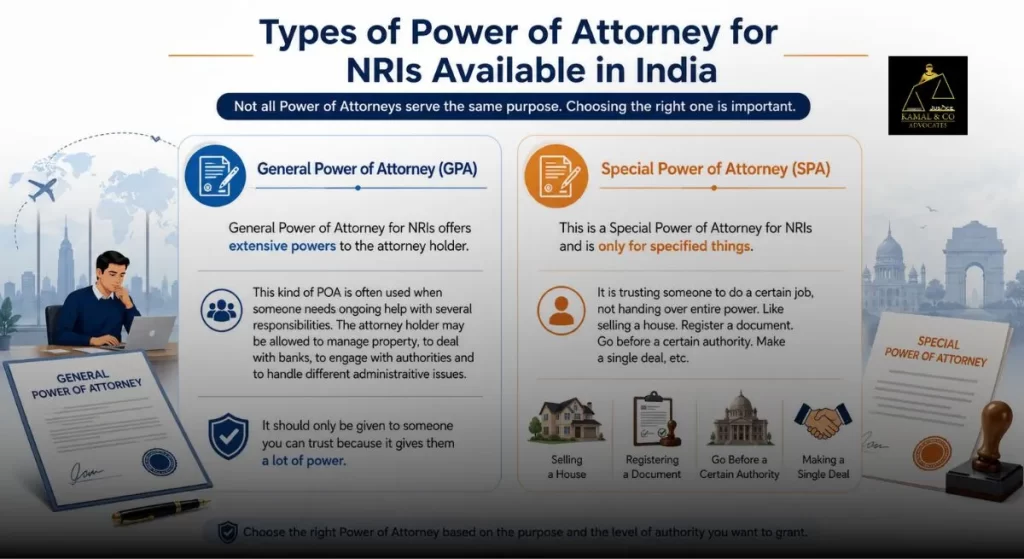
Not all Power of Attorneys serve the same purpose. Choosing the right one is important.
General Power of Attorney (GPA)
General Power of Attorney for NRIs offers extensive powers to the attorney holder.
This kind of POA is often used when someone needs ongoing help with several responsibilities. The attorney holder may be allowed to manage property, to deal with banks, to engage with authorities and to handle different administrative issues.
It should only be given to someone you can trust because it gives them a lot of power.
Special Power of Attorney (SPA)
This is a Special Power of Attorney for NRIs and is only for specified things.
It is trusting someone to do a certain job, not handing over entire power. Like selling a house. Register a document. Go before a certain authority. Make a single deal, etc.
The 2025 Registration Amendment Act has changed everything for property POAs in Karnataka in particular. A POA issued before to 22 July 2025 under the old framework may now need to be re-executed and registered to be enforceable in a NRI property transfer. NRIs who have executed a GPA or SPA prior to that date should check with a civil lawyer about its present validity before using it for any Sub-Registrar proceeding.
Eligibility Requirements for Creating a Valid Power of Attorney for NRIs
Who Can Make a Power of Attorney In India?
Any adult NRI who is legally able to contract under the Indian Contract Act, 1872 can execute a Power of Attorney.
The person must know what the paper is about and agree to let someone else act for them.
Who Can Be Appointed as an Attorney Holder In India?
Most NRIs appoint a parent, spouse, sibling or any other close family member. However, the law does not restrict you to family only.
Trust is the most crucial thing. Choosing the right person is more important than choosing a family member.
Documents Required for NRIs to Create a Valid Power of Attorney for NRIs
Commonly required documents are:
| Document | Purpose |
|---|---|
| Valid Indian Passport (Copy) | Establishes the identity of the principal (NRI). |
| Overseas Address Proof (Utility Bill, Bank Statement, etc.) | Confirms NRI status and overseas residence. |
| Visa / Residency Permit | Verifies the country of residence and legal stay abroad. |
| PAN Card | Mandatory for property transactions and tax-related matters in India. |
| Aadhaar Card (If Applicable) | Required for KYC compliance under updated RBI guidelines. |
| Property Documents (Title Deed, Sale Agreement, etc.) | Identifies and supports the property transaction covered by the POA. |
| Passport-Sized Photographs | Required for registration and Sub-Registrar office formalities. |
RBI’s new KYC Master Directions say that officials, including Indian bank branches abroad, can now attest to NRI papers. This makes the initial process easier for NRIs who live in places without Indian consulates.
Step-by-Step Process to Create a Valid Power of Attorney for NRIs
Step 1: Prepare the POA Document
It should explicitly identify both parties and describe the powers being given. If POA is for property, the property specifics should be correctly given.
Step 2: Sign before competent authorities
The POA is normally signed in the NRI’s country of residence. Depending upon local laws, the document may need to be signed in the presence of a Notary Public or other authorised person.
Step 3: Apostille or Embassy Attestation
This process is known as power of attorney attestation for NRIs and is needed to authenticate the document.
If the POA is carried out in a country which is a member of the Hague Apostille Convention, an apostille is normally necessary. In some other countries, attestation of the Indian Embassy or Consulate can be required.
Step 4: Send the Original Document to India
After authentication, the original document should be sent to India. In most situations, authorities will require the original POA rather than a scanned copy.
Step 5: Adjudication and Registration in India
Depending upon the purpose for which the power of attorney (POA) has been awarded, the POA once received in India may required to be stamped. As per the Indian Stamp Act, 1899, the document should be presented to the local District Registrar for adjudication (stamping and payment of the state-specific stamp fee) within 90 days of delivery of the document.
Apostille and Embassy Attestation Requirements for NRIs
A lot of NRIs get confused between notarization, apostille and embassy attestation.
- Notarisation: signing in front of a Notary Public. Required first.
- Apostille: International certification for countries party to the Hague Convention of October 5, 1961. India became a party to the Convention in 2005. The Ministry of External Affairs has clarified that an apostilled document of any member country is valid in India without any further attestation. The important destinations for NRIs include United Kingdom, United States of America, Australia, United Arab Emirates, Canada, Germany, France and Singapore.
- Embassy Attestation: For countries not party to the Apostille Convention, Embassy Attestation is required (Saudi Arabia, Kuwait, and Bahrain for some document types). In some countries, the Indian Embassy or Consulate authenticates the document.
NRIs in India for attestation of papers can use the MEA’s e-Sanad portal for the ease of the process for other types of documents.
Is Registration of a Power of Attorney Mandatory for NRIs?
One of the most typical things NRIs ask is if registration is required.
The answer depends on what the document is for.
Registration plays a very an essential part in many property-related matters. Authorities in charge of real estate transactions may require compliance with registration rules before approving the power of attorney for NRIs.
Stamp duty regulations can also be different in each state. Not meeting these requirements can lead to unwanted issues in the future.
Common Mistakes to Avoid While Handling NRI Legal Documents in India
Many disputes arise not because of bad intentions, but because the document was poorly prepared.
- A mistake people commonly make is giving somebody too much power, without thinking of the consequences.
- Another is to use general online templates that don’t consider the POA’s special purpose.
- Problems can also arise if the information on the property is not true, if the authentication criteria are not observed or if the registration is too delayed.
- In some cases, defective or improperly executed POAs can lead to ownership disputes and lengthy court proceedings. Knowing how to file a Civil Suit becomes important when legal remedies are required to resolve such conflicts.
Can an NRI Revoke a Power of Attorney?
Generally, Powers of Attorney for NRIs can be revoked. There are several legal circumstances when they cannot be overturned.
The NRI can opt to close the trust if the NRI’s connection with the attorney holder has ended, the objective of the POA has been served or there are concerns of abuse.
Inform the relevant officials, banks and institutions when necessary and document the revocation correctly.
How Long Does a Power of Attorney for NRIs Remain Valid?
A POA’s validity in India remains according to the terms mentioned in the document.
- Some POAs are created for a specific transaction and automatically come to an end once the task is completed. Others are only effective until revoked.
- A Power of Attorney can also be revoked by the death of the principal, the fulfillment of the purpose for which it was created or other lawful causes.
- If the situation changes the document can usually be changed or exchanged for a new one.
Power of Attorney for NRIs: Final Thoughts with Kamal and Co. Advocates
A power of attorney for NRIs is not just a piece of paper. It is what helps things move when you are not in India to do them yourself. That is why the document has to be clear, properly signed, and accepted in the right way. If the wording is loose or the process is skipped, trouble usually shows up later.
For those who want NRI legal services done without extra back-and-forth, Kamal and Co. Advocates is one of the legal names that comes up for this kind of work. India is advancing towards digital property registration, so the POA system will see a shift. But whatever is being digitised, the principles of excellent drafting and authenticity will always be important.
Disclaimer: This is for the purpose of general information only and does not represent legal advice. All laws and regulations are subject to change. Please seek the opinion of a skilled a.dvocate for advice relating to your own circumstances. The Bar Council of India (BCI) has prohibited legal practitioners from soliciting work