

You submit an application to a government department. They ask for one document. You submit it. A few weeks later, they ask for another. Then another. Months pass, and nothing moves.
You call the office. No answer. You send emails. No response. You visit in person. You’re told to come back later.
Most people in this situation keep waiting because they assume there’s nothing else they can do. After all, if a government authority isn’t acting, who do you even complain to? This is where a writ petition is required.
You might be wondering how to file a writ petition in case of an unfair act by a public authority, a refusal to perform its duties, or a violation of a legal or constitutional right.
In this blog, we’ll take you through a writ petition, when it can be filed, the varieties of writs in India, the method to file, the fee involved, the important dates and the landmark court rulings that continue to impact people’s rights.
As of March 2026, the total number of pending cases throughout all levels of the Indian judiciary was 55.8 million, including over 180,000 cases that had been pending for more than three decades. That gives you an idea of how often people are going to the courts, and how important it is to file correctly the first time around.
What Is a Writ Petition in India?
A writ petition is a written application to a High Court or the Supreme Court to find out what happened when a legal or constitutional right has been violated.
In simple terms, it is a process by which citizens can seek justice in the courts whenever a government agency does something that is unlawful, illegal or otherwise not in accordance with its legal obligations or that violates legally protected rights.
The power to issue writs is expressly provided in the Constitution.
- Fundamental rights are enforceable by the Supreme Court under Article 32.
- Article 226 of the Constitution authorises the High Courts to provide directions for the enforcement of the fundamental rights and other legal rights.
When Can You File a Writ Petition?
People often mistakenly think that every dispute may be converted into a writ petition. That is not how the writ jurisdiction operates.
Generally, writ petitions are entertained by the courts when there is some legal or constitutional right affected, and there is an element of public law involved.
Common situations can include:
- Violation of fundamental rights.
- Unlawful detention.
- Government personnel misuse their authority.
- Failure of a government agency to discharge an obligation imposed by law.
- Decisions of administration are random.
- Orders are issued without authority.
A Step-by-Step Process: How to File a Writ Petition in India?
Let’s understand the writ petition procedure in detail.
Step 1: What is the legal wrong?
First, see what right has been infringed. Ask yourself:
- Which authority acted?
- What action was taken?
- Which legal right was affected?
- Is there any public law element involved?
Step 2: Find the Correct Writ
The nature of the grievance dictates the type of writ.
For instance:
- If you are being held unlawfully, you may need to file a habeas corpus petition.
- A writ of mandamus may be justified for the inaction of the government.
- The ruling of an illegal tribunal could be challenged through certiorari.
Step 3: Collect Relevant Documents
Strong documentation often makes a significant difference. Gather:
- Government notices.
- Orders.
- E-mails.
- Letters.
- Applications
- Replies from authorities obtained.
- Any other records that may support.
The court will be reliant on documentary evidence.
The most common preventable mistake we encounter is people coming to us after the window to collect evidence has closed. Immediately save everything when a government authority performs an action you think is wrong. print emails, notices, and photos. Every communication must be confirmed in writing. Often, a well-documented trail can make or break a writ petition at the admission stage.
Step 4: Seek A Writ Petition Advocate
An expert advocate in a writ petition can help:
- Assess maintainability.
- Build a legal base.
- Write the petition.
- Make sure you follow the process correctly.
In cases involving unlawful detention, arrest, police action, or violations of personal liberty, consulting an experienced High court & writ lawyer can help you determine whether a writ petition is the appropriate legal remedy.
Step 5: Prepare the Petition
The petition shall explicitly state:
- Case Facts
- Important dates
- Rights impacted
- Legal ground
- Requested relief
Step 6: Attach Supporting Documents
All the required documents should be included as an annexure. One important part of understanding how to file a writ petition is making sure your paperwork is complete. Courts like petitioners to have documentary proof to support their arguments, where possible.
Missing documentation causes delays and complaints from the registry.
Step 7: Pay Court Fees
The fee stipulated has to be paid before filing. The actual fee varies depending on the court and the type of petition.
Step 8: File Before the Appropriate Court
Once finished, the petition can be filed before the High Court or the Supreme Court.
2026 e-Filing Update: SC-eFM 3.0 platform for electronic filing at the Supreme Court of India. The e-Committee of the Supreme Court has also launched the national e-filing system for the High Courts and District Courts throughout India. Online filing of cases by advocates and parties-in-person without physically attending the court.
Step 9: Attend Preliminary Hearings
Once filed, the petition will be reviewed by the registrar. If the procedural criteria are satisfied, the case is presented before the court.
At this stage, the court may:
- Send a note to the responders.
- Ask questions.
- Provide for interim aid in emergencies.
- If no case can be made, strike out the petition.
Step 10: Continue Until Final Disposal
After the notices are served, the two parties submit their cases.
Then the court decides whether to award relief.
Some issues are settled quickly; others may take several hearings over a long period of time. You can then track the status of any filed case using the e-Courts Case Status portal.
In case of unlawful imprisonment, demolition notice or government action which can cause irreversible damage, your advocate has to ask for an interim remedy immediately when the breach is ongoing. The courts can impose a temporary injunction while the actual issue is heard. Don’t wait for final disposal when temporary protection is available, and it is urgently needed.
Landmark Writ Petition Cases Every Citizen Should Know
ADM Jabalpur v. Shivkant Shukla
This case emerged during the Emergency and dealt with the suspension of personal liberty.
Although heavily criticised today, it remains one of the most discussed constitutional cases in Indian legal history.
Maneka Gandhi v. Union of India
Maneka Gandhi’s decision changed the interpretation of Article 21 substantially.
The Supreme Court said any procedure affecting human liberty must be fair, just and reasonable.
The decision dramatically expanded the constitutional protections available to citizens.

High Court vs Supreme Court: Where Can You File a Writ Petition?
| Factor | High Court (Article 226) | Supreme Court (Article 32) |
|---|---|---|
| Jurisdiction | Fundamental rights and other legal rights | Fundamental rights only |
| Accessibility | Geographically accessible | Restricted (last resort) |
| Cost | Lower | Significantly higher |
| Scope | Fundamental + Legal Rights | Fundamental Rights |
| First Preference | Yes, for most citizens | Only if the High Court remedy fails or is unavailable |
What Are The Types of Writs in India?
The Constitution recognises five writs, and each of them serves a distinct purpose.
1. Habeas Corpus Petition
The phrase “Habeas Corpus” means “produce the body.” A habeas corpus petition is filed for unlawful detention.
While habeas corpus provides relief against illegal detention, individuals facing the threat of arrest may also explore remedies available under Anticipatory Bail in Indian Law.
If the petition is valid, the court could order the authorities to hand up the detainee and justify why. If the detention is unlawful, the court might order the immediate release of the detainees.
2. Mandamus Writ
A mandamus writ is issued when a public officer refuses to discharge a duty imposed by law.
Therefore, where a statutory authority refuses to entertain an application which it is bound to entertain under law, the court may direct that authority to do its duty.
3. Certiorari Writ
A certiorari writ is issued to quash an order of a lower court, tribunal or authority that has acted without jurisdiction or in excess of its jurisdiction or in violation of principles of law. This writ serves as a corrective tool when choices are made wrongly.
4. Prohibition Writ
A prohibition writ is an order that stops a lower court or tribunal from continuing with anything that is outside its legal jurisdiction. The difference is in the time.
Certiorari corrects what has already been done, whereas prohibition forbids the authority from doing the unlawful act in the first place.
5. Quo Warranto Writ
A quo warranto writ literally means “by what authority?”
It allows the court to investigate whether a person in a public office is legally entitled to hold that position.
If the appointment is an illegal one, then the court may investigate the person’s claim to the office and may even set it aside.
Who Can File a Writ Petition?

Many people think that writ petitions can be filed solely by lawyers or large companies. No, that’s not right. If anyone is adversely affected in his legal or constitutional rights, he may approach the court.
That’s why understanding how to file a writ petition is important for ordinary citizens as well. In some instances:
- Individuals can petition for themselves.
- The parties concerned may be represented by a legal representative.
- NGOs and social organisations may approach courts in appropriate cases.
- Public Interest Litigations (PILs) may be filed where larger public concerns are involved.
Indian courts have, over the years, adopted a relatively liberal approach in matters involving public interest and constitutional rights. If you want to file an petition at High Court you can consult with our High Court legal team who handles all the related matters, they can help you understand the complete procedure and help you avoid making any mistake.
What Documents Do You Need to File a Writ Petition?
Some of the common documents required for a writ petition are:
| Document | Purpose |
|---|---|
| Proof of identity (Aadhaar, Passport, Voter ID, etc.) | Establishes the petitioner’s identity. |
| Proof of address | Confirms jurisdiction and residence details. |
| All government orders are being challenged | Forms the core basis of the writ petition. |
| Official correspondence (emails, letters, notices) | Establishes the sequence of events and communications. |
| Application receipts and acknowledgements | Proves prior attempts to seek relief from the concerned authority. |
| Authorisation letter / Power of Attorney (if applicable) | Required when filing through an authorised representative. |
| Copies of any prior court orders (if any) | Discloses previous litigation history and related proceedings. |
What Should the Writ Petition Format in India Include?
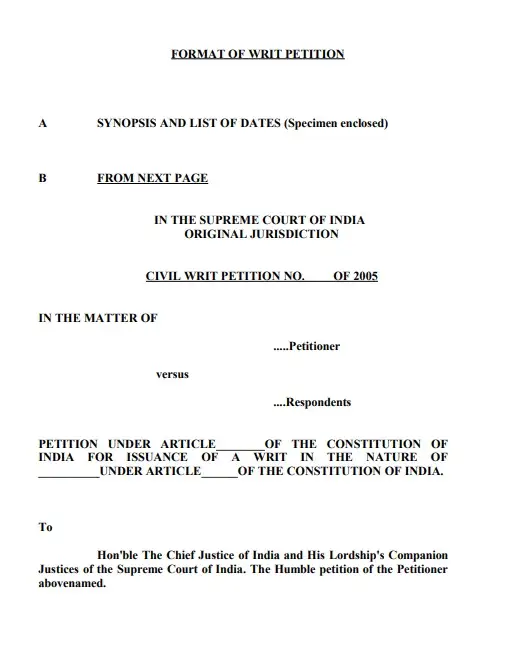
The writ petition format normally includes:
- Cause title
- Details of parties
- Jurisdiction clause
- Facts of the case
- Grounds for relief
- Prayer clause
- Verification
- Affidavit
- Annexures
Individual courts may need certain procedures, but these are the main parts that are in practically all writ petitions.
How Much Does It Cost to File a Writ Petition?
The court fees for writ petition matters are generally not very high.
However, the overall cost may be:
- Court costs
- Printing and Copying Charges
- Fee for a notary
- Documentation fees
- An advocate for a writ petition charges a fee.
- Other filing fees
The general price varies depending on the complexity of the issue and the extent of the legal aid needed.
Writ Petition Timeline: How Long Does It Take?
The writ petition timeline varies significantly from case to case
| Stage | Estimated Duration |
|---|---|
| Filing | 1–7 Days |
| Admission | Few Days to Weeks |
| Notice Stage | Variable (depends on the complexity of the case and court proceedings) |
| Final Disposal | Several Months to Years |
Other writ petitions may take several months or more, depending on:
- Court workload.
- Complexity of matters
- Number of parties engaged.
- Records accessibility.
- Hearing frequency.
What Are The Things You Should Check Before Filing a Writ Petition?
- Have I clearly identified the right (fundamental or statutory) that has been infringed?
- Have I filed a formal complaint to the authority and not received a satisfactory answer?
- Do I have evidence in writing that the authority did or did not do something?
- Is this a question of public law (as opposed to a merely private dispute)?
- Have I investigated whether there is an other legal remedy (appeal, revision, tribunal) that is less effective?
- Have I filed within a reasonable period from the date of the action that I am challenging?
- Has the right High Court been confirmed based on where the case began or where the respondent authority is located?
- Do I know what type of writ is suitable to my particular complaint?
- Have I talked to an attorney to see if my case is valid?
If you answered “yes” to all of the above, you’re ready to proceed with the filing.
Common Reasons Why Writ Petitions Get Rejected
Courts may dismiss writ petitions on many reasons, such as:
- Lack of jurisdiction
- Filing delays
- Insufficient documentation
- There is an alternative method.
- No legal status.
- The hiding of essential information.
A Few Final Things to Remember: How to File a Writ Petition?
Learning how to file a writ petition is basically about knowing what to do when a government entity stops complying with the rules. Whether it’s an unjust order, undue delay or a breach of your rights, a writ petition gives you a means to ask the court to step in. At first, the writ petition filing process may seem daunting, but once you understand the principles, it becomes a lot easier.
If you are facing a circumstance like this and require legal clarity, the experts at Kamal and Co. Advocates can help you to understand the options available to you under the law and the following steps that may be appropriate for your case.
Disclaimer: This material is for general information and educational purposes only and is not legal advice. Laws, court procedures and filing requirements are subject to change and may vary depending on the facts of each case. Reading this content does not establish a lawyer-client relationship. If you require legal help on a specific matter, you should speak with a trained legal professional.




4 thoughts on “How to File a Writ Petition in India: Step-by-Step Legal Guide for Citizens (2026)”
Pingback: Essential Legal Rights In India: You must know - Kamal and Co. Advocates
Pingback: NICE Road Land Acquisition Case: Karnataka HC Judgment (2026)
Pingback: FCRA Act Explained: What Is the Foreign Contribution Regulation Act & Who Does It Apply To? - Kamal and Co. Advocates
Pingback: HYDRAA Hyderabad: What to Do After a Demolition Notice