

Just imagine: the land is bought, the financing is in place, a start date for construction is on the calendar, and then someone finally asks, “Do we need environmental clearance for this?”
If the answer is yes and the approval isn’t in hand yet, that one question can undo months of planning. Work may have to stop. Costs climb. And in 2026, thanks to a year of Supreme Court activity on this exact issue, “we’ll sort it out later” is a far riskier bet than it used to be.
The rules aren’t the same for every business; they shift depending on what the project involves, how big it is, and where it sits. This guide walks through when environmental clearance (EC) applies, how the process actually works in practice today, which other approvals usually travel alongside it, and what changed in Indian environmental law through 2026 that project owners genuinely need to know about.
Quick answer: EC is the pre-clearance you need to obtain for activities under the EIA Notification, 2006. What you need depends on your activity, size, and location. EC is different from Pollution control consent (CTE/CTO) and other clearances like forest, wildlife, and CRZ.
What Is Environmental Clearance in India?
Environmental clearance is the authority granted by the government to undertake certain projects that could have a substantial influence on the environment. It is based on two legal pillars, the Environment (Protection) Act, 1986, and EIA Notification, 2006, which are handled by the Ministry of Environment, Forest and Climate Change (MoEFCC).
In short, the agencies want to know what impact a planned project might have on the air, water, land, forests, animals and nearby residents before the project begins. If approval is given, it usually comes with conditions the project owner must follow during construction and operation.
When Is Environmental Clearance Required for a Business?
For any new project, the starting question is whether the activity falls within the Schedule to the EIA Notification, 2006, and whether it crosses the applicable threshold.
The notification’s schedule covers sectors like mining, thermal power, chemicals, manufacturing, infrastructure, construction, and industrial estates, but the threshold itself moves depending on production capacity, built-up area, mining area, and location.
The same check should be made when an existing business plans to change or expand its operations.
A sensible practice is to check the environmental requirements before finalising the project design, construction plan or expansion budget.
Industries Commonly Subject to Environmental Clearance
Projects that involve mining, cement, chemicals, power, roads, ports, large construction projects and certain industrial or real-estate developments can require EC.
Legal Framework for Environmental Clearance in India
The Environment (Protection) Act, 1986 is the parent legislation under which most environmental regulation in India operates. The EIA Notification, 2006 lays out the actual process, screening, scoping, environmental studies, public consultation, and appraisal, for projects that fall within its scope.
The rules and procedures here have changed materially over the past two years through amendments, government directions, and, as covered below, significant Supreme Court intervention. Relying on an old checklist, or a process you followed for a project three years ago, is one of the fastest ways to get this wrong in 2026.
What's the Difference Between Category A and Category B Projects?
Projects covered by the EIA framework are broadly divided into Category A and Category B.
- Category A projects are appraised at the central level by MoEFCC, with support from the relevant Expert Appraisal Committee.
- Category B projects go through the state-level route, the State Environment Impact Assessment Authority (SEIAA) and State Expert Appraisal Committee (SEAC).
Category B is further split into B1 (which normally requires a full EIA study) and B2 (a lighter process), with screening determining which track a project falls into.
How Does Environmental Clearance Work in Karnataka?
Businesses looking for information on environmental clearance in Karnataka should keep two things in mind.
- First, the project remains subject to the national environmental clearance framework.
- Second, the Karnataka State Pollution Control Board (KSPCB) is a statutory agency set up in 1974 under the Water Act, which was subsequently expanded to air pollution.
A Category B project may be considered through the state-level environmental appraisal system. At the same time, the business may need Consent to Establish or Consent to Operate from the Karnataka State Pollution Control Board.
So, a company setting up a manufacturing unit in Karnataka should not ask only whether it needs EC. It should ask: What environmental approvals and consents are required for this particular project?
Depending on the project and its location, the answer may include environmental clearance, pollution-control consent, waste authorisations, forest clearance, wildlife approval, or coastal regulation approval.
What Businesses Should Know About The Industrial Pollution Laws in India?
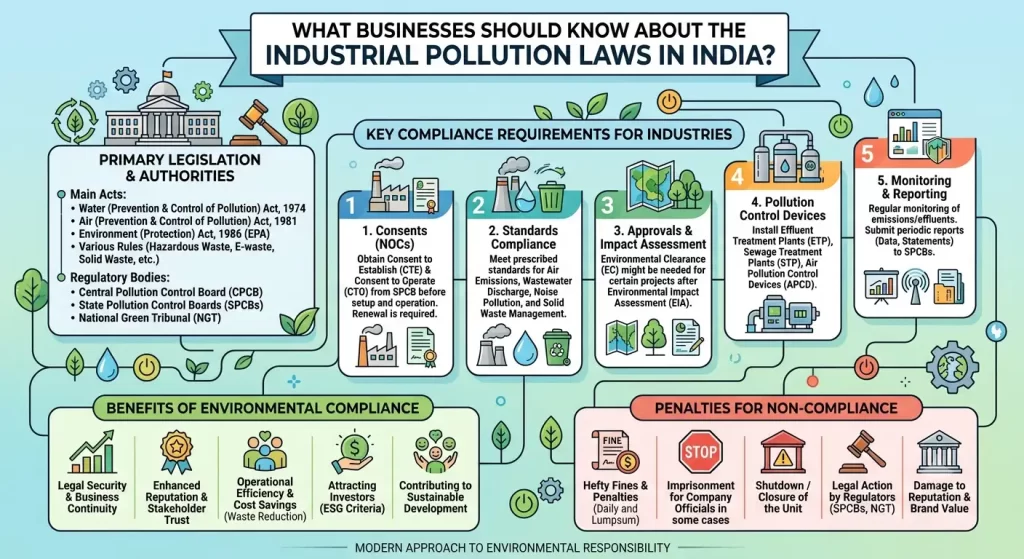
Environmental clearance is only one strand of India’s industrial pollution framework. Separate obligations flow from the Water (Prevention and Control of Pollution) Act, 1974 and the Air (Prevention and Control of Pollution) Act, 1981, both enforced through state boards under the oversight of the Central Pollution Control Board (CPCB).
An industrial unit may need Consent to Establish before it is set up and Consent to Operate before it begins operations. The exact requirement depends on the nature and category of the unit.
Businesses often use the phrase “pollution control board NOC” when referring to these approvals. It is better to identify the actual consent or authorisation required instead of assuming that one general NOC will cover every obligation.
The distinction between EC and pollution-control consent is important:
- Environmental clearance examines the broader environmental impact of a covered project.
- Pollution-control consent deals mainly with the unit’s emissions, effluent, waste and other pollution-related aspects.
Where a project needs EC, it will typically need pollution-control consent as well; the two address different regulatory questions and rarely substitute for each other.
Environmental Clearance Process in India: Step-by-Step
The exact method depends on the project’s category, location and applicable requirements.
- See if EC is needed. Consider the activity, size, capacity and location of the project in terms of the Schedule to the EIA Notification, 2006.
- Identify the project type. Classify the project as Category A, B1 or B2. This affects the authority, study, and procedure.
- Online submission of the proposal. Applications are normally filed through PARIVESH, the government’s online platform for environment, forest, wildlife, and CRZ-related clearances.
- Conduct full screening and scoping, if appropriate. For some projects, Terms of Reference must be screened, scoped, and approved before additional environmental studies can be undertaken.
- Preparation of EIA and EMP: The project proponent gets the Environmental Impact Assessment and Environmental Management Plan prepared, usually through a consultant accredited by QCI/NABET.
- Conduct a public consultation if necessary. Some projects include public consultation to enable the affected communities and other stakeholders to express their views.
- Appraisal of the proposal: The proposal, EIA/EMP material and other supporting documents are considered by the relevant Expert Appraisal Committee or state-level appraisal body.
- Get the decision. The relevant authority may grant EC with conditions, request additional information, or reject the proposal.
- Track application and meet all the requirements. PARIVESH provides the facility to the applicants to track the proposals and the facility to use the “Know Your Approval” feature. Applicants should check the current process before filing because procedures and portal requirements may change.
What Happens After Environmental Clearance Is Granted?
Obtaining EC is not the end of the compliance process.
The approval normally contains conditions relating to matters such as pollution control, water use, waste management, monitoring, reporting, and environmental safeguards. Those conditions must be followed during the life of the project.
This is particularly important for manufacturing units. Their day-to-day operations may affect emissions, effluent, waste generation, water consumption, and the surrounding environment.
A notable 2026 development here: MoEFCC has moved the Certified Compliance Report (CCR) process, the mechanism by which project proponents report on EC conditions for expansion proposals, onto a dedicated PARIVESH module. Hybrid (online-and-physical) processing was permitted only until 28 February 2026; from 1 March 2026, all CCR applications must go through PARIVESH exclusively. Businesses still filing compliance reports the old way risk delays they didn’t have before.
Even where an EC has been issued, facilities which do not meet the conditions attached to the EC may still be subject to regulatory action.
Businesses need to keep records of EC, consent forms, monitoring reports, waste records, compliance reports and regular communication with authorities. These records can become important during inspections, renewals, expansions or disputes.
Environmental Clearance vs Other Environmental Approvals
| Approval | Broad purpose |
|---|---|
| Environmental Clearance | Environmental appraisal of covered projects. |
| Consent to Establish | Permission to establish an applicable unit from a pollution-control perspective. |
| Consent to Operate | Permission to operate an applicable unit. |
| Forest Clearance | Required where forest land is involved. |
| Wildlife Approval | Relevant where protected areas or wildlife-related restrictions apply. |
| CRZ Clearance | Required for certain activities in regulated coastal areas. |
Environmental Clearance for New Projects, Expansion and Modernisation
Expansion is one of the areas where businesses often make mistakes. Suppose a manufacturing unit has EC for annual production of 50,000 tonnes. The company later decides to increase capacity, add another production line, or introduce a new product.
- Before making the change, it should check whether the proposed activity is covered by the existing approval or whether a fresh approval, amendment, or additional permission is required.
- The same issue can arise when a business changes its raw materials, manufacturing process, product mix, or project site.
- Existing approvals should be reviewed whenever the project changes. It is risky to assume that an old EC automatically covers every future modification.
What Changed in The Environmental Clearance and Compliance in 2026?
2026 has been an unusually active year for EC law in India.
Vanashakti v. Union of India: the case every business should know about. In May 2025, a two-judge Bench struck down the government’s 2017 notification and 2021 Office Memorandum that allowed “post-facto” EC, regularising a project’s clearance after construction had already started. That ruling was recalled on review in November 2025 for a fresh, fuller hearing.
On 29 July 2026, a three-judge Bench (Chief Justice Surya Kant, and Justices Joymalya Bagchi and V.M. Pancholi) delivered the settled position. In brief:
- Prior EC remains the rule; projects can’t ordinarily start first and seek clearance later.
- The 2017 notification was upheld, but the 2021 OM was quashed, though only prospectively, using the Court’s Article 142 powers, so clearances already granted stand and only fresh applications under either instrument are barred.
- Section 3 of the Environment (Protection) Act, 1986 still lets the Union Government create a narrow, time-bound statutory scheme for exceptional cases, but only through a proper notification, never an administrative memo.
The practical takeaway: if your project needs EC, get it before you start work. That old safety net is gone.
Besides CCR going online by March 2026, MoEFCC has proposed the creation of two new central organizations, a Standing Authority on Environmental Impact Assessment and a Standing Committee on Environmental Impact Appraisal, to review applications in case state-level SEIAA/SEAC bodies remain inactive. This would dramatically change the timing for Category B projects behind a delayed state authority. Businesses should instead watch this space for state-level applications, not assume the timelines of today.
NGT Compliance Requirements and Environmental Disputes
The National Green Tribunal is a specialised forum for environmental disputes. It deals with matters involving pollution, environmental damage, natural resources, environmental approvals and related regulatory action. It may even give compensation and directions for restoration or compliance. It may even give compensation and directions for restoration or compliance.
A business may become involved in NGT proceedings because of a complaint, inspection, pollution incident, breach of approval conditions or action by a pollution-control authority.
In such situations, a business should be able to show:
- What approvals it obtained.
- What conditions were imposed.
- What monitoring it carried out.
- How it managed waste and pollution.
- What corrective steps it took when a problem was identified.
Remember that good records do not guarantee that a dispute will not arise. But poor records can make an otherwise manageable issue much more difficult.
Practitioner Red Flags: What We Look For Before Sign-Off
Before signing off on a project, watch for:
- Construction already underway before EC applicability was settled;
- An EC that doesn’t match the current project configuration;
- Capacity increases treated as ordinary operational changes;
- EC conditions sitting with nobody internally responsible;
- CTE/CTO treated as interchangeable with EC;
- Compliance reports maintained separately across departments; and
- An approval obtained years ago but never reassessed after material project changes.
How Can Businesses Build an Environmental Compliance Framework?
A practical compliance system should begin with an approval matrix.
- The matrix should identify the project activity, applicable law, required approval, responsible authority, filing deadline, and person responsible within the business.
- The company should also maintain a compliance calendar and a central record of approvals, consent conditions, monitoring reports, waste records and regulatory correspondence.
- Periodic environmental audits can help identify gaps before they result in notices, penalties or disputes. The audit should compare the conditions in the approvals with what the business is actually doing on the ground.
- This review is especially useful before an expansion, acquisition, change in production, change in raw materials, or major modification to the project.
- The purpose is not to create unnecessary paperwork. It is to ensure that the business can answer one straightforward question at any time: Are our current operations consistent with the environmental approvals and legal requirements that apply to us?
Environmental Clearance Is Part of Smart Business Planning
EC isn’t just an approval to obtain; it’s a compliance obligation that runs for the life of the project, from planning through construction, operation, and every expansion after that. And as 2026’s case law makes clear, “we’ll sort it out later” is now a considerably riskier bet than it used to be.
Planning a new project, expansion or change to an existing operation? Kamal & Co. Advocates can evaluate your project against the EC Readiness Check above, mapping the real approval stack and identifying compliance holes before they become delays to construction or regulatory action.