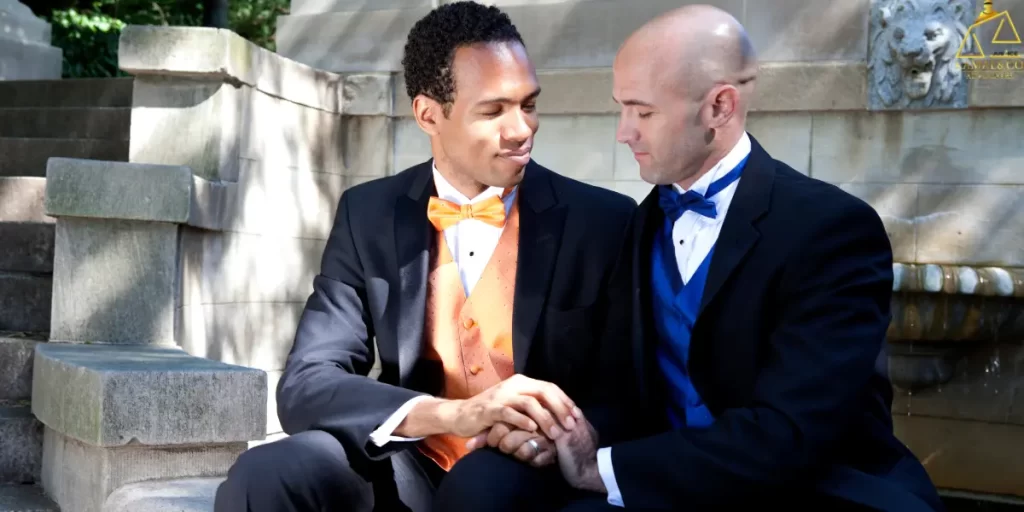

Love doesn’t ask for permission, but the law often does. When it comes to same-sex marriages in India, that’s exactly where things stand.
People can love freely, live together, and even build a life, but when it comes to making it “official” on paper, the system still says, “not yet.”
Over the past few years, India has seen major legal shifts, from decriminalising same-sex relationships to public debates about marriage equality. But even with all the conversations, one big question remains: Is same sex marriage legal?
This blog explains the real status of gay marriage, or homo marriage, in India today. Can you register it? What does the law actually say, and what’s likely to change next?
Let’s get into the facts, the roadblocks, and the quiet progress that’s still happening, even if the law hasn’t fully caught up yet.
Is Same-Sex Marriage Legal in India?
Before we talk about the laws and rights, let us understand what same sex marriages really mean in India. Globally, it refers to a legally recognised union between two people of the same gender, with the same rights and duties as any heterosexual marriage. But in India, though, the meaning is different.
You can live together, hold a ceremony, or even marry abroad under another country’s law. However, Indian law does not recognise it, and that marriage doesn’t hold legal weight here. If you’re in confusion and need legal guidance, speaking with an experienced family lawyer can be helpful.
That’s why the debate isn’t just about love or social acceptance; it’s about legal recognition, which decides whether your partner can inherit property, make medical decisions, or be recognised as a “spouse” in official records.
What Has the Supreme Court Said About Same-Sex Marriage in India?
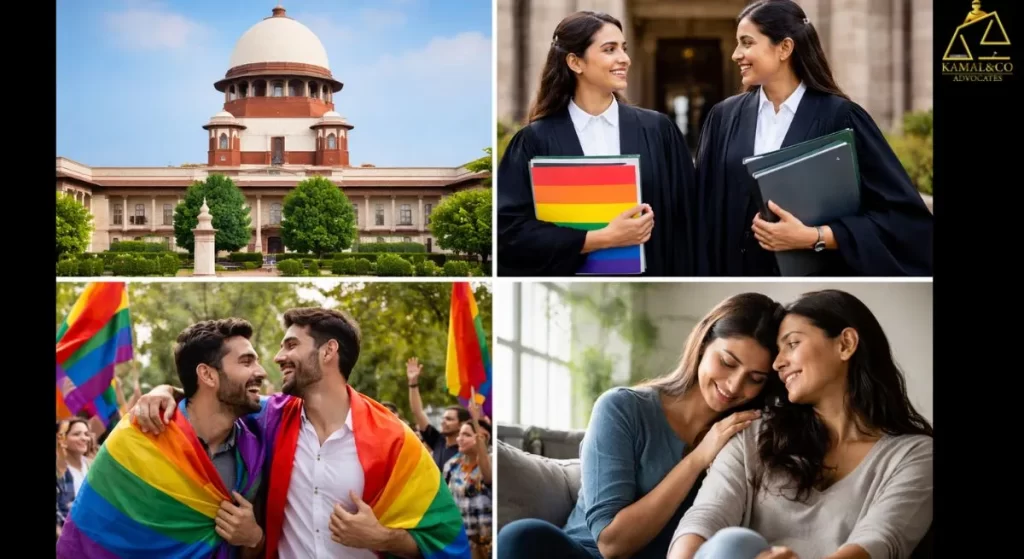
The legal position on same-sex marriages in India has evolved significantly over the last decade, although marriage equality has not yet been recognised by law.
1. 2018: Decriminalisation of Same-Sex Relationships
A major milestone came in the landmark case of Navtej Singh Johar v. Union of India (2018), where the Supreme Court struck down parts of Section 377 of the Indian Penal Code. The Court held that consensual same-sex relationships between adults are legal and protected under the constitutional rights to equality, dignity, privacy, and personal liberty.
This judgment decriminalised homosexuality in India but did not grant legal recognition to same-sex marriages.
2. 2023: Supreme Court Decision on Same-Sex Marriage
On 17 October 2023, a Constitution Bench of the Supreme Court delivered its judgment in Supriyo @ Supriya Chakraborty v. Union of India.
The Court unanimously recognised that LGBTQIA+ persons have the right to choose their partners and form relationships. However, by a majority verdict, it declined to recognise a constitutional right to same-sex marriage under existing Indian laws.
The Supreme Court observed that:
There is currently no fundamental right to marry under the Constitution.
The Special Marriage Act, 1954, cannot be judicially rewritten to include same-sex couples.
The power to recognise same-sex marriages and create a legal framework lies with Parliament and the legislature.
LGBTQIA+ persons are entitled to equal protection under the law and cannot face discrimination solely because of their sexual orientation.
3. 2025: Review Petitions Dismissed
In January 2025, the Supreme Court dismissed review petitions challenging the 2023 judgment. As a result, the legal position remains unchanged: same-sex marriages are not legally recognised or registrable under current Indian marriage laws.
What Is the Legal Position in 2026?
As of 2026:
Same-sex relationships are legal in India.
Same-sex couples can live together without legal restrictions.
Same-sex marriages cannot be registered under the Special Marriage Act, 1954, or personal marriage laws.
Same-sex couples do not automatically receive spousal rights relating to inheritance, adoption, succession, pension, tax benefits, or medical decision-making.
Any change in marriage recognition must come through legislative reform by Parliament rather than judicial interpretation.
While the Supreme Court acknowledged the rights and dignity of LGBTQIA+ individuals, it left the question of marriage equality to the legislature, making legal reform the primary path toward recognition of same-sex marriages in India.
Can Same-Sex Couples Register Their Marriage in India?
What does it mean if you ask, “Can we register our same-sex marriage in India?” Here is the answer:
- The principal private and civil marriage legislation, such as the Special Marriage Act of 1954, continues to utilize terminology assuming a man-woman partnership. For further knowledge on how the Special Marriage Act is different from normal marriage, you can check out our detailed guide on it.
- The Supreme Court’s 2023 and 2025 decisions mean the judiciary has left the matter of registration and recognition mostly to the legislature (Parliament) and states. That means registrars are not mandated by the Court to treat same-sex unions as marriages under current law.
- Some states may offer registration of live-in relationships or informal recognition, but that is not the same as full marriage registration with all rights.
- Practically, many gay marriage or homo marriage attempts to register are either refused or go into litigation. Without clear law, couples face uncertainty.
What Legal Rights Do Same-Sex Couples Have in India?
Here are some important rights that are lost when registration is not done, along with reasons why they’re important.
- Document your relationship: joint lease, shared utility bills, bank statements, and photos together. These materials help in legal and administrative contexts.
- Create the legal documents: Write a will that names each other, sign a power of attorney (POA) for health as well as money decisions, and fill out the nomination forms for banks and insurance.
- Investigate state options: If your state offers the registration of live-in relationships or some kind of recognition of partnerships, you can register it. It may not be a full marriage, but it gives some legal basis.
- If married abroad, where same-sex marriages are recognised, maintain the certificate. It may help with employer benefits, visa issues, or future Indian recognition.
- Consult a lawyer: Because the legal field is evolving, a lawyer can guide you on whether you can attempt registration or should prepare for litigation if refused.
- Keep records of registration attempts and refusals: If a registrar refuses to register your relationship, maintain the denial document. That helps if you later approach the court.
What Rights Do Same-Sex Couples Still Not Have?
Here are some important rights that are lost when registration isn’t done, along with reasons why they’re important. Even though formal recognition remains limited, the absence of legal marriage registration in Bangalore or elsewhere in India can create practical difficulties for same-sex couples in several areas:
- Property and inheritance rights: If you and your partner are registered, it’s clear that you are married and that your partner is an inheritor. If you don’t register, your partner may have trouble claiming property unless you have formal documents and proof.
- Medical decisions: Hospitals and doctors may accept a spouse’s decision if a marriage certificate is present. Without it, you rely on POA or other legal paperwork, which may be challenged.
- Adoption/parental rights: Many adoption agencies and courts consider legal marital status; non-recognised unions may face additional scrutiny.
- Tax/pension/insurance benefits: These often presume a legally registered spouse. Absent registration, you may lose entitlements.
Immigration/visa issues: If one partner is foreign or resides abroad, a recognised marriage helps to secure spouse visas; without recognised registration, you may face hurdles.
Registration of Same-Sex Marriages in India: Legal Status Explained
| Aspect | Current Legal Status in India | Practical Implications for Couples |
|---|---|---|
| Legal recognition of same-sex marriage | Not explicitly recognised under any Indian law | Couples cannot register their marriage under Indian law; ceremonial recognition only |
| Registration under the Special Marriage Act, 1954 | Act defines marriage as a union between a man and a woman | Marriage registrars typically do not allow registration of same-sex marriages |
| Supreme Court rulings (2023–2025) | The right to marry does not automatically include same-sex couples | Legal recognition depends on Parliament or state legislation |
| Decriminalisation of same-sex relationships | Consensual same-sex sexual acts are legal (Navtej Singh Johar v. Union of India, 2018) | Couples can live together legally, but marriage rights remain unrecognised |
| Live-in relationships | Recognised by some courts as “chosen families” | Partners can cohabit and access some rights, but not full marital benefits |
| Marriages registered abroad | Valid in the country of registration | Not fully recognised in India; may help with employer benefits, visas, or international legal matters |
| Inheritance and property rights | Not automatically granted to partners | Couples need wills, nomination forms, or legal agreements to secure inheritance |
| Medical and healthcare decisions | Not presumed for partners | Requires Power of Attorney or legal authorisation to make decisions |
| Adoption and parental rights | Limited recognition | Adoption may require additional legal steps; many agencies require marital status |
| Tax, pension, and insurance benefits | Not automatically applicable | Couples may lose entitlements unless recognised privately |
| Emerging trends | Increasing acceptance of cohabitation and chosen families | Legal recognition may improve incrementally through state or legislative reforms |
How Can Same-Sex Couples Protect Their Legal and Financial Rights?
- Will: Ensures your partner can inherit your assets and property as intended.
- Medical Power of Attorney: Authorises your partner to make healthcare decisions during emergencies.
- Financial Power of Attorney: Allows your partner to manage financial matters if you become unable to do so.
- Nomination Forms: Help designate your partner as the beneficiary of bank accounts, insurance, investments, and employment benefits.
- Joint Ownership Agreements: Clarify ownership rights in jointly purchased property or assets.
- Cohabitation/Partnership Agreement: Records financial, residential, and relationship arrangements between partners.
- Emergency Authorisation Letters: Useful for hospital access or urgent administrative matters.
The Road Ahead for Same Sex Marriages in India
The journey toward legal recognition of same sex marriages in India isn’t over; it’s evolving. The courts have made space for conversations, the public is slowly opening up, and the legal system is under pressure to catch up with reality.
While couples still can’t register their marriage officially, many are finding ways to protect their rights with the legal documentation, partnership agreements, and public advocacy.
Until laws are updated, understanding your rights and taking practical legal steps can make a real difference. Firms like Kamal and Co. Advocates help couples navigate this uncertain ground, from live-in documentation to legal consultations on relationship rights.
.
FAQs Related To Same Sex Marriage
Can I register my gay marriage in India now?
At present, you cannot reliably register under central law because the laws don’t explicitly allow it, and there is no guarantee registrars will accept it. The practical outcome is uncertain.
Can same-sex couples adopt a child in India?
Same-sex couples cannot currently adopt a child jointly as a couple in India because Indian adoption rules recognise married couples for joint adoption. However, an LGBTQ+ individual can adopt a child subject to the applicable adoption laws and eligibility requirements.
What did the Supreme Court say about same sex marriage?
The Court said the right to choose a partner is fundamental, but marriage under existing Acts (such as the Special Marriage Act) for same-sex couples is not covered by them. The Court emphasised that it is for Parliament/state legislatures to decide legal recognition.
Are there any legal recognitions currently for same-sex couples?
Yes, certain High Courts have recognised that same-sex couples can form “chosen families” or have cohabitation rights. For example, the Madras High Court emphasised that marriage is not the only way to form a family.
What should couples do while registration is uncertain?
Document your relationship, draft legal protection (wills, POA, bank nominations), register any available state-level schemes for live-ins or partnerships, consult a lawyer, and keep records of denial if you attempt registration.