


Tax evasion gets misused a lot in Indian tax conversations. A missed deadline, an honest mistake, an actual criminal case – people lump all of it under one word. But it’s not one thing. And that matters, because the consequences are very different depending on which one you’re actually dealing with.
Here’s what we’ve noticed over the years. Tax evasion cases rarely start big. Someone keeps part of their cash sales off the books. Or skips reporting a side income. Nothing dramatic. It just sits there. Then a scrutiny notice shows up, or the AIS flags a mismatch, and suddenly it’s not small anymore. If you’re already at that stage, speaking with an experienced tax and criminal lawyer early can change how the rest of this plays out.
In this blog, we’re covering the meaning of tax evasion under the law, where it stops being planning and becomes an offence, the penalties involved, and what’s changed since the Income Tax Act, 2025 and Finance Act, 2026 came into force.
What Is The Meaning Of Tax Evasion in India?
Tax evasion is hiding income, or lying about it, to pay less tax than you owe. Section 478 of the Income Tax Act, 2025 covers this (it was Section 276C before, under the old 1961 Act). And it’s not treated as a paperwork issue. It’s a criminal offence, a wilful attempt to evade tax, whether that’s through fake books, hidden receipts, or just not declaring income at all.
Common examples of tax evasion are:
- Not reporting cash sales
- Claiming fake expenses or deductions
- Undervaluing property in a sale deed to cut stamp duty and tax
- Keeping money in benami accounts
- Falsifying invoices to lower taxable profit.
Tax Avoidance vs Tax Evasion: Where Is the Legal Difference?
Tax avoidance is legal. It means reducing your tax bill using tools the law itself provides, such as a deduction under Section 80C or a business structure that uses legitimate exemptions.
Tax evasion is illegal. It means hiding income or facts you were legally required to disclose.
| Basis | Tax Avoidance | Tax Evasion |
|---|---|---|
| Legality | Legal | Illegal |
| Method | Uses exemptions and deductions within the law | Hides or misrepresents facts |
| Intent | Reduce tax through planning | Escape tax through concealment |
| Consequence | None, if done correctly | Penalty, prosecution, or both |
| Example | Investing in ELSS for Section 80C benefit | Not declaring rental income |
Aggressive tax planning that crosses into artificial arrangements can be reclassified as evasion, even where it was structured to look like avoidance. Legal advice matters before a structure is finalised, not after a notice arrives.
Tax Evasion Under the Income-tax Act, 2025: Old Law vs New Law
The Income Tax Act, 2025 replaced the Income Tax Act, 1961 for income earned from Tax Year 2026-27 onward. Every section was renumbered, and the Finance Act, 2026 then amended several of the new offence provisions.
| Old Provision (1961 Act) | Deals With | New Provision (2025 Act) |
|---|---|---|
| Section 276C | Wilful attempt to evade tax | Section 478 |
| Section 270A | Penalty for under-reporting and misreporting income | Section 439 |
| Section 271(1)(c) | Concealment of income (pre-2017 cases) | Largely subsumed into Section 439 |
| Section 132 | Search and seizure | Section 247 |
| Section 133A | Survey | Section 253 |
Timing matters here. Get a notice dated before 1 April 2026, and it’s still governed by the old Act, old section numbers, and all. Anything landing from Tax Year 2026-27 onward runs under the new Act instead. Mixing the two up in a reply is a common and costly mistake.
Tax Evasion Penalties in India: Civil and Criminal Consequences
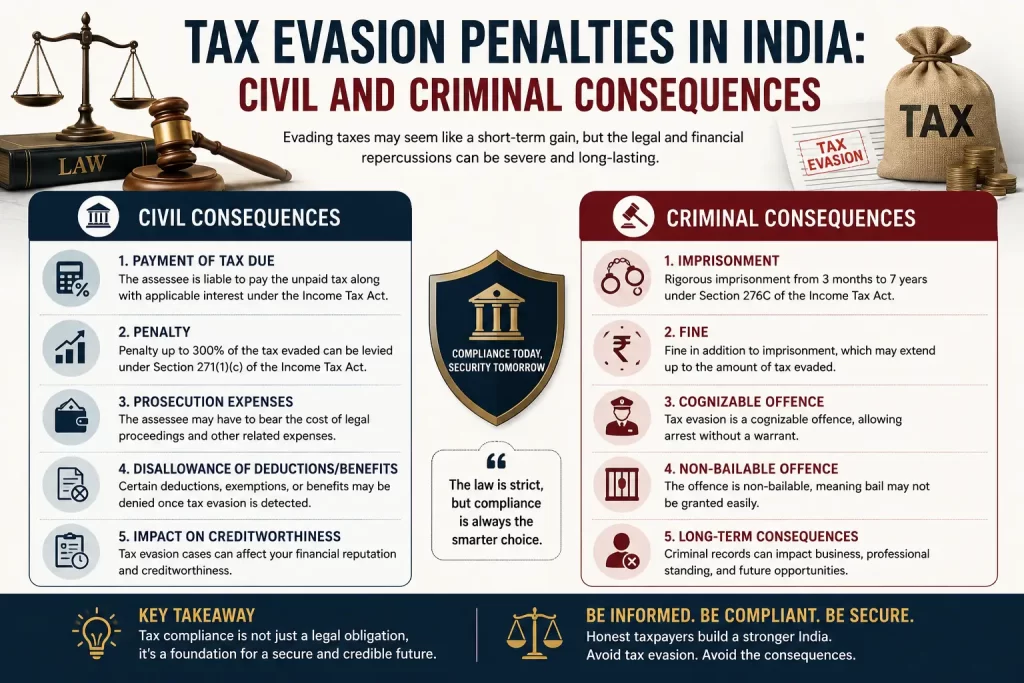
Not every consequence that follows a tax default is a “tax evasion penalty.” Three tracks apply, and it matters which one a specific default falls under.
Civil consequences:
This is when Income understatement and misrepresentation occur (Section 439, previous Section 270A):
- Income understatement: 50% of the tax on the understated income
- Misrepresentation: deliberate suppression of income, fictitious entries, false claims – 200% of the tax
- Tax demand and interest on top of the penalty
Criminal consequences:
This applies only where the attempt to evade tax is wilful (Section 478, earlier Section 276C). The Finance Act, 2026 replaced the earlier rigid custodial sentence with a graded structure tied to the amount involved, effective for Tax Year 2026-27 onward:
Amount Sought to Be Evaded | Punishment |
Exceeds Rs. 50 lakh | Simple imprisonment up to 2 years, or fine, or both |
Exceeds Rs. 10 lakh but not Rs. 50 lakh | Simple imprisonment up to 6 months, or fine, or both |
Rs. 10 lakh or below | Fine only |
This is lighter than the earlier framework, which allowed rigorous imprisonment up to seven years above Rs. 25 lakh. The change reflects a legislative shift toward proportionate sentencing. Criminal liability still sits on top of, not instead of, the civil penalty. Abetting a false return under Section 484 still draws up to seven years, so an accountant who prepares fabricated books at a client’s instruction remains exposed to the older, harsher band.
Administrative consequences:
This covers the process around a default rather than the default itself: search, survey, reassessment, and recovery proceedings. These can run alongside civil or criminal consequences, and are explained below.
In addition, there are standard penalties for defaults like delayed filing of ITRs, non-appearance for tax audit, and mistakes in TDS/PAN. Tax evasion refers to willful acts of omission and commission by taxpayers to hide income and evade payment of taxes.
Does Intent Actually Matter? What the Supreme Court Said
Section 478 (earlier Section 276C) is not automatic. The department still has to prove intent.
In Vijay Krishnaswami v. DDIT (Investigation), a search turned up unaccounted cash, and the department filed a criminal complaint for evasion. But the taxpayer had already disclosed the income and received penalty immunity from the Settlement Commission, with no finding of fraud against him.
The Supreme Court quashed the prosecution and ordered the department to pay Rs. 2 lakh in costs. Its reasoning: prosecution needs proof of real intent to evade tax, not just an unresolved dispute, and the department cannot prosecute against its own binding circulars.
The takeaway is that a wrong tax position taken honestly is not automatically evasion. Intent has to be shown.
Income Tax Search vs Survey: They Are Not the Same
Everyday Indian tax content tends to call any enforcement visit a “raid.” A precise account keeps three actions apart:
Survey (Section 253, earlier Section 133A):
Officers doing a survey can come into the business during working hours and check the records, that part’s allowed. What they can’t do: search anyone personally, break open a lock, or walk away with cash or jewellery.
Search and seizure (Section 247, earlier Section 132):
Triggered where the department has credible information of undisclosed income or assets. Officers can enter and search premises, including homes and lockers, seize cash and documents, and record statements under oath.
Assessment or reassessment:
The follow-up stage where the department examines what was found and raises a tax demand, whether or not a search or survey preceded it.
A search is not an arrest. It is a fact-finding action, but the first 24 to 48 hours often shape whether prosecution follows at all.
Tax Evasion, Black Money and Undisclosed Income: What's the Connection?
“Black money” is simply income that was earned but never made it onto the books, never declared, never taxed. It’s not a small problem either: the Ministry of Finance told the Rajya Sabha that the Income Tax Department flagged ₹30,444 crore in undisclosed income through 465 survey operations in FY 2024-25 alone. That scale of detection tells any business with informal cash practices something useful ie; data-matching has improved enough that gaps now surface even without a search.
Does Tax Evasion Attract PMLA? Clearing Up a Common Myth
Plain tax evasion under the Income Tax Act is not, by itself, a scheduled offence under PMLA. The Enforcement Directorate cannot open a PMLA (Prevention of Money Laundering Act) case purely because someone evaded income tax within India.
The connection runs through a specific chain, and each link has to be present. Undisclosed foreign income and assets are covered by the Black Money (Undisclosed Foreign Income and Assets) and Imposition of Tax Act, 2015. Any deliberate attempt to escape tax liability under Section 51 of this Act is considered a scheduled offense under the PMLA, provided all the requirements of that offence under the statute are fulfilled. Owning a foreign asset does not, by itself, trigger this chain; what matters is whether the non-disclosure meets the Black Money Act’s threshold for a wilful offence.
In short, domestic evasion stays with the Income Tax Department. A foreign asset issue may stay within the Black Money Act’s civil track, or escalate to its criminal track and PMLA, depending on whether those specific statutory conditions are met.
Can a Company's Directors Be Prosecuted for Tax Evasion?
Tax evasion is not only an individual’s problem. Many real cases involve companies, LLPs, and partnership firms, and the law does not let the entity absorb the blame alone.
According to the Income Tax Act, 1961, as per Section 278B, in case a company indulges in any offences such as willful evasion, all the persons who are responsible for conducting the business at the relevant point in time are presumed to be guilty as well, unless they prove that it was done without their knowledge or that all reasonable precautions had been taken to prevent it.
A title alone does not decide liability. Courts look at whether a director actually had real charge of financial affairs, not just whether their name was on the board. A genuinely passive or non-executive director has a stronger case if that limited role is documented.
For founders and directors, the practical point is simple: board minutes and clear delegation of financial authority matter more than designation, and are easier to establish before a notice arrives than after.
Note: This cites Section 278B of the 1961 Act. Its renumbered equivalent under the 2025 Act should be confirmed before publishing.
Compounding of Offences: A Way Out Before Trial
Not every tax evasion case ends in a courtroom. The Income Tax Act allows certain offences, including wilful evasion under Section 478, to be compounded: the accused pays a specified fee, and the department agrees not to pursue prosecution. It does not erase the tax liability or civil penalty, but it can prevent a trial.
Compounding is usually more accessible for first-time defaults and harder once a case involves aggravating factors, such as habitual evasion or large seized cash.
How to Avoid Legal Trouble Around Tax Evasion
Most tax evasion cases did not start with intent to commit a crime. They started with poor advice, casual record-keeping, or a small mismatch ignored for too long.
- Reconcile Form 26AS and the Annual Information Statement with your actual income before filing
- Keep every deduction backed by a genuine document
- Report foreign bank accounts, shares, and income every year, even at a small balance
- Respond to any notice within the timeline; silence is read as avoidance
- Get a second opinion before an aggressive tax position, especially around property or large cash dealings
- If you discover a past non-disclosure, take legal advice before deciding how to correct it
- If you’re on either side of a business acquisition, undisclosed tax exposure is exactly the kind of risk that gets priced into a share purchase agreement.
When Should You Seek Professional Advice on Tax Evasion Risk?
Not every tax error requires a lawyer, but taking professional advice becomes essential when the facts are unclear, the amount involved is material, or the issue could extend beyond a routine tax adjustment.
Take legal advice if you have:
- Received any notice alleging concealment or misreporting of data.
- Discovered previously undisclosed income or assets.
- Identified a significant AIS or tax-record mismatch.
A CA or tax professional is mostly preferred during regular audits or compliance, while a tax lawyer is necessary when there is potential criminal liability, prosecution, search and seizure, or wider legal exposure.
Final Word On The Meaning Of Tax Evasion
Tax evasion cases rarely start big. They begin with an oversight, a handy loophole, or something said at the time that made sense. By the time they receive the notice, their choices become limited.
A useful way to think about where you stand: a position resting on a genuine interpretational question or a documented deduction is tax-planning territory. A position resting on a fact the department does not know about is closer to evasion risk, whatever the amount. The checklist above is a reasonable starting point for that self-check.
Where the self-check raises a doubt, whether from a past filing, a foreign asset, or a notice already in hand, that is the point to get a professional opinion rather than wait. Kamal & Co. Advocates advises on tax notices, search and seizure matters, prosecution under the Income Tax Act, and compliance through our financial fraud and High Court practice and tax advisory services.